Mevin B. Hooten - Böcker
Visar alla böcker från författaren Mevin B. Hooten. Handla med fri frakt och snabb leverans.
6 produkter
6 produkter
1 078 kr
Skickas inom 10-15 vardagar
Bringing Bayesian Models to Life empowers the reader to extend, enhance, and implement statistical models for ecological and environmental data analysis. We open the black box and show the reader how to connect modern statistical models to computer algorithms. These algorithms allow the user to fit models that answer their scientific questions without needing to rely on automated Bayesian software. We show how to handcraft statistical models that are useful in ecological and environmental science including: linear and generalized linear models, spatial and time series models, occupancy and capture-recapture models, animal movement models, spatio-temporal models, and integrated population-models. Features:R code implementing algorithms to fit Bayesian models using real and simulated data examples.A comprehensive review of statistical models commonly used in ecological and environmental science.Overview of Bayesian computational methods such as importance sampling, MCMC, and HMC.Derivations of the necessary components to construct statistical algorithms from scratch.Bringing Bayesian Models to Life contains a comprehensive treatment of models and associated algorithms for fitting the models to data. We provide detailed and annotated R code in each chapter and apply it to fit each model we present to either real or simulated data for instructional purposes. Our code shows how to create every result and figure in the book so that readers can use and modify it for their own analyses. We provide all code and data in an organized set of directories available at the authors' websites.
479 kr
Skickas inom 7-10 vardagar
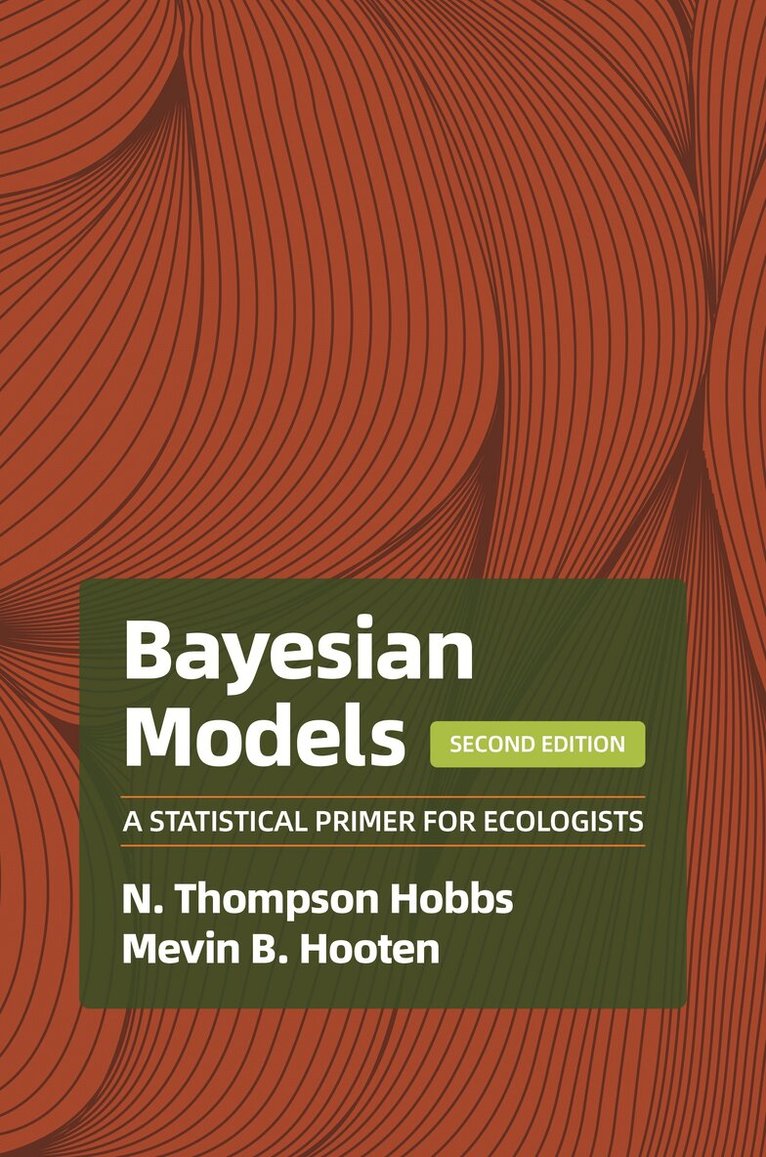
Bayesian modeling has become an indispensable tool for ecological research because it is uniquely suited to deal with complexity in a statistically coherent way. This textbook provides a comprehensive and accessible introduction to the latest Bayesian methods--in language ecologists can understand. Unlike other books on the subject, this one emphasizes the principles behind the computations, giving ecologists a big-picture understanding of how to implement this powerful statistical approach. Bayesian Models is an essential primer for non-statisticians. It begins with a definition of probability and develops a step-by-step sequence of connected ideas, including basic distribution theory, network diagrams, hierarchical models, Markov chain Monte Carlo, and inference from single and multiple models. This unique book places less emphasis on computer coding, favoring instead a concise presentation of the mathematical statistics needed to understand how and why Bayesian analysis works. It also explains how to write out properly formulated hierarchical Bayesian models and use them in computing, research papers, and proposals.This primer enables ecologists to understand the statistical principles behind Bayesian modeling and apply them to research, teaching, policy, and management. * Presents the mathematical and statistical foundations of Bayesian modeling in language accessible to non-statisticians* Covers basic distribution theory, network diagrams, hierarchical models, Markov chain Monte Carlo, and more* Deemphasizes computer coding in favor of basic principles* Explains how to write out properly factored statistical expressions representing Bayesian models
479 kr
Skickas inom 7-10 vardagar
A fully updated and expanded edition of the essential primer on Bayesian modeling for ecologistsUniquely suited to deal with complexity in a statistically coherent way, Bayesian modeling has become an indispensable tool for ecological research. This book teaches the basic principles of mathematics and statistics needed to apply Bayesian models to the analysis of ecological data, using language non-statisticians can understand. Deemphasizing computer coding in favor of a clear treatment of model building, it starts with a definition of probability and proceeds step-by-step through distribution theory, likelihood, simple Bayesian models, and hierarchical Bayesian models. Now revised and expanded, Bayesian Models enables students and practitioners to gain new insights from ecological models and data properly tempered by uncertainty.Covers the basic rules of probability needed to model diverse types of ecological data in the Bayesian frameworkShows how to write proper mathematical expressions for posterior distributions using directed acyclic graphs as templatesExplains how to use the powerful Markov chain Monte Carlo algorithm to find posterior distributions of model parameters, latent states, and missing dataTeaches how to check models to assure they meet the assumptions of model-based inferenceDemonstrates how to make inferences from single and multiple Bayesian modelsProvides worked problems for practicing and strengthening modeling skillsFeatures new chapters on spatial models and modeling missing data
698 kr
Skickas inom 10-15 vardagar
Bringing Bayesian Models to Life empowers the reader to extend, enhance, and implement statistical models for ecological and environmental data analysis. We open the black box and show the reader how to connect modern statistical models to computer algorithms. These algorithms allow the user to fit models that answer their scientific questions without needing to rely on automated Bayesian software. We show how to handcraft statistical models that are useful in ecological and environmental science including: linear and generalized linear models, spatial and time series models, occupancy and capture-recapture models, animal movement models, spatio-temporal models, and integrated population-models. Features:R code implementing algorithms to fit Bayesian models using real and simulated data examples.A comprehensive review of statistical models commonly used in ecological and environmental science.Overview of Bayesian computational methods such as importance sampling, MCMC, and HMC.Derivations of the necessary components to construct statistical algorithms from scratch.Bringing Bayesian Models to Life contains a comprehensive treatment of models and associated algorithms for fitting the models to data. We provide detailed and annotated R code in each chapter and apply it to fit each model we present to either real or simulated data for instructional purposes. Our code shows how to create every result and figure in the book so that readers can use and modify it for their own analyses. We provide all code and data in an organized set of directories available at the authors' websites.
820 kr
Skickas inom 10-15 vardagar
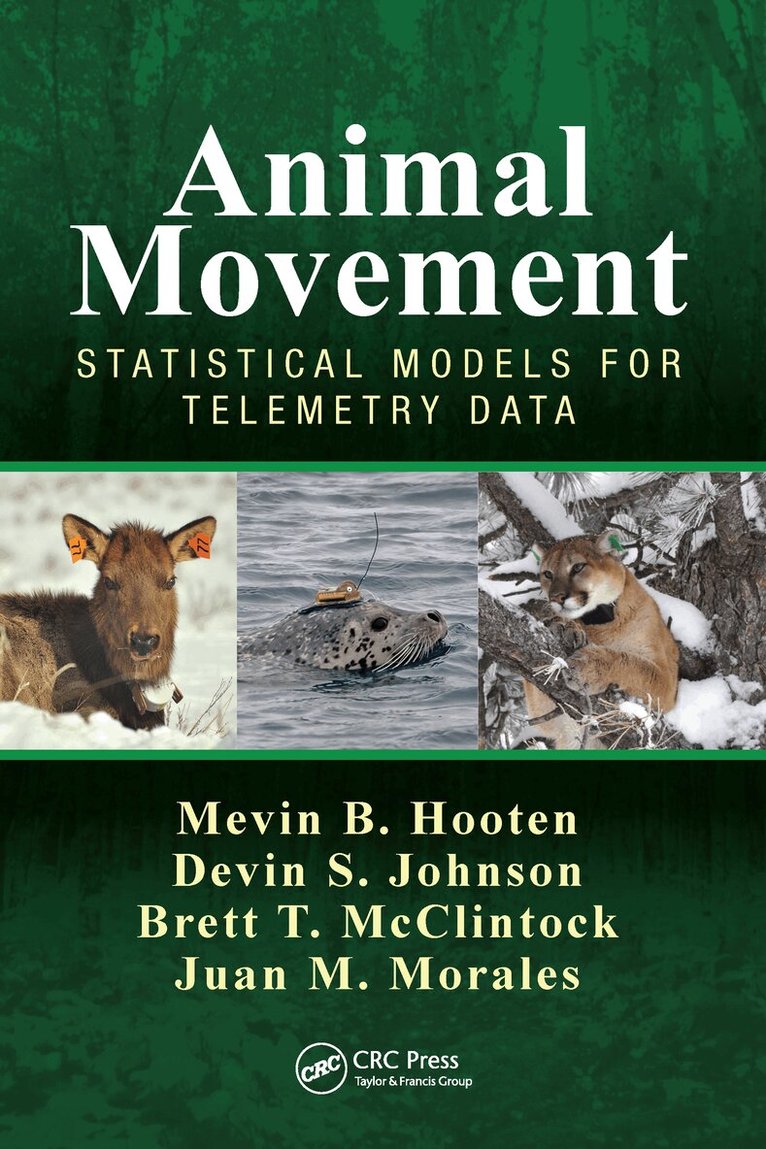
The study of animal movement has always been a key element in ecological science, because it is inherently linked to critical processes that scale from individuals to populations and communities to ecosystems. Rapid improvements in biotelemetry data collection and processing technology have given rise to a variety of statistical methods for characterizing animal movement. The book serves as a comprehensive reference for the types of statistical models used to study individual-based animal movement. Animal Movement is an essential reference for wildlife biologists, quantitative ecologists, and statisticians who seek a deeper understanding of modern animal movement models. A wide variety of modeling approaches are reconciled in the book using a consistent notation. Models are organized into groups based on how they treat the underlying spatio-temporal process of movement. Connections among approaches are highlighted to allow the reader to form a broader view of animal movement analysis and its associations with traditional spatial and temporal statistical modeling.After an initial overview examining the role that animal movement plays in ecology, a primer on spatial and temporal statistics provides a solid foundation for the remainder of the book. Each subsequent chapter outlines a fundamental type of statistical model utilized in the contemporary analysis of telemetry data for animal movement inference. Descriptions begin with basic traditional forms and sequentially build up to general classes of models in each category. Important background and technical details for each class of model are provided, including spatial point process models, discrete-time dynamic models, and continuous-time stochastic process models. The book also covers the essential elements for how to accommodate multiple sources of uncertainty, such as location error and latent behavior states. In addition to thorough descriptions of animal movement models, differences and connections are also emphasized to provide a broader perspective of approaches.
2 557 kr
Skickas inom 10-15 vardagar
The study of animal movement has always been a key element in ecological science, because it is inherently linked to critical processes that scale from individuals to populations and communities to ecosystems. Rapid improvements in biotelemetry data collection and processing technology have given rise to a variety of statistical methods for characterizing animal movement. The book serves as a comprehensive reference for the types of statistical models used to study individual-based animal movement. Animal Movement is an essential reference for wildlife biologists, quantitative ecologists, and statisticians who seek a deeper understanding of modern animal movement models. A wide variety of modeling approaches are reconciled in the book using a consistent notation. Models are organized into groups based on how they treat the underlying spatio-temporal process of movement. Connections among approaches are highlighted to allow the reader to form a broader view of animal movement analysis and its associations with traditional spatial and temporal statistical modeling.After an initial overview examining the role that animal movement plays in ecology, a primer on spatial and temporal statistics provides a solid foundation for the remainder of the book. Each subsequent chapter outlines a fundamental type of statistical model utilized in the contemporary analysis of telemetry data for animal movement inference. Descriptions begin with basic traditional forms and sequentially build up to general classes of models in each category. Important background and technical details for each class of model are provided, including spatial point process models, discrete-time dynamic models, and continuous-time stochastic process models. The book also covers the essential elements for how to accommodate multiple sources of uncertainty, such as location error and latent behavior states. In addition to thorough descriptions of animal movement models, differences and connections are also emphasized to provide a broader perspective of approaches.