M.H. Salmon - Böcker
Visar alla böcker från författaren M.H. Salmon. Handla med fri frakt och snabb leverans.
3 produkter
3 produkter
1 062 kr
Skickas inom 10-15 vardagar
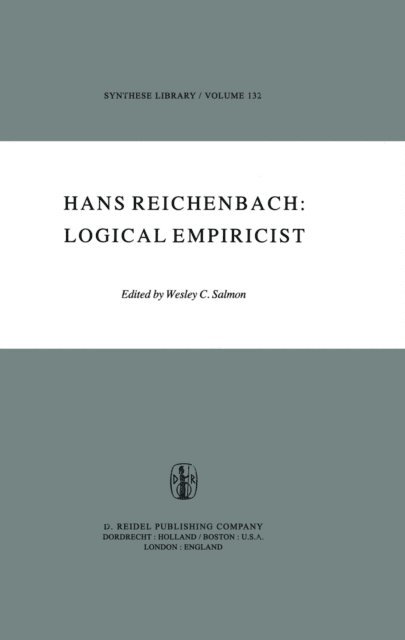
Logical empiricism - not to be confused with logical positivism (see pp. 40-44) - is a movement which has left an indelible mark on twentieth century philosophy; Hans Reichenbach (1891-1953) was one of its found ers and one of its most productive advocates. His sudden and untimely death in 1953 halted his work when he was at the height of his intellectual powers; nevertheless, he bequeathed to us a handsome philosophical inheritance. At the present time, twenty-five years later, we can survey our heritage and see to what extent we have been enriched. The present collection of essays constitutes an effort to do just that - to exhibit the scope and unity of Reichenbach's philosophy, and its relevance to current philosophical issues. There is no Nobel Prize in philosophy - the closest analogue is a volume in The Library of Living Philosophers, an honor which, like the Nobel Prize, cannot be awarded posthumously. Among 'scientific philosophers,' Rudolf Carnap, Albert Einstein, Karl Popper, and Bertrand Russell have been so honored. Had Reichenbach lived longer, he would have shared the honor with Carnap, for at the time of his death a volume on Logical Empiricism, treating the works of Carnap and Reichenbach, was in its early stages of preparation. In the volume which emerged, Carnap wrote, "In 1953, when Reichenbach's creative activity was suddenly ended by his premature death, our movement lost one of its most active leaders.
1 094 kr
Skickas inom 10-15 vardagar
Logical empiricism - not to be confused with logical positivism (see pp. 40-44) - is a movement which has left an indelible mark on twentieth century philosophy; Hans Reichenbach (1891-1953) was one of its found ers and one of its most productive advocates. His sudden and untimely death in 1953 halted his work when he was at the height of his intellectual powers; nevertheless, he bequeathed to us a handsome philosophical inheritance. At the present time, twenty-five years later, we can survey our heritage and see to what extent we have been enriched. The present collection of essays constitutes an effort to do just that - to exhibit the scope and unity of Reichenbach's philosophy, and its relevance to current philosophical issues. There is no Nobel Prize in philosophy - the closest analogue is a volume in The Library of Living Philosophers, an honor which, like the Nobel Prize, cannot be awarded posthumously. Among 'scientific philosophers,' Rudolf Carnap, Albert Einstein, Karl Popper, and Bertrand Russell have been so honored. Had Reichenbach lived longer, he would have shared the honor with Carnap, for at the time of his death a volume on Logical Empiricism, treating the works of Carnap and Reichenbach, was in its early stages of preparation. In the volume which emerged, Carnap wrote, "In 1953, when Reichenbach's creative activity was suddenly ended by his premature death, our movement lost one of its most active leaders.
Del 206 - Synthese Library
Philosophy of Logical Mechanism
Essays in Honor of Arthur W. Burks, With his responses
Häftad, Engelska, 2011
534 kr
Skickas inom 10-15 vardagar
This work is divided into two parts. Part I contains sixteen critical es says by prominent philosophers and computer scientists. Their papers offer insightful, well-argued contemporary views of a broad range of topics that lie at the heart of philosophy in the second half of the twen tieth century: semantics and ontology, induction, the nature of prob ability, the foundations of science, scientific objectivity, the theory of naming, the logic of conditionals, simulation modeling, the relatiOn be tween minds and machines, and the nature of rules that guide be havior. In this volume honoring Arthur W. Burks, the philosophical breadth of his work is thus manifested in the diverse aspects of that work chosen for discussion and development by the contributors to his Festschrift. Part II consists of a book-length essay by Burks in which he lays out his philosophy of logical mechanism while responding to the papers in Part I. In doing so, he provides a unified and coherent context for the range of problems raised in Part I, and he highlights interesting relationships among the topics that might otherwise have gone un noticed. Part II is followed by a bibliography of Burks's published works.