Michael A. Collins - Böcker
Visar alla böcker från författaren Michael A. Collins. Handla med fri frakt och snabb leverans.
3 produkter
3 produkter
1 632 kr
Skickas inom 10-15 vardagar
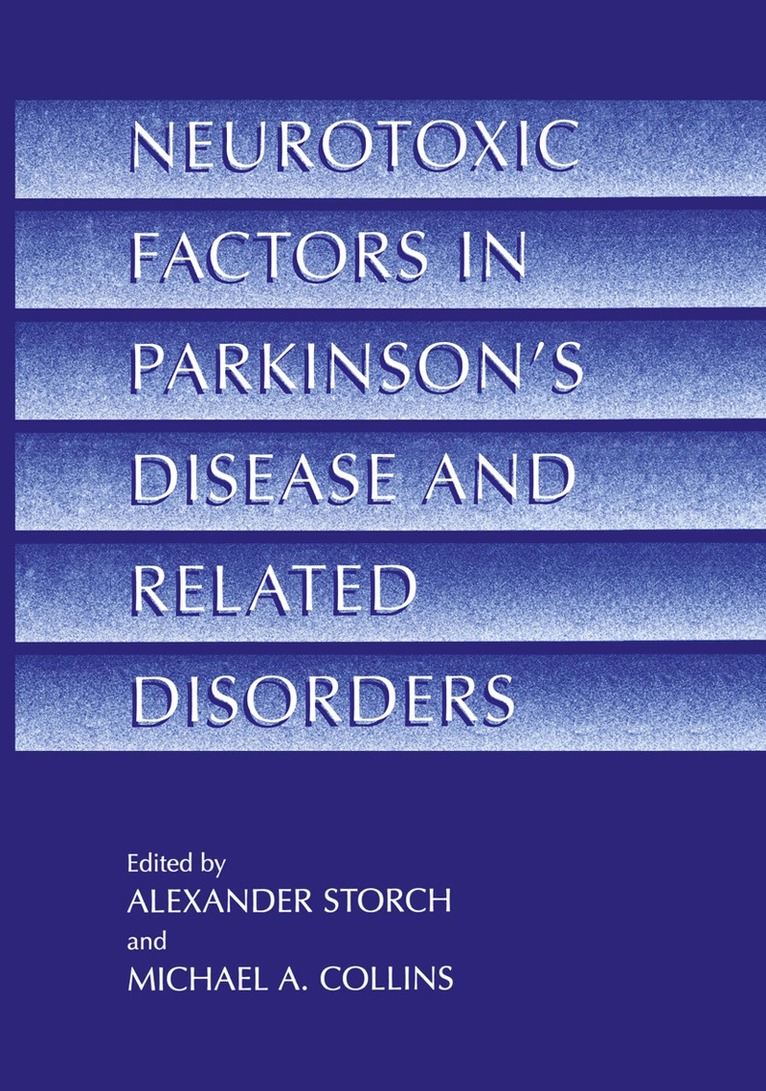
nd This book stems from the 2 Parkinson's Disease Symposium on "Neurotoxic Factors in Parkinsons disease and related disorders", held on August 6-7,1999 at the University ofUlm Medical School in Ulm at the Danube, Germany. The symposium wasalso asatellite ofthejointmeetingofthe InternationalSocietyfor Neurochemistry (ISN) and the European Society for Neurochemistry (ESN) that followed immediately afterwards in Berlin. The specific topic, neurotoxic factors in Parkinson's disease (PD), was chosen in light of accumulating neurobiological and epidemiological evidence indicating that the causes of this second most common neurodegenerative disorder, and possibly of related conditions such as multiple systems atrophy, in some manner involve environ- mental (xenobiotic) and even endogenous toxic agents. This volume brings together much of that neurobiological evidence; and in epidemiology, several recent major studies ofPD - for example, a study of20,000 twins published in the Journal of the American Medical Association in 1999 - conclude that environmental and life style than genetics, appear to be critical in the idiopathic disease.However, factors, rather the precise roles of neurotoxic factors in the pathogenesis of PD and related basal ganglia disorders remain uncertain, despite the cascade of research resulting from the discovery of the prototype MPTP in the early 1980's, and frankly, we have been surprised by the paucity of concentrated attention on specific environmental agents other than MPTP.
Elusive Democracy
Dalit Politics, Elections, and the Dilemmas of Representation
Inbunden, Engelska, 2025
1 192 kr
Skickas inom 7-10 vardagar
Today, India is widely celebrated as the world's largest democracy. However, not all groups experience India's political institutions the same way. This book draws on extensive interviews with longtime Dalit (ex-Untouchable) activists and original archives of party documents to explore the democratic transformation of one of India's most prominent Dalit-led parties, the Viduthalai Chiruthaigal Katchi (VCK; Liberation Panthers Party). Through a historical and ethnographic account of the VCK's transition from boycotts to ballots, this book provides a novel perspective on India's democratic trajectory, as well as its limits. Whereas VCK leaders initially viewed elections as an instrument to spur development and contest power asymmetries, they would come to recognize that democratic institutions can equally function as a means of containment, and control. The research shows how democratic politics opened new space for Dalit political advancement while simultaneously imposing unique constraints on these leaders that would reconfigure very nature of their politics.
1 632 kr
Skickas inom 10-15 vardagar
nd This book stems from the 2 Parkinson's Disease Symposium on "Neurotoxic Factors in Parkinsons disease and related disorders", held on August 6-7,1999 at the University ofUlm Medical School in Ulm at the Danube, Germany. The symposium wasalso asatellite ofthejointmeetingofthe InternationalSocietyfor Neurochemistry (ISN) and the European Society for Neurochemistry (ESN) that followed immediately afterwards in Berlin. The specific topic, neurotoxic factors in Parkinson's disease (PD), was chosen in light of accumulating neurobiological and epidemiological evidence indicating that the causes of this second most common neurodegenerative disorder, and possibly of related conditions such as multiple systems atrophy, in some manner involve environ- mental (xenobiotic) and even endogenous toxic agents. This volume brings together much of that neurobiological evidence; and in epidemiology, several recent major studies ofPD - for example, a study of20,000 twins published in the Journal of the American Medical Association in 1999 - conclude that environmental and life style than genetics, appear to be critical in the idiopathic disease.However, factors, rather the precise roles of neurotoxic factors in the pathogenesis of PD and related basal ganglia disorders remain uncertain, despite the cascade of research resulting from the discovery of the prototype MPTP in the early 1980's, and frankly, we have been surprised by the paucity of concentrated attention on specific environmental agents other than MPTP.