Michael E. Summers – författare
Visar alla böcker från författaren Michael E. Summers. Handla med fri frakt och snabb leverans.
2 produkter
2 produkter
Del 123 - Geophysical Monograph Series
Atmospheric Science Across the Stratopause
Inbunden, Engelska, 2000
1 086 kr
Skickas inom 11-20 vardagar
Published by the American Geophysical Union as part of the Geophysical Monograph Series, Volume 123.In recent years, two separate geophysical research cultures have developed in the United States to study the atmosphere: one of space scientists, who focus on the mesosphere, thermosphere and ionosphere, and the other of atmospheric scientists, who focus on the troposphere and stratosphere. The boundary between these two research domains roughly coincides with the stratopause (50 km). While the division ofthe atmosphere into layers and boundaries serves as a useful way to characterize the various chemical and dynamical processes that distinguish these layers, these boundaries are not impermeable. To understand such critical issues as global change, geophysicists must study the atmosphere as an integrated system. The purpose of this monograph is to highlight those studies that consider the coupling of these two regions and thus bring together two scientific specialties (atmospheric science and space science) that are often considered separately.
E-bok
Engelska, 2017206 kr
Läs direkt efter köp
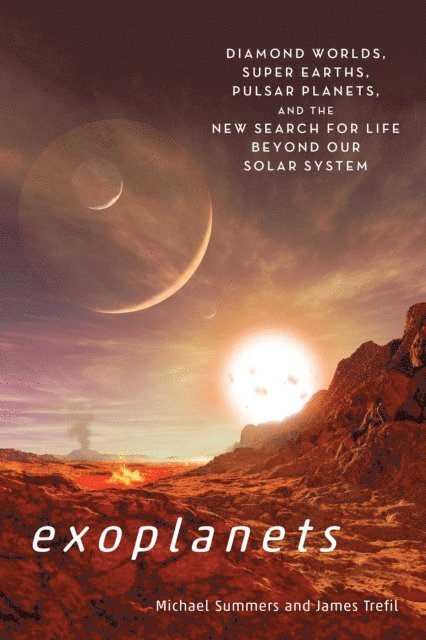
The past few years have seen an incredible explosion in our knowledge of the universe. Since its 2009 launch, the Kepler satellite has discovered more than two thousand exoplanets, or planets outside our solar system. More exoplanets are being discovered all the time, and even more remarkable than the sheer number of exoplanets is their variety. In Exoplanets, astronomer Michael Summers and physicist James Trefil explore these remarkable recent discoveries: planets revolving around pulsars, planets made of diamond, planets that are mostly water, and numerous rogue planets wandering through the emptiness of space. This captivating book reveals the latest discoveries and argues that the incredible richness and complexity we are finding necessitates a change in our questions and mental paradigms. In short, we have to change how we think about the universe and our place in it, because it is stranger and more interesting than we could have imagined.