Michael F. Oppenheimer - Böcker
Visar alla böcker från författaren Michael F. Oppenheimer. Handla med fri frakt och snabb leverans.
6 produkter
6 produkter
Nontariff Barriers
The Effects On Corporate Strategy In High-technology Sectors
Inbunden, Engelska, 2019
2 103 kr
Skickas inom 10-15 vardagar
This book explores the impact of Japanese and European nontariff barriers (NTBs) on the international marketing, investment, and technology strategies of small- to medium-sized high-technology U.S. firms. The study documents a pronounced dichotomy between strategies of small and large companies that, to a significant extent, reflects the gap in the resources, bargaining power, and familiarity with foreign markets of these two groups. Conclusions concerning the efficacy of corporate strategies adopted are supported by an analysis of over 20 case studies. These strategies range from licensing agreements with local firms to use of a trading company or local distributor, formation of a joint venture with a local firm, and establishment of a wholly owned subsidiary in the foreign market.
Nontariff Barriers
The Effects On Corporate Strategy In High-technology Sectors
Häftad, Engelska, 2020
616 kr
Skickas inom 10-15 vardagar
This book explores the impact of Japanese and European nontariff barriers (NTBs) on the international marketing, investment, and technology strategies of small- to medium-sized high-technology U.S. firms. .
2 103 kr
Skickas inom 10-15 vardagar
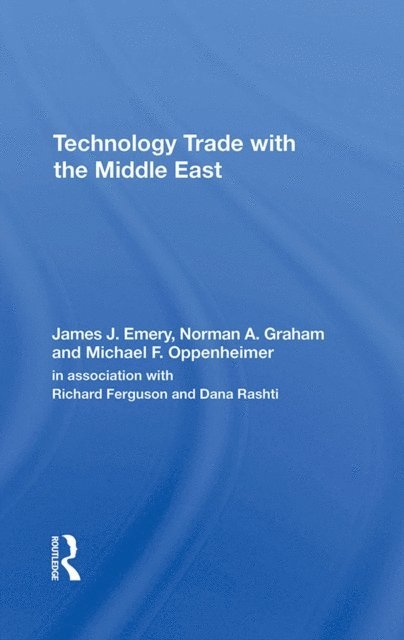
First published in 1986, the research for this book was originally undertaken by the authors at The Futures Group for the Office of Technology Assessment. This study assesses technology trade from the perspective of the competing supplier countries. This group was defined to include the United States, Japan, and Western Europe. Six Middle Eastern countries were selected for detailed review: Algeria, Egypt, Iran, Iraq, Kuwait, and Saudi Arabia.
1 292 kr
Skickas inom 10-15 vardagar
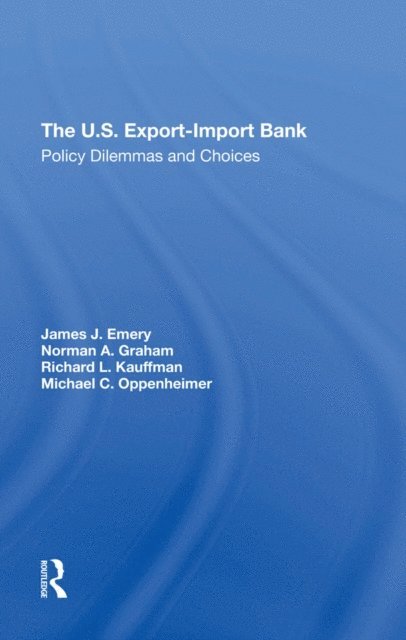
This book assesses the politics and programs of the U.S. Export-Import Bank and their relevance to U.S. trade policy. Focusing on the direct loan program for large credits with maturities of more than five years, the authors evaluate the broad criteria employed by the Bank in its decision-making process and the resulting allocation of Bank resources. They also examine the distribution of Bank loans and subsidies across industries and relate this to key industry characteristics such as comparative advantage and export dependence. The problems faced by the Eximbank in recent years—high borrowing costs, intensified export credit competition, limited resources, increased risks, conflicting mandates to be competitive yet self-sustaining -—have given tremendous importance to the careful articulation of policy and administration of programs. The authors find Bank policies to be broadly supportive of the U.S. trade policy goals, but also identify several areas of inconsistency and lack of definition and offer alternative means of specifying criteria to overcome these problems.
616 kr
Skickas inom 10-15 vardagar
First published in 1986, the research for this book was originally undertaken by the authors at The Futures Group for the Office of Technology Assessment. This study assesses technology trade from the perspective of the competing supplier countries. This group was defined to include the United States, Japan, and Western Europe. Six Middle Eastern countries were selected for detailed review: Algeria, Egypt, Iran, Iraq, Kuwait, and Saudi Arabia.
440 kr
Skickas inom 10-15 vardagar
This book assesses the politics and programs of the U.S. Export-Import Bank and their relevance to U.S. trade policy. Focusing on the direct loan program for large credits with maturities of more than five years, the authors evaluate the broad criteria employed by the Bank in its decision-making process and the resulting allocation of Bank resources. They also examine the distribution of Bank loans and subsidies across industries and relate this to key industry characteristics such as comparative advantage and export dependence. The problems faced by the Eximbank in recent years—high borrowing costs, intensified export credit competition, limited resources, increased risks, conflicting mandates to be competitive yet self-sustaining -—have given tremendous importance to the careful articulation of policy and administration of programs. The authors find Bank policies to be broadly supportive of the U.S. trade policy goals, but also identify several areas of inconsistency and lack of definition and offer alternative means of specifying criteria to overcome these problems.