Michael Grunstein – författare
Visar alla böcker från författaren Michael Grunstein. Handla med fri frakt och snabb leverans.
3 produkter
3 produkter
E-bok
Engelska, 2004380 kr
Läs direkt efter köp
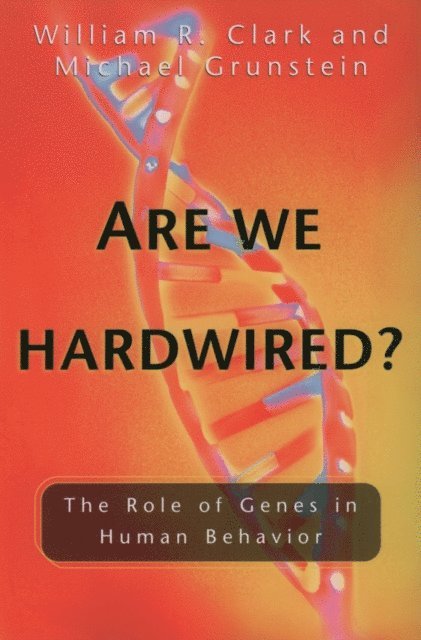
Books such as Richard Dawkins''s The Selfish Gene have aroused fierce controversy by arguing for the powerful influence of genes on human behavior. But are we entirely at the mercy of our chromosomes? In Are We Hardwired?, scientists William R. Clark and Michael Grunstein say the answer is both yes--and no. The power and fascination of Are We Hardwired? lie in their explanation of that deceptively simple answer. Using eye-opening examples of genetically identical twins who, though raised in different families, have had remarkably parallel lives, the authors show that indeed roughly half of human behavior can be accounted for by DNA. But the picture is quite complicated. Clark and Grunstein take us on a tour of modern genetics and behavioral science, revealing that few elements of behavior depend upon a single gene; complexes of genes, often across chromosomes, drive most of our heredity-based actions. To illustrate this point, they examine the genetic basis, and quirks, of individual behavioral traits--including aggression, sexuality, mental function, eating disorders, alcoholism, and drug abuse. They show that genes and environment are not opposing forces; heredity shapes how we interpret our surroundings, which in turn changes the very structure of our brain. Clearly we are not simply puppets of either influence. Perhaps most interesting, the book suggests that the source of our ability to choose, to act unexpectedly, may lie in the chaos principle: the most minute differences during activation of a single neuron may lead to utterly unpredictable actions. This masterful account of the nature-nurture controversy--at once provocative and informative--answers some of our oldest questions in unexpected new ways
Häftad, Engelska, 2004
442 kr
Skickas inom 5-8 vardagar
Addressing one of the most controversial topics in human biology, the role of genes in governing behaviour, this book is sure to generate widespread interest. Clark and Grunstein are excellent guides to the current scientific understanding, explaining the genetic and molecular basis of human behaviour within the broader context of animal behaviour generally. They develop the subject clearly, building up from the classic twin studies in humans, and from the most basic behaviours such as chemotaxis in paramecia, to corresponding tropisms and memory in roundworms, and memory and learning in fruit flies, then to complex behaviours of mice and humans. They cover all of the politically sensitive issues of behaviour genetics as applied to humans - susceptibilities to disease, eating disorders, aggression, addiction and compulsive behaviours, intelligence, sexual orientation - clearly, and with impeccable balance. The authors show why they feel that substantial parts of our personalities and identities are established by our exact genetic complements, without reducing us to powerless creations our genes. Behaviour is treated as a complex interaction of nature and nurture - to understand ourselves fully, neither can be dismissed out of hand. Clark brings a fine balance and graceful touch to his most ambitious popular book yet.
E-bok
PDF, Engelska, 2004367 kr
Läs direkt efter köp
Books such as Richard Dawkins''s The Selfish Gene have aroused fierce controversy by arguing for the powerful influence of genes on human behavior. But are we entirely at the mercy of our chromosomes? In Are We Hardwired?, scientists William R. Clark and Michael Grunstein say the answer is both yes--and no. The power and fascination of Are We Hardwired? lie in their explanation of that deceptively simple answer. Using eye-opening examples of genetically identical twins who, though raised in different families, have had remarkably parallel lives, the authors show that indeed roughly half of human behavior can be accounted for by DNA. But the picture is quite complicated. Clark and Grunstein take us on a tour of modern genetics and behavioral science, revealing that few elements of behavior depend upon a single gene; complexes of genes, often across chromosomes, drive most of our heredity-based actions. To illustrate this point, they examine the genetic basis, and quirks, of individual behavioral traits--including aggression, sexuality, mental function, eating disorders, alcoholism, and drug abuse. They show that genes and environment are not opposing forces; heredity shapes how we interpret our surroundings, which in turn changes the very structure of our brain. Clearly we are not simply puppets of either influence. Perhaps most interesting, the book suggests that the source of our ability to choose, to act unexpectedly, may lie in the chaos principle: the most minute differences during activation of a single neuron may lead to utterly unpredictable actions. This masterful account of the nature-nurture controversy--at once provocative and informative--answers some of our oldest questions in unexpected new ways