Michael J. Decker - Böcker
Visar alla böcker från författaren Michael J. Decker. Handla med fri frakt och snabb leverans.
7 produkter
7 produkter
1 205 kr
Skickas inom 10-15 vardagar
This is the first in-depth historical study of Byzantine Cappadocia. The authors draw on extensive textual and archaeological materials to examine the nature and place of Cappadocia in the Byzantine Empire from the fourth through eleventh centuries.
4 194 kr
Kommande
The archaeology of Byzantium is the archaeology of an empire whose chronological bounds, broadly speaking, spanned the fourth through fifteenth century AD. The authors whose works are collected in this handbook examine methods and practice of Byzantine archaeology as well as the materials typically encountered in artifacts produced within the imperial boundaries. Byzantine archaeology is still a relatively young discipline, and, while vast in its scope and ambition, work in the field tends to be challenging to access. This volume aims to remedy this situation by providing current views of the nature of Byzantine archaeology, exploring crucial studies which elucidate salient features of the empire's people, as well as offering glimpses of how things may develop in the near future.
2 101 kr
Kommande
The archaeology of Byzantium is the archaeology of an empire whose chronological bounds, broadly speaking, spanned the fourth through fifteenth century AD. The authors whose works are collected in this handbook examine methods and practice of Byzantine archaeology as well as the materials typically encountered in artifacts produced within the imperial boundaries. Byzantine archaeology is still a relatively young discipline, and, while vast in its scope and ambition, work in the field tends to be challenging to access. This volume aims to remedy this situation by providing current views of the nature of Byzantine archaeology, exploring crucial studies which elucidate salient features of the empire's people, as well as offering glimpses of how things may develop in the near future.
1 205 kr
Skickas inom 10-15 vardagar
This is the first in-depth historical study of Byzantine Cappadocia. The authors draw on extensive textual and archaeological materials to examine the nature and place of Cappadocia in the Byzantine Empire from the fourth through eleventh centuries.
392 kr
Skickas inom 10-15 vardagar
The Byzantine Dark Ages explores current debates about the sudden transformation of the Byzantine Empire in the wake of environmental, social and political changes. Those studying the Byzantine Empire, the successor to the Roman Empire in the eastern Mediterranean, have long recognized that the mid-7th century CE ushered in sweeping variations in the way of life of many inhabitants of the Mediterranean world, with evidence of the decline of the size and economic prosperity of cities, a sharp fall in expressions of literary culture, the collapse in trade networks, and economic and political instability.Michael J. Decker looks at the material evidence for the 7th to 9th centuries, lays out the current academic discourse about its interpretation, and suggests new ways of thinking about this crucial era. Important to readers interested in understanding how and why complex societies and imperial systems undergo and adapt to stresses, this clearly written, accessible work will also challenge students of archaeology and history to think in new ways when comprehending the construction of the past.
1 383 kr
Skickas inom 10-15 vardagar
The Byzantine Dark Ages explores current debates about the sudden transformation of the Byzantine Empire in the wake of environmental, social and political changes. Those studying the Byzantine Empire, the successor to the Roman Empire in the eastern Mediterranean, have long recognized that the mid-7th century CE ushered in sweeping variations in the way of life of many inhabitants of the Mediterranean world, with evidence of the decline of the size and economic prosperity of cities, a sharp fall in expressions of literary culture, the collapse in trade networks, and economic and political instability.Michael J. Decker looks at the material evidence for the 7th to 9th centuries, lays out the current academic discourse about its interpretation, and suggests new ways of thinking about this crucial era. Important to readers interested in understanding how and why complex societies and imperial systems undergo and adapt to stresses, this clearly written, accessible work will also challenge students of archaeology and history to think in new ways when comprehending the construction of the past.
344 kr
Skickas inom 3-6 vardagar
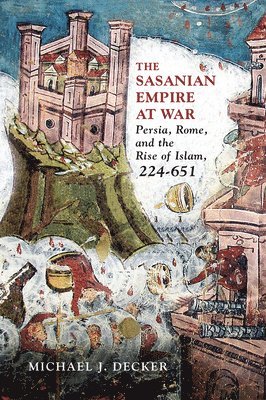
A comprehensive military history of one of the most important empires of Late AntiquityThe Sasanian Empire at War: Persia, Rome, and the Rise of Islam, 224–651 is the first comprehensive study in English examining war and society in one of the most important empires in world history: the Persian Empire of 224-651 AD, ruled by the Sasanian clan. At its height the Sasanians governed lands from the Indus River in the east to Egypt and the Mediterranean in the west. Adversaries of Rome, they also faced grave challenges from nomadic powers from Central Asia, notably the Huns and Turks. The Sasanians were able to maintain their empire for hundreds of years through nearly constant warfare, but when their expansion was checked in the north by the Byzantines at Constantinople in 626, and with the Muslim invasions to their south and west beginning in the 630s, the empire could no longer be sustained, and it finally collapsed.In this book, Michael J. Decker examines Sasanian warfare, including military capabilities, major confrontations, organization and weapons of the Persian army. In addition to providing a comprehensive overview of the conflicts that marked this vital period in the history of Eurasia, The Sasanian Empire at War challenges long cherished notions of the inferiority of Sasanian military capabilities and renders a new image of a sophisticated, confident culture astride the heart of Eurasia at the end of the ancient world and birth of the Silk Road. Persian arms were among the many features of their culture that drew widespread admiration and was one of the keys to the survival of Iranian culture beyond the Arab Conquest and into the present day.