Michael Land - Böcker
Visar alla böcker från författaren Michael Land. Handla med fri frakt och snabb leverans.
6 produkter
6 produkter
860 kr
Skickas inom 5-8 vardagar
The cooperative action of different regions of our brains gives us an amazing capacity to perform activities as diverse as playing the piano and hitting a tennis ball. Somehow, without conscious effort, our eyes find the information we need to operate successfully in the world around us. The development of head-mounted eye trackers over recent years has made it possible to record where we look during different active tasks, and so work out what information our eyes supply to the brain systems that control our limbs. We are now in a position to explore the strategies that the eye movement system uses in the initiation and guidance of action.Looking and Acting examines a wide range of visually guided behaviour, from sedentary tasks like reading and drawing, to dynamic activities such as driving and playing cricket. A central theme is that the eye movement system has its own knowledge about where to find the most appropriate information for guiding action - information not usually available to conscious scrutiny. Thus each type of action has its own specific repertoire of linked eye movements, acquired in parallel with the motor skills themselves. Starting with a brief background to eye movement studies, the book then reviews a range of observations and analyses of different activities. It ends with discussions of the nature of visual representation, the neurophysiology of the systems involved, and the roles of attention and learning.Opening a field in eye movement research, this fascinating book will be of great interest to all vision scientists (psychologists, physiologists, ophthalmologists) whether at professional, graduate, or advanced undergraduate levels. It will also be of value to musicians, artists, sports scientists, and transport engineers, and indeed anyone intrigued by the way we sample the visual world.
275 kr
Skickas inom 5-8 vardagar
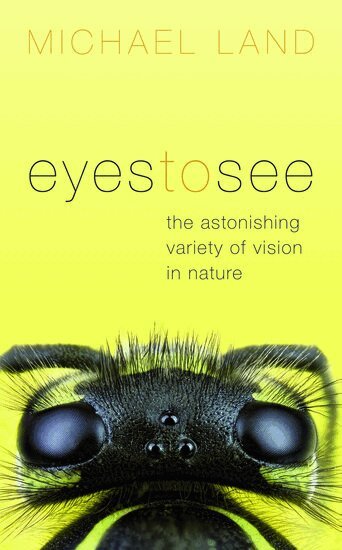
Vision is the sense by which we and other animals obtain most of our information about the world around us. Darwin appreciated that at first sight it seems absurd that the human eye could have evolved by natural selection. But we now know far more about vision, the many times it has independently evolved in nature, and the astonishing variety of ways to see. The human eye, with a lens forming an image on a sensitive retina, represents just one. Scallops, shrimps, and lobsters all use mirrors in different ways. Jumping spiders scan with their front-facing eyes to check whether the object in front is an insect to eat, another spider to mate with, or a predator to avoid. Mantis shrimps can even measure the polarization of light. Animal eyes are amazing structures, often involving precision optics and impressive information processing, mainly using wet protein - not the substance an engineer would choose for such tasks. In Eyes to See, Michael Land, one of the leading world experts on vision, explores the varied ways in which sight has evolved and is used in the natural world, and describes some of the ingenious experiments researchers have used to uncover its secrets. He also discusses human vision, including his experiments on how our eye movements help us to do everyday tasks, as well as skilled ones such as sight-reading music or driving. He ends by considering the fascinating problem of how the constantly shifting images from our eyes are converted in the brain into the steady and integrated conscious view of the world we experience.
954 kr
Skickas inom 10-15 vardagar
Security is a paradox. It is often viewed as intrusive, unwanted, a hassle, or something that limits personal, if not professional, freedoms. However, if we need security, we often feel as if we can never have enough. Security Management: A Critical Thinking Approach provides security professionals with the ability to critically examine their organizational environment and make it secure while creating an optimal relationship between obtrusion and necessity. It stresses the benefits of using a methodical critical thinking process in building a comprehensive safety management system. The book provides a mechanism that enables readers to think clearly and critically about the process of security management, emphasizing the ability to articulate the differing aspects of business and security management by reasoning through complex problems in the changing organizational landscape. The authors elucidate the core security management competencies of planning, organizing, staffing, and leading while providing a process to critically analyze those functions. They specifically address information security, cyber security, energy-sector security, chemical security, and general security management utilizing a critical thinking framework. Going farther than other books available regarding security management, this volume not only provides fundamental concepts in security, but it also creates informed, critical, and creative security managers who communicate effectively in their environment. It helps create a practitioner who will completely examine the environment and make informed well-thought-out judgments to tailor a security program to fit a specific organization.
954 kr
Skickas inom 10-15 vardagar
How far would or should you go to feel secure? While everyone wants safety and security, the measures to achieve it are often viewed of as intrusive, unwanted, a hassle, and limiting to personal and professional freedoms. Yet, when an incident occurs, we can never have enough security. Security Management for Occupational Safety provides a framework through which occupational safety practitioners can critically examine their organizational environments and make them safer while assuming a best possible relationship between obtrusion and necessity.This book examines the diverse factors involved in occupational management—planning, people, budget, information, and preparedness—to present an accurately balanced picture of safety functions. It uses a critical thinking approach to interpreting data as a tool for providing more effective occupational safety management. The book discusses core security management competencies of planning, organizing, staffing, and leading while providing a process to critically analyze those functions. It stresses the benefits of using a methodical critical thinking process in building a comprehensive safety management system, addressing information security, cyber security, energy-sector security, chemical security, and general security management utilizing a critical thinking framework.The author doesn’t focus on how to secure, guard, or protect. While there are commonalities in many aspects of occupational risks and hazards, all are going to be unique. Instead, he guides you through each stage of critical thinking, emphasizing the ability to articulate the differing aspects of business and security management by reasoning through complex problems in the changing organizational landscape. The book not only provides fundamental concepts in security but it also creates informed, critical, and creative security managers who communicate effectively in their environment and make informed well-thought-out judgments to tailor a security program to fit a specific organization.
1 330 kr
Skickas inom 10-15 vardagar
How far would or should you go to feel secure? While everyone wants safety and security, the measures to achieve it are often viewed of as intrusive, unwanted, a hassle, and limiting to personal and professional freedoms. Yet, when an incident occurs, we can never have enough security. Security Management for Occupational Safety provides a framework through which occupational safety practitioners can critically examine their organizational environments and make them safer while assuming a best possible relationship between obtrusion and necessity.This book examines the diverse factors involved in occupational management—planning, people, budget, information, and preparedness—to present an accurately balanced picture of safety functions. It uses a critical thinking approach to interpreting data as a tool for providing more effective occupational safety management. The book discusses core security management competencies of planning, organizing, staffing, and leading while providing a process to critically analyze those functions. It stresses the benefits of using a methodical critical thinking process in building a comprehensive safety management system, addressing information security, cyber security, energy-sector security, chemical security, and general security management utilizing a critical thinking framework.The author doesn’t focus on how to secure, guard, or protect. While there are commonalities in many aspects of occupational risks and hazards, all are going to be unique. Instead, he guides you through each stage of critical thinking, emphasizing the ability to articulate the differing aspects of business and security management by reasoning through complex problems in the changing organizational landscape. The book not only provides fundamental concepts in security but it also creates informed, critical, and creative security managers who communicate effectively in their environment and make informed well-thought-out judgments to tailor a security program to fit a specific organization.
1 400 kr
Skickas inom 10-15 vardagar
Security is a paradox. It is often viewed as intrusive, unwanted, a hassle, or something that limits personal, if not professional, freedoms. However, if we need security, we often feel as if we can never have enough. Security Management: A Critical Thinking Approach provides security professionals with the ability to critically examine their organizational environment and make it secure while creating an optimal relationship between obtrusion and necessity. It stresses the benefits of using a methodical critical thinking process in building a comprehensive safety management system. The book provides a mechanism that enables readers to think clearly and critically about the process of security management, emphasizing the ability to articulate the differing aspects of business and security management by reasoning through complex problems in the changing organizational landscape. The authors elucidate the core security management competencies of planning, organizing, staffing, and leading while providing a process to critically analyze those functions. They specifically address information security, cyber security, energy-sector security, chemical security, and general security management utilizing a critical thinking framework. Going farther than other books available regarding security management, this volume not only provides fundamental concepts in security, but it also creates informed, critical, and creative security managers who communicate effectively in their environment. It helps create a practitioner who will completely examine the environment and make informed well-thought-out judgments to tailor a security program to fit a specific organization.