Michael N Mitchell – Författare
Visar alla böcker från författaren Michael N Mitchell. Handla med fri frakt och snabb leverans.
7 produkter
7 produkter
891 kr
Tillfälligt slut
879 kr
Tillfälligt slut
1 116 kr
Skickas inom 10-15 vardagar
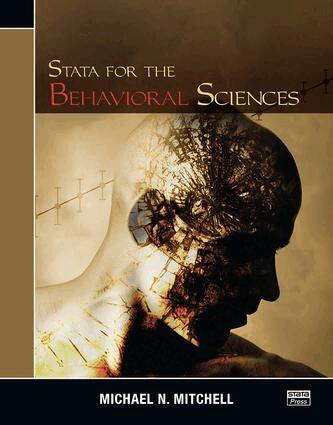
Stata for the Behavioral Sciences, by Michael Mitchell, is the ideal reference for researchers using Stata to fit ANOVA models and other models commonly applied to behavioral science data. Drawing on his education in psychology and his experience in consulting, Mitchell uses terminology and examples familiar to he reader as he demonstrates how to fit a variety of models, how to interpret results, how to understand simple and interaction effects, and how to explore results graphically. Although this book is not designed as an introduction to Stata, it is appealing even to Stata novices. Throughout the text, Mitchell thoughtfully addresses any features of Stata that are important to understand for the analysis at hand. He also is careful to point out additional resources such as related videos from Stata's YouTube channel.This book is an easy-to-follow guide to analyzing data using Stata for researchers in the behavioral sciences and a valuable addition to the bookshelf of anyone interested in applying ANOVA methods to a variety of experimental designs.
845 kr
Skickas inom 7-10 vardagar
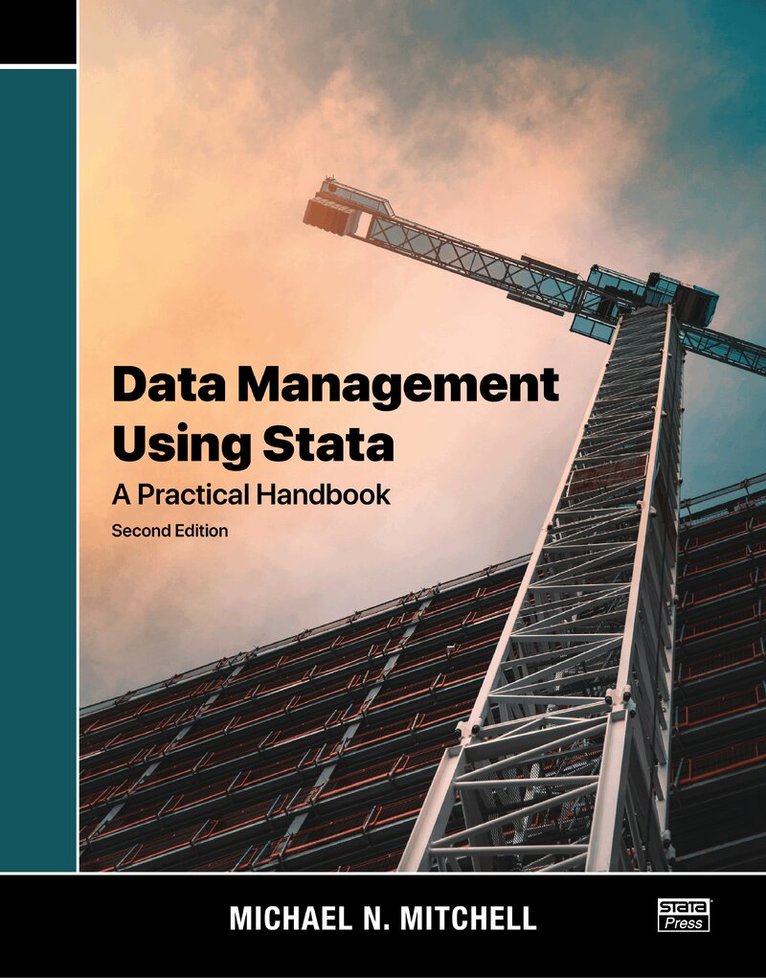
This second edition of Data Management Using Stata focuses on tasks that bridge the gap between raw data and statistical analysis. It has been updated throughout to reflect new data management features that have been added over the last 10 years. Such features include the ability to read and write a wide variety of file formats, the ability to write highly customized Excel files, the ability to have multiple Stata datasets open at once, and the ability to store and manipulate string variables stored as Unicode. Further, this new edition includes a new chapter illustrating how to write Stata programs for solving data management tasks. As in the original edition, the chapters are organized by data management areas: reading and writing datasets, cleaning data, labeling datasets, creating variables, combining datasets, processing observations across subgroups, changing the shape of datasets, and programming for data management. Within each chapter, each section is a self-contained lesson illustrating a particular data management task (for instance, creating date variables or automating error checking) via examples. This modular design allows you to quickly identify and implement the most common data management tasks without having to read background information first. In addition to the “nuts and bolts” examples, author Michael Mitchell alerts users to common pitfalls (and how to avoid them) and provides strategic data management advice. This book can be used as a quick reference for solving problems as they arise or can be read as a means for learning comprehensive data management skills. New users will appreciate this book as a valuable way to learn data management, while experienced users will find this information to be handy and time saving—there is a good chance that even the experienced user will learn some new tricks.
822 kr
Skickas inom 10-15 vardagar
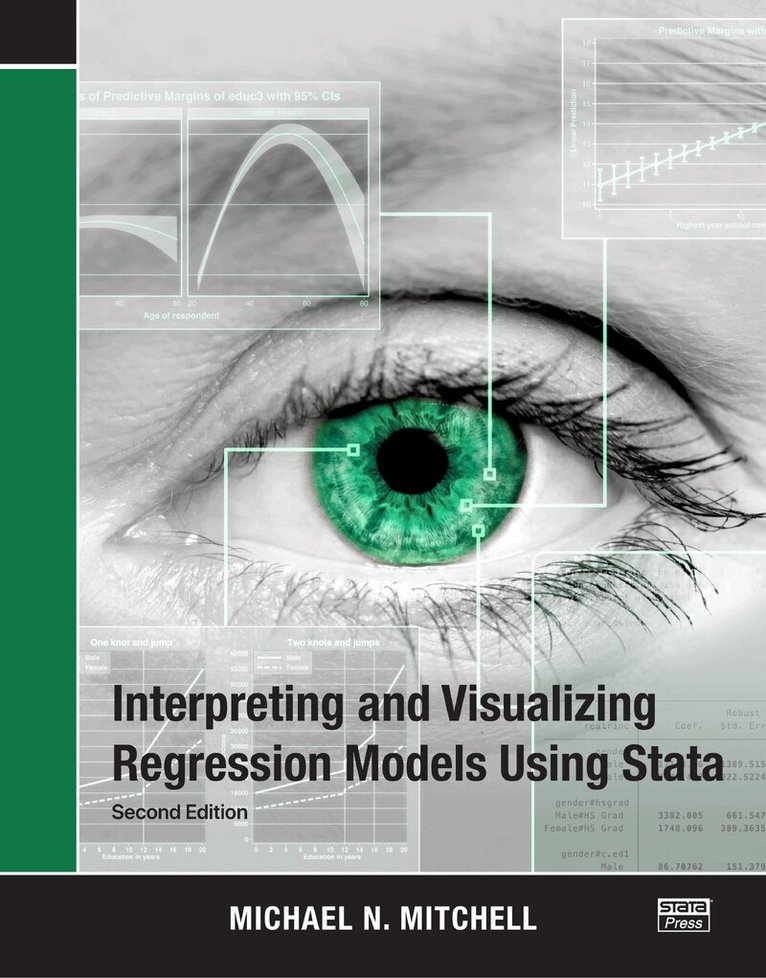
Interpreting and Visualizing Regression Models Using Stata, Second Edition provides clear and simple examples illustrating how to interpret and visualize a wide variety of regression models. Including over 200 figures, the book illustrates linear models with continuous predictors (modeled linearly, using polynomials, and piecewise), interactions of continuous predictors, categorical predictors, interactions of categorical predictors, and interactions of continuous and categorical predictors. The book also illustrates how to interpret and visualize results from multilevel models, models where time is a continuous predictor, models with time as a categorical predictor, nonlinear models (such as logistic or ordinal logistic regression), and models involving complex survey data. The examples illustrate the use of the margins, marginsplot, contrast, and pwcompare commands. This new edition reflects new and enhanced features added to Stata, most importantly the ability to label statistical output using value labels associated with factor variables. As a result, output regarding marital status is labeled using intuitive labels like Married and Unmarried instead of using numeric values such as 1 and 2. All the statistical output in this new edition capitalizes on this new feature, emphasizing the interpretation of results based on variables labeled using intuitive value labels. Additionally, this second edition illustrates other new features, such as using transparency in graphics to more clearly visualize overlapping confidence intervals and using small sample-size estimation with mixed models. If you ever find yourself wishing for simple and straightforward advice about how to interpret and visualize regression models using Stata, this book is for you.
1 026 kr
Skickas inom 10-15 vardagar
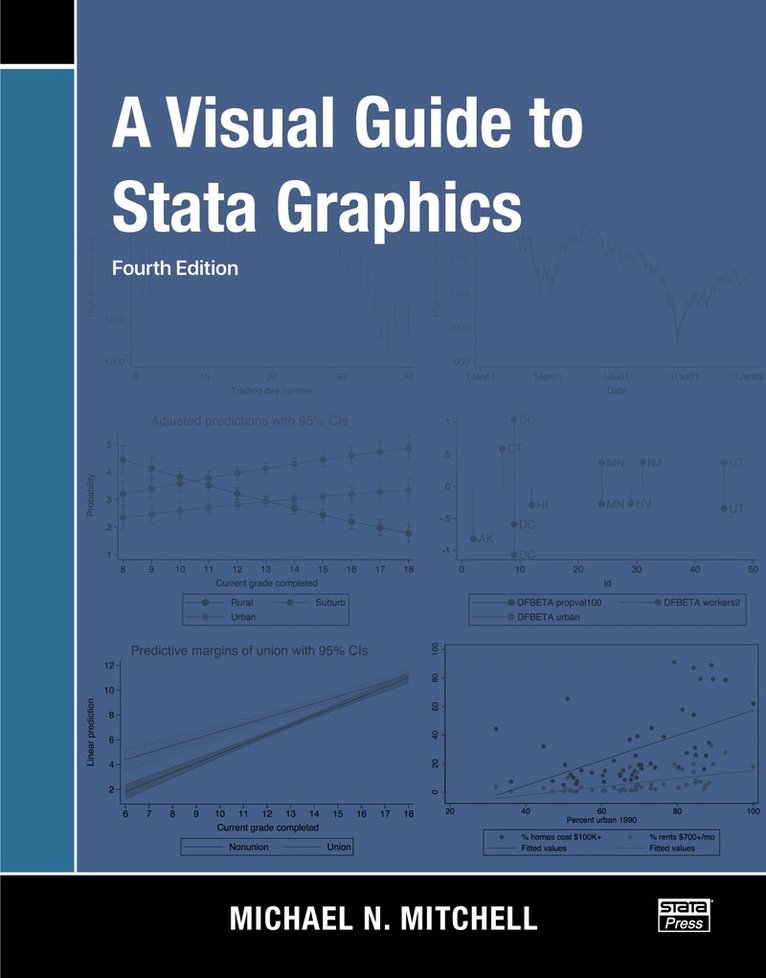
Whether you are new to Stata graphics or a seasoned veteran, this book will teach you how to use Stata to make publication-quality graphs that will stand out and enhance your statistical results. With over 1,200 illustrated examples and quick-reference tabs, this book quickly guides you to the information you need for creating and customizing high-quality graphs for any type of statistical data. Each graph is displayed in full color with simple and clear instructions that illustrate how to create and customize graphs using Stata commands. Whether you use this book as a learning tool or a quick reference, you will have the power of Stata graphics at your fingertips.
913 kr
Skickas inom 7-10 vardagar
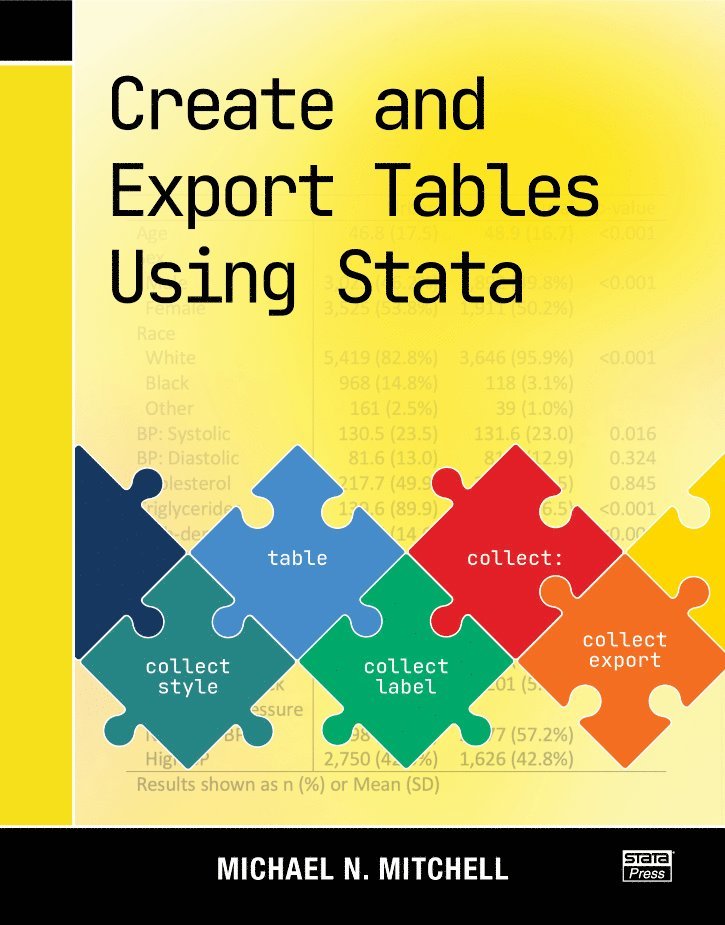
In Create and Export Tables Using Stata, Michael Mitchell teaches you how to expertly craft custom, publication-quality tables of summary statistics, regression results, and more. Mitchell examined hundreds of published journal articles from many disciplines, searching for commonly used table layouts. This book breaks down how to create the most popularly used tables by guiding you through examples using Stata’s table, dtable, and etable commands, as well as the collect suite of commands.This book begins with 24 sample tables, including 6 examples of a Table 1, 8 examples of regression models, 4 examples with Student's t tests, and an example of reporting results from a pretest–posttest design. Each sample table is illustrated step by step, showing you how to create it, customize it, and export it as a Word document. You'll also learn how you can export your table as a PDF or an Excel spreadsheet.After the quick examples, the book takes a more thorough look at the process of creating a Table 1—a table of descriptive statistics that optionally includes a comparison across groups. This discussion also includes extensive instruction on how to create different types of composite results to include in your table; composite results combine multiple statistics into one cell, such as the mean (SE) or median (IQR).Next Mitchell focuses on creating tables from regression models, such as multiple regression, multivariate regression, logistic, and multinomial logistic models, and illustrates how to make tables that combine results from several models.The book ends with a look under the hood, describing what a collection looks like and the steps used by the collect suite of commands for creating a table and filling it in based on the contents of the collection. This information can help you more deeply understand the process of creating tables and help you make more complex tables using Stata.Create and Export Tables Using Stata is integral to anyone reporting data characteristics or analysis. You will learn how to create tables with the layout, formatting, and style you need. Optimize your workflow by using your styles to automate the creation of any future tables. You will take this book off your shelf over and over again as it quickly becomes your go-to reference for creating tables in Stata.