Michael Seadle – författare
562 kr
Skickas inom 10-15 vardagar
1 950 kr
Skickas inom 10-15 vardagar
655 kr
Läs direkt efter köp
Arguing that there never was a time when politicians did not prevaricate and when some communities did not doubt conclusions that others considered to be facts, The Measurement of Information Integrity puts the post-truth era in context and offers measures for integrity in the modern world.
Incorporating international examples from a range of disciplines, this book provides the reader with tools that will help them to evaluate public statements - especially ones involving the sciences and scholarship. It also provides intellectual tools to those who must assess potential violations of public or academic integrity. Many of these tools involve measurement mechanisms, ways of putting cases into context, and a recognition that few cases are simple black-and-white violations. Demonstrating that a binary approach to judging research integrity fails to recognize the complexity of the environment, Seadle highlights that even flawed discoveries may still contain value. Finally, the book reminds its reader that research integrity takes different forms in different disciplines and that each one needs separate consideration, even if the general principles remain the same for all.
The Measurement of Information Integrity will help those who want to do research well, as well as those who must ascertain whether results have failed to meet the standards of the community. It will be of particular interest to researchers and students engaged in the study of library and information science.
649 kr
Läs direkt efter köp
Arguing that there never was a time when politicians did not prevaricate and when some communities did not doubt conclusions that others considered to be facts, The Measurement of Information Integrity puts the post-truth era in context and offers measures for integrity in the modern world.
Incorporating international examples from a range of disciplines, this book provides the reader with tools that will help them to evaluate public statements - especially ones involving the sciences and scholarship. It also provides intellectual tools to those who must assess potential violations of public or academic integrity. Many of these tools involve measurement mechanisms, ways of putting cases into context, and a recognition that few cases are simple black-and-white violations. Demonstrating that a binary approach to judging research integrity fails to recognize the complexity of the environment, Seadle highlights that even flawed discoveries may still contain value. Finally, the book reminds its reader that research integrity takes different forms in different disciplines and that each one needs separate consideration, even if the general principles remain the same for all.
The Measurement of Information Integrity will help those who want to do research well, as well as those who must ascertain whether results have failed to meet the standards of the community. It will be of particular interest to researchers and students engaged in the study of library and information science.
1 028 kr
Skickas inom 5-8 vardagar
1 973 kr
Skickas inom 11-20 vardagar
506 kr
Skickas inom 10-15 vardagar
629 kr
Läs direkt efter köp
Institutions typically treat research integrity violations as black and white, right or wrong. The result is that the wide range of grayscale nuances that separate accident, carelessness, and bad practice from deliberate fraud and malpractice often get lost. This lecture looks at how to quantify the grayscale range in three kinds of research integrity violations: plagiarism, data falsification, and image manipulation.
Quantification works best with plagiarism, because the essential one-to-one matching algorithms are well known and established tools for detecting when matches exist. Questions remain, however, of how many matching words of what kind in what location in which discipline constitute reasonable suspicion of fraudulent intent. Different disciplines take different perspectives on quantity and location. Quantification is harder with data falsification, because the original data are often not available, and because experimental replication remains surprisingly difficult. The same is true with image manipulation, where tools exist for detecting certain kinds of manipulations, but where the tools are also easily defeated.
This lecture looks at how to prevent violations of research integrity from a pragmatic viewpoint, and at what steps can institutions and publishers take to discourage problems beyond the usual ethical admonitions. There are no simple answers, but two measures can help: the systematic use of detection tools and requiring original data and images. These alone do not suffice, but they represent a start.
The scholarly community needs a better awareness of the complexity of research integrity decisions. Only an open and wide-spread international discussion can bring about a consensus on where the boundary lines are and when grayscale problems shade into black. One goal of this work is to move that discussion forward.
2 002 kr
Läs direkt efter köp
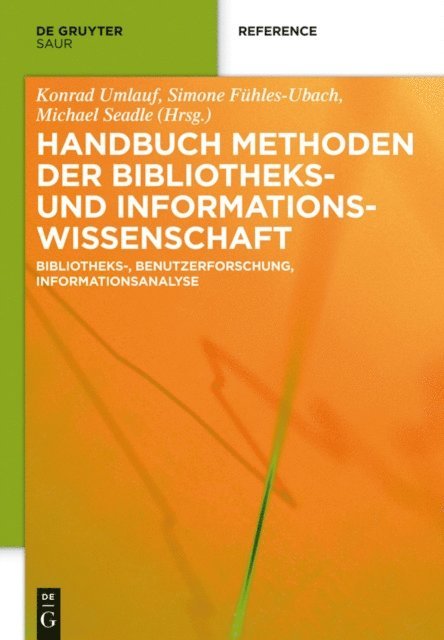
Dieses Handbuch stellt in Beiträgen der führenden Experten qualitative und quantitative Forschungsmethoden des Faches vor. Behandelt werden sowohl fachspezifische Methoden wie auch Methoden der Sozialwissenschaften und der Informatik: Entwicklung von Forschungsdesigns, Befragungen, Nutzungsmessung von Websites, Benutzerforschung, Ethnomethodologie, Methoden der Informetrie, Evaluation von Informationssystemen, Inhaltsanalyse, Diskursanalyse, hermeneutische Methoden, Delphi-Methode, Methoden der buchwissenschaftlichen Forschung, Forschungsmethoden für historische Fragestellungen, Methoden der Lese- und Mediennutzungsforschung. Auch neue Möglichkeiten der Unterstützung durch Online-Tools (z.B. Online-Befragungen) werden erklärt.
1 655 kr
Skickas inom 5-8 vardagar
1 436 kr
Läs direkt efter köp
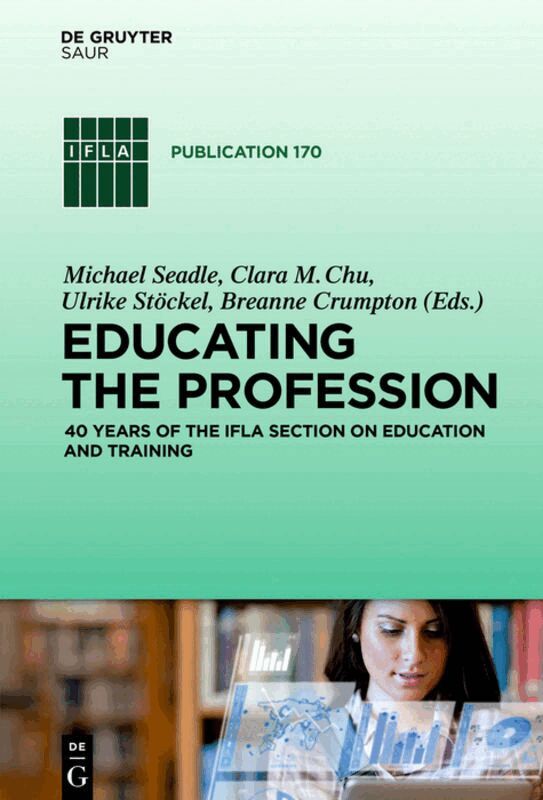
Education and training for the library profession have changed over the decades, and this publication looks both at the past and the future of these developments at schools of library and information science as well as the role of IFLA''s Section on Education and Training. The chapters cover regional developments in Europe, Asia, Africa, Australia and the Americas; special topics, such as quality assurance and case studies; and future considerations in LIS education.
1 436 kr
Läs direkt efter köp
Education and training for the library profession have changed over the decades, and this publication looks both at the past and the future of these developments at schools of library and information science as well as the role of IFLA''s Section on Education and Training. The chapters cover regional developments in Europe, Asia, Africa, Australia and the Americas; special topics, such as quality assurance and case studies; and future considerations in LIS education.
818 kr
Tillfälligt slut
818 kr
Tillfälligt slut