Michel Lemoine – författare
Visar alla böcker från författaren Michel Lemoine. Handla med fri frakt och snabb leverans.
4 produkter
4 produkter
Inbunden, Engelska, 1991
1 123 kr
Skickas inom 10-15 vardagar
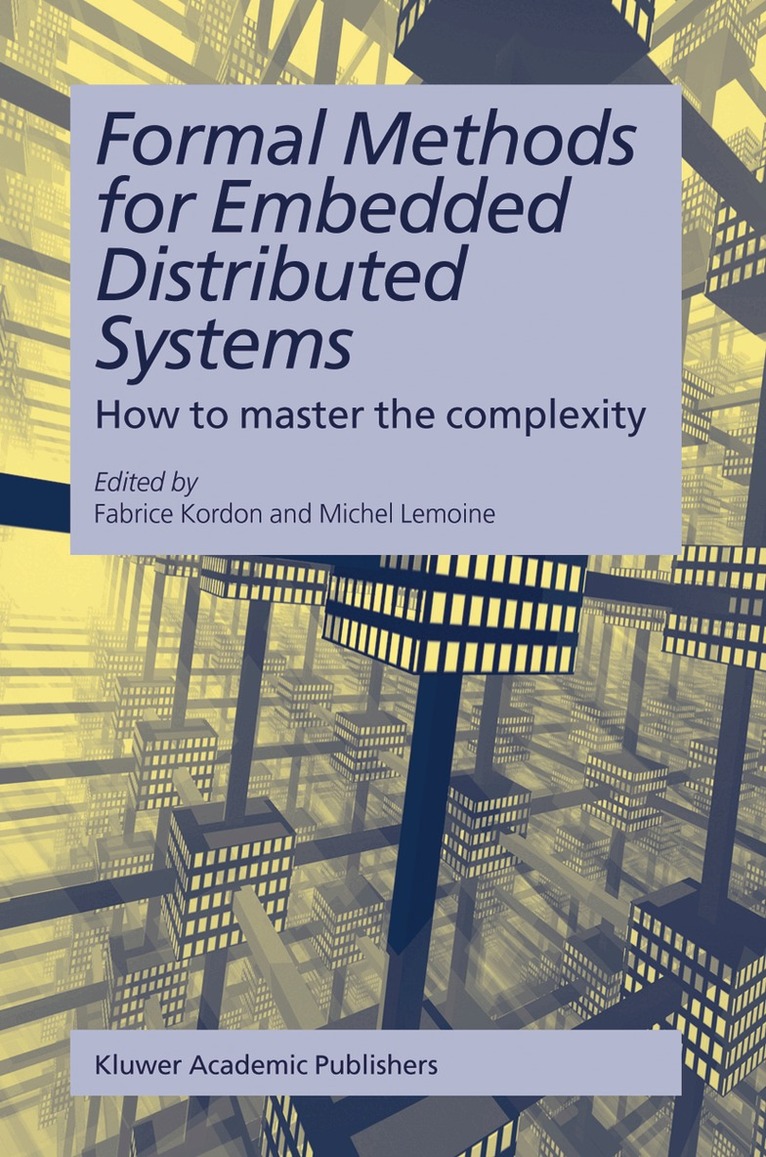
The development of any Software (Industrial) Intensive System, e.g. critical embedded software, requires both different notations, and a strong development process. Different notations are mandatory because different aspects of the Software System have to be tackled. A strong development process is mandatory as well because without a strong organization we cannot warrantee the system will meet its requirements. Unfortunately, much more is needed! Formal Methods for Embedded Distributed Systems is dedicated to the presentation of some techniques to be used in the context of distributed and/or embedded systems. Since formal techniques rely on models, i.e. different descriptions of the system to be designed, the presented techniques are located in the first part of software development. Formal Methods for Embedded Distributed Systems makes many connections between "traditional development approaches" and the latest developments in formal techniques that are known as the best solution to significantly increase the reliability of such systems.The target audience is mainly composed of professionals (engineers, researchers and teachers), and students (graduated and postgraduated) who want to have a clear understanding of how to manage the inherent complexity of critical and/or distributed systems.
Häftad, Engelska, 2010
1 123 kr
Skickas inom 10-15 vardagar
The development of any Software (Industrial) Intensive System, e.g. critical embedded software, requires both different notations, and a strong devel- ment process. Different notations are mandatory because different aspects of the Software System have to be tackled. A strong development process is mandatory as well because without a strong organization we cannot warrantee the system will meet its requirements. Unfortunately, much more is needed! The different notations that can be used must all possess at least one property: formality. The development process must also have important properties: a exha- tive coverage of the development phases, and a set of well integrated support tools. In Computer Science it is now widely accepted that only formal notations can guarantee a perfect de?ned meaning. This becomes a more and more important issue since software systems tend to be distributed in large systems (for instance in safe public transportation systems), and in small ones (for instance numerous processors in luxury cars). Distribution increases the complexity of embedded software while safety criteria get harder to be met. On the other hand, during the past decade Software Engineering techniques have been improved a lot, and are now currently used to conduct systematic and rigorous development of large software systems. UML has become the de facto standard notation for documenting Software Engineering projects. UML is supported by many CASE tools that offer graphical means for the UML notation.
708 kr
Läs direkt efter köp
For the second time, the European Software Engineering Conference is being held jointly with the ACM SIGSOFT Symposium on the Foundations of Software Engine- ing (FSE). Although the two conferences have different origins and traditions, there is a significant overlap in intent and subject matter. Holding the conferences jointly when they are held in Europe helps to make these thematic links more explicit, and enco- ages researchers and practitioners to attend and submit papers to both events. The ESEC proceedings have traditionally been published by Springer-Verlag, as they are again this year, but by special arrangement, the proceedings will be distributed to members of ACM SIGSOFT, as is usually the case for FSE. ESEC/FSE is being held as a single event, rather than as a pair of collocated events. Submitted papers were therefore evaluated by a single program committee. ESEC/FSE represents a broad range of software engineering topics in (mainly) two continents, and consequently the program committee members were selected to represent a spectrum of both traditional and emerging software engineering topics. A total of 141 papers were submitted from around the globe. Of these, nearly half were classified as research - pers,aquarterasexperiencepapers,andtherestasbothresearchandexperiencepapers. Twenty-nine papers from five continents were selected for presentation and inclusion in the proceedings. Due to the large number of industrial experience reports submitted, we have also introduced this year two sessions on short case study presentations.
565 kr
Skickas inom 10-15 vardagar
For the second time, the European Software Engineering Conference is being held jointly with the ACM SIGSOFT Symposium on the Foundations of Software Engine- ing (FSE). Although the two conferences have different origins and traditions, there is a significant overlap in intent and subject matter. Holding the conferences jointly when they are held in Europe helps to make these thematic links more explicit, and enco- ages researchers and practitioners to attend and submit papers to both events. The ESEC proceedings have traditionally been published by Springer-Verlag, as they are again this year, but by special arrangement, the proceedings will be distributed to members of ACM SIGSOFT, as is usually the case for FSE. ESEC/FSE is being held as a single event, rather than as a pair of collocated events. Submitted papers were therefore evaluated by a single program committee. ESEC/FSE represents a broad range of software engineering topics in (mainly) two continents, and consequently the program committee members were selected to represent a spectrum of both traditional and emerging software engineering topics. A total of 141 papers were submitted from around the globe. Of these, nearly half were classified as research - pers,aquarterasexperiencepapers,andtherestasbothresearchandexperiencepapers. Twenty-nine papers from five continents were selected for presentation and inclusion in the proceedings. Due to the large number of industrial experience reports submitted, we have also introduced this year two sessions on short case study presentations.