
Michelle E Kruger – författare
2 446 kr
Läs direkt efter köp
2 077 kr
Läs direkt efter köp
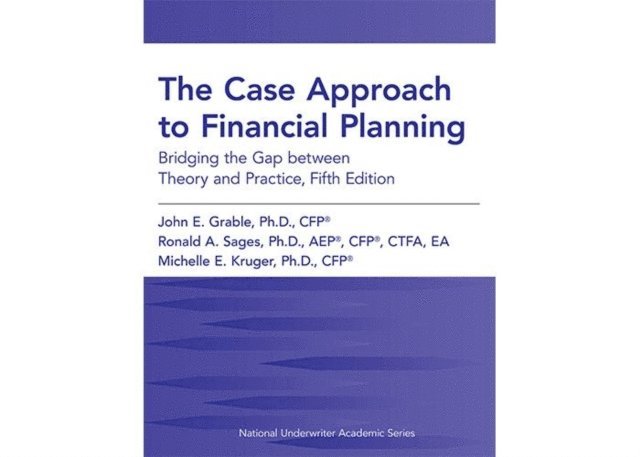
The Case Approach to Financial Planning: Bridging the Gap between Theory and Practice, Fifth Edition, meets the demand for comprehensive and realistic financial planning analytical practice problems. The fifth edition has been comprehensively updated to meet this demand, with several new cases added in chapter fourteen.
With twenty up-to-date case studies, strategies to develop client-specific recommendations, and learning aids like access to a fully integrated Financial Planning Analysis Excel™ package, this is a must have for any aspiring financial planner. It provides the tools and foundation to learn by doing.
This title features:
A content review of the major subject areas typically taught in a college-level financial planning curriculumA comprehensive review of important financial planning mathematical formulas and proceduresA step-by-step guide to the preparation of a comprehensive personal financial planFinancial planning strategies that can be applied to a variety of clients and client circumstancesInstructions on how to do calculations essential to creating a financial plan.New in the Fifth Edition:
New case studies, including a psychology of financial planning case study and a new case study on ethics and practice standardsThe latest tax figures and data, including a new section summarizing the time value of money calculations, including updated tax rates and standard deductions, pass-through deductions, qualified business income, and moreUpdate on educational financing, including the latest figures for a gift tax exclusion and the latest on 529 plan contributions, the American Opportunity Credit, and the Lifetime Learning CreditThe latest retirement plan figures, including retirement plan catch-up provisions and taxation of social security benefitsUpdated estate planning figures, including trust and estate ordinary income rates and capital gain tax ratesA preview of possible changes to the Secure Act (Secure Act 2.0), including RMD and 401k plan proposalsAnalysis of the different types of business entities, including partnerships, LLCs, S-Corps, and C-CorpsDiscussion of risk and return, including inflation risk and market riskA new section on benchmarking, including the most widely used market indexesA new section personal automobile policies, including discussion of bodily injury and property damage liabilityTopics Covered:
The Financial Planning ProcessFinancial Planning ComputationsCash Flow and Net Worth PlanningIncome Tax PlanningLife Insurance PlanningHealth Insurance PlanningDisability Insurance PlanningLong-Term Care Insurance PlanningProperty and Casualty Insurance PlanningEducation PlanningRetirement PlanningEstate PlanningAnd More! See the “Table of Contents” section for a full list of topics2 064 kr
Läs direkt efter köp
The book not only highlights various elements involved in comprehensive financial planning, including estate, tax, cash flow, education planning, and much more-but also introduces important behavioral perspectives and communication techniques. As a way to synthesize these pieces and learn how the plan writing process unfolds, students follow a running case-the Hubble family.
This title features:
A thorough review of the new 7-step systematic financial planning process.A description of the regulatory environment in which every financial planner operates.An in-depth discussion of client communication and counseling techniques.Financial planning approaches that can be applied to a variety of clients and client circumstances.A chapter-by-chapter focus on analytical tools and techniques that can be used to evaluate client data.An example of a complete written financial plan with explanations about how analyses lead to the recommendations.Chapter-based learning aids, including access to a fully integrated Financial Planning Analysis Excel package and other online support materials, including video examples of client communication and counseling strategies.Instructions on how to do calculations essential to creating a financial plan.Numerous self-test questions to test comprehension of material.New in the 2nd Edition:
Updated materials that address CFP Board's new Client Psychology learning outcomes.Videos that can be used to illustrate client communication and counseling techniques.Revised and expanded test bank.Updated Excel package.Topics Covered:
CFP Board's 7-step financial planning process.Step-by-step guide to formulating a financial plan and presenting it to a client.Guides for different types of financial planning such as life insurance planning, long-term care insurance planning, and retirement planning.Comprehensive Hubble case.And More! See the “Table of Contents” section for a full list of topics1 045 kr
Läs direkt efter köp
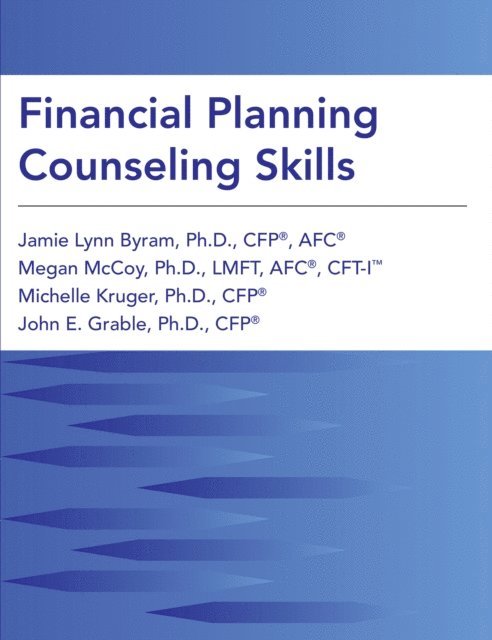
Many of the day-to-day tasks performed by financial planners fall within the broader scope of counseling. Financial planners often face counseling like-incidents in their work. As a result, financial planners need a working knowledge of client and financial planner attitudes, values, and biases. Financial Planning Counseling Skills specifically describes how a financial planner can blend counseling, psychological, and behavioral finance theories, models, and approaches into their practice with clients. Discover:
Chapter Applications that include testing materials, such as short answer questions, essay questions, matching charts and sample interview questions A running case study that covers topics for each of the ten chapters that apply principles learned in the chapters Charts that demonstrate how an office environment should be structured to positively influence a client's psychology Each chapter contains frequent discussion points set off in boxes for easy identification that provide practical guidance on points discussed in the text Key terms are highlighted and defined so students can easily find and understand the termsTopics Covered:
The application of counseling theory to the practice of financial planning Understanding the importance of using theory in practice and demonstrating how a financial planner can use counseling theories to build client trust and enhance client interactions How to establish, manage, and maintain client relationships, including how to build a trust-based client relationship How to communicate effectively with clients, especially how to obtain deeper insight into a client's values, goals and other valuable information and the importance of nonverbal communication Reflective listening skills, including how it allows planners to gain information and understand the entirety of the client's situation The importance of questioning skills, including open and closed-ended questions The issues with heuristics, or mental shortcuts that allow a decision-maker to process information or make decisions more quickly The role of a financial planner in identifying and monitoring client biases and how they impact client's decision making Sources of money conflict, including areas of potential conflict between spouses and family members, as well as money taboos and differing money personalities How financial planners can communicate the importance of agreeing on financial goals and objectives Discussion of the most common money disorders, including compulsive shopping, gambling, workaholism, hoarding, and financial denial, including the symptoms of these disorders and how a financial planner can support clients with these disorders Description of relational money disorders, such as parental manipulation and financial enabling Discussion of financial infidelity, including the impact of addiction How a financial planner can deal with clients' personal crises such as loss and grief How financial planners can mediate the impact of financial shocks by providing financial education