
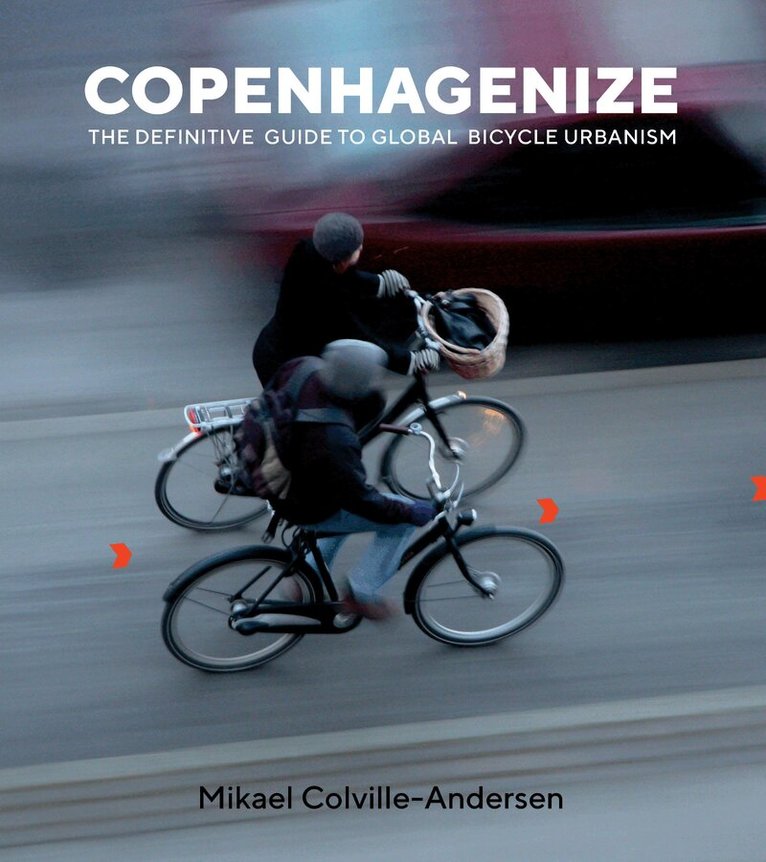
The bicycle enjoyed a starring role in urban history over a century ago, but now it is back, stronger than ever. It is the single most important tool for improving our cities. Designing around it is the most efficient way to make our cities life-sized—to scale cities for humans. It is time to cement the bicycle firmly in the urban narrative in US and global cities. Enter urban designer Mikael Colville-Andersen. He has worked for dozens of global cities on bicycle planning, strategy, infrastructure design, and communication. He is known around the world for his colorful personality and enthusiasm for the role of bike in urban design. In Copenhagenize, he shows cities how to effectively and profitably re-establish the bicycle as a respected, accepted, and feasible form of transportation. Building on his popular blog of the same name, Copenhagenize offers vivid project descriptions, engaging stories, and best practices, alongside beautiful and informative visuals to show how to make the bicycle an easy, preferred part of everyday urban life. Copenhagenize will serve as inspiration for everyone working to get the bicycle back into our cities. It will give planners and designers the ammunition to push back against the Automobile Age and convince the skeptics of the value of the life-sized city. This is not a guide on how to become Copenhagen, but how to learn from the successes and failures (yes, failures) of Copenhagen and other cities around the world that are striving to become more livable. We need to act in order to save our cities—and us—from ourselves. Copenhagenize shows the path forward.

A provocative case for why we must rediscover and adapt proven human-scale solutions to meet the challenges of climate change and social upheavalTechnological innovation is often presented as the answer to every challenge, but many of the solutions we need for the future are not new at all. Drawing on experiences from the COVID-19 pandemic, his years on the ground doing volunteer work in wartime Ukraine, and examples from cities around the globe, urban design expert Mikael Colville-Andersen explores how communities respond when modern systems fail and reveals what they can teach us about building resilient societies in challenging times.Reporting from the front lines of war, climate change, and global pandemic, Colville-Andersen shows how crisis exposes what actually works—and how our future may depend on rediscovering what we already know. From low-tech urban practices that have been forgotten or overlooked to contemporary experiments in some of the world’s most innovative cities, he shares a rich catalogue of proven tactics that can help communities facing climate change, social fragmentation, resource constraints, and growing uncertainty.Through stories of citizen-led initiatives, public-space transformation, and creative approaches to everything from mobility and food security to water management and climate adaptation, Welcome to Analogville offers a hopeful vision of how citizens and cities can become more resilient, adaptable, and human-centered in an increasingly unpredictable world.
The bicycle enjoyed a starring role in urban history over a century ago, but now it is back, stronger than ever. It is the single most important tool for improving our cities. Designing around it is the most efficient way to make our cities life-sized—to scale cities for humans. It is time to cement the bicycle firmly in the urban narrative in US and global cities. Enter urban designer Mikael Colville-Andersen. He has worked for dozens of global cities on bicycle planning, strategy, infrastructure design, and communication. He is known around the world for his colorful personality and enthusiasm for the role of bike in urban design. In Copenhagenize, he shows cities how to effectively and profitably re-establish the bicycle as a respected, accepted, and feasible form of transportation. Building on his popular blog of the same name, Copenhagenize offers vivid project descriptions, engaging stories, and best practices, alongside beautiful and informative visuals to show how to make the bicycle an easy, preferred part of everyday urban life. Copenhagenize will serve as inspiration for everyone working to get the bicycle back into our cities. It will give planners and designers the ammunition to push back against the Automobile Age and convince the skeptics of the value of the life-sized city. This is not a guide on how to become Copenhagen, but how to learn from the successes and failures (yes, failures) of Copenhagen and other cities around the world that are striving to become more livable. We need to act in order to save our cities—and us—from ourselves. Copenhagenize shows the path forward.
A provocative case for why we must rediscover and adapt proven human-scale solutions to meet the challenges of climate change and social upheavalTechnological innovation is often presented as the answer to every challenge, but many of the solutions we need for the future are not new at all. Drawing on experiences from the COVID-19 pandemic, his years on the ground doing volunteer work in wartime Ukraine, and examples from cities around the globe, urban design expert Mikael Colville-Andersen explores how communities respond when modern systems fail and reveals what they can teach us about building resilient societies in challenging times.Reporting from the front lines of war, climate change, and global pandemic, Colville-Andersen shows how crisis exposes what actually works—and how our future may depend on rediscovering what we already know. From low-tech urban practices that have been forgotten or overlooked to contemporary experiments in some of the world’s most innovative cities, he shares a rich catalogue of proven tactics that can help communities facing climate change, social fragmentation, resource constraints, and growing uncertainty.Through stories of citizen-led initiatives, public-space transformation, and creative approaches to everything from mobility and food security to water management and climate adaptation, Welcome to Analogville offers a hopeful vision of how citizens and cities can become more resilient, adaptable, and human-centered in an increasingly unpredictable world.