Mike X Cohen – författare
386 kr
Skickas inom 5-8 vardagar
1 351 kr
Skickas
1 361 kr
Läs direkt efter köp
A comprehensive guide to the conceptual, mathematical, and implementational aspects of analyzing electrical brain signals, including data from MEG, EEG, and LFP recordings.
This book offers a comprehensive guide to the theory and practice of analyzing electrical brain signals. It explains the conceptual, mathematical, and implementational (via Matlab programming) aspects of time-, time-frequency- and synchronization-based analyses of magnetoencephalography (MEG), electroencephalography (EEG), and local field potential (LFP) recordings from humans and nonhuman animals. It is the only book on the topic that covers both the theoretical background and the implementation in language that can be understood by readers without extensive formal training in mathematics, including cognitive scientists, neuroscientists, and psychologists.
Readers who go through the book chapter by chapter and implement the examples in Matlab will develop an understanding of why and how analyses are performed, how to interpret results, what the methodological issues are, and how to perform single-subject-level and group-level analyses. Researchers who are familiar with using automated programs to perform advanced analyses will learn what happens when they click the “analyze now” button.
The book provides sample data and downloadable Matlab code. Each of the 38 chapters covers one analysis topic, and these topics progress from simple to advanced. Most chapters conclude with exercises that further develop the material covered in the chapter. Many of the methods presented (including convolution, the Fourier transform, and Euler''s formula) are fundamental and form the groundwork for other advanced data analysis methods. Readers who master the methods in the book will be well prepared to learn other approaches.
899 kr
Läs direkt efter köp
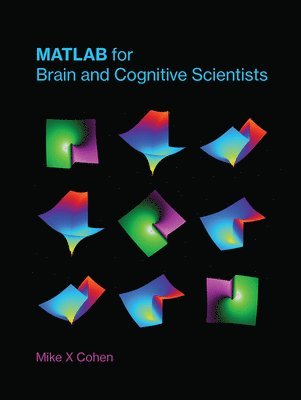
An introduction to a popular programming language for neuroscience research, taking the reader from beginning to intermediate and advanced levels of MATLAB programming.
MATLAB is one of the most popular programming languages for neuroscience and psychology research. Its balance of usability, visualization, and widespread use makes it one of the most powerful tools in a scientist''s toolbox. In this book, Mike Cohen teaches brain scientists how to program in MATLAB, with a focus on applications most commonly used in neuroscience and psychology. Although most MATLAB tutorials will abandon users at the beginner''s level, leaving them to sink or swim, MATLAB for Brain and Cognitive Scientists takes readers from beginning to intermediate and advanced levels of MATLAB programming, helping them gain real expertise in applications that they will use in their work.
The book offers a mix of instructive text and rigorous explanations of MATLAB code along with programming tips and tricks. The goal is to teach the reader how to program data analyses in neuroscience and psychology. Readers will learn not only how to but also how not to program, with examples of bad code that they are invited to correct or improve. Chapters end with exercises that test and develop the skills taught in each chapter. Interviews with neuroscientists and cognitive scientists who have made significant contributions their field using MATLAB appear throughout the book. MATLAB for Brain and Cognitive Scientists is an essential resource for both students and instructors, in the classroom or for independent study.
732 kr
Läs direkt efter köp
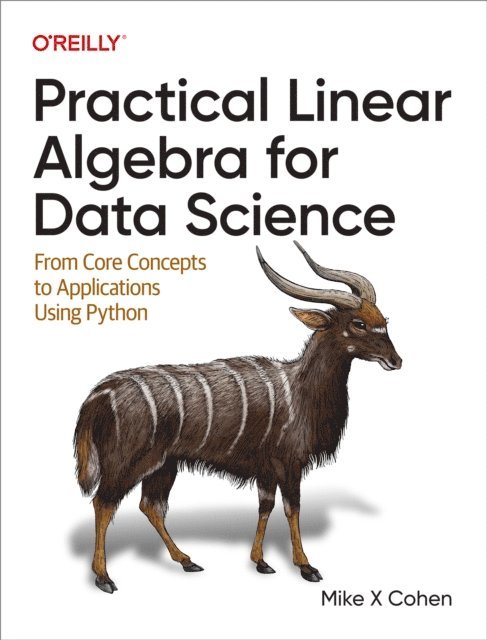
If you want to work in any computational or technical field, you need to understand linear algebra. As the study of matrices and operations acting upon them, linear algebra is the mathematical basis of nearly all algorithms and analyses implemented in computers. But the way it''s presented in decades-old textbooks is much different from how professionals use linear algebra today to solve real-world modern applications.
This practical guide from Mike X Cohen teaches the core concepts of linear algebra as implemented in Python, including how they''re used in data science, machine learning, deep learning, computational simulations, and biomedical data processing applications. Armed with knowledge from this book, you''ll be able to understand, implement, and adapt myriad modern analysis methods and algorithms.
Ideal for practitioners and students using computer technology and algorithms, this book introduces you to:
The interpretations and applications of vectors and matricesMatrix arithmetic (various multiplications and transformations)Independence, rank, and inversesImportant decompositions used in applied linear algebra (including LU and QR)Eigendecomposition and singular value decompositionApplications including least-squares model fitting and principal components analysis734 kr
Läs direkt efter köp
If you want to work in any computational or technical field, you need to understand linear algebra. As the study of matrices and operations acting upon them, linear algebra is the mathematical basis of nearly all algorithms and analyses implemented in computers. But the way it''s presented in decades-old textbooks is much different from how professionals use linear algebra today to solve real-world modern applications.
This practical guide from Mike X Cohen teaches the core concepts of linear algebra as implemented in Python, including how they''re used in data science, machine learning, deep learning, computational simulations, and biomedical data processing applications. Armed with knowledge from this book, you''ll be able to understand, implement, and adapt myriad modern analysis methods and algorithms.
Ideal for practitioners and students using computer technology and algorithms, this book introduces you to:
The interpretations and applications of vectors and matricesMatrix arithmetic (various multiplications and transformations)Independence, rank, and inversesImportant decompositions used in applied linear algebra (including LU and QR)Eigendecomposition and singular value decompositionApplications including least-squares model fitting and principal components analysis596 kr
Skickas inom 5-8 vardagar
457 kr
Läs direkt efter köp
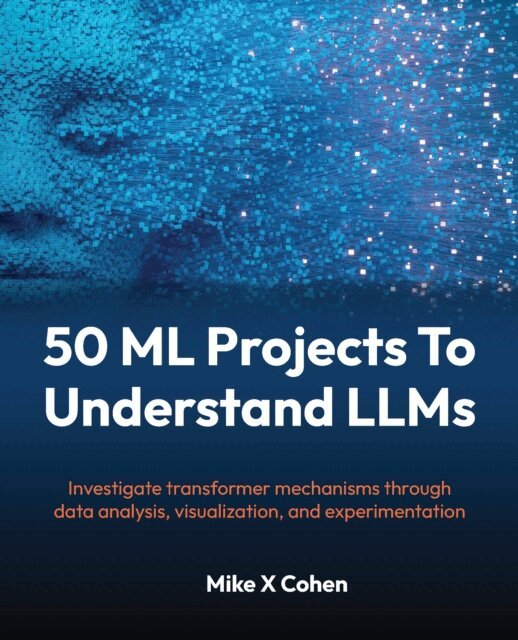
Most books teach you how to build LLMs from scratch or deploy them via APIs. This book uses guided machine learning projects to teach you how to understand, visualize, and investigate LLMs including GPT and BERT.
Key Features
Each project is built around three learning goals: machine learning techniques, LLM mechanisms, and Python coding with data visualization.This is not a dense theoretical textbook; it''s hands-on, practical, and project-oriented.You will learn how to measure, visualize, and manipulate the internal components of LLMs directly.Book Description
Through 50 hands-on, guided projects solved in Python, you will investigate the internal mechanisms of large language models by treating their hidden states, attention patterns, and embeddings as data to analyze. Rather than accepting LLMs as black boxes, you will open them up, examine what''s inside, and run experiments to understand why they behave the way they do. All projects are based on Python (using libraries such as NumPy, PyTorch, statsmodels, scikit-learn, Matplotlib, Pandas, and Seaborn) and come with full solutions and partial solution notebook files, so you can practice and improve your skills in data science, deep learning, data visualization, and scientific and statistical coding.What you will learn
Tokenization schemes and their statistical propertiesEmbedding spaces: cosine similarity, semantic axes, and analogy vectorsOutput logits, softmax distributions, perplexity, and language biasesLayer-by-layer transformer dynamics and dimensionalityAttention mechanisms: QKV weights, attention scores, head ablation, and activation patchingMLP subblocks: neuron tuning, mutual information, subspace analysis, and statistics-based causal manipulationsLogit lens, indirect object identification, and causal tracingWho this book is for
This book is for data scientists, ML engineers, and researchers who want to go beyond surface-level understanding of LLMs. Prior Python experience is required. Familiarity with machine learning or deep learning is helpful but not required — techniques are introduced as they arise throughout the projects.
633 kr
Skickas inom 5-8 vardagar
559 kr
Tillfälligt slut