Mikhail I. Rabinovich - Böcker
Visar alla böcker från författaren Mikhail I. Rabinovich. Handla med fri frakt och snabb leverans.
9 produkter
9 produkter
1 121 kr
Skickas inom 5-8 vardagar
1 064 kr
Skickas inom 10-15 vardagar
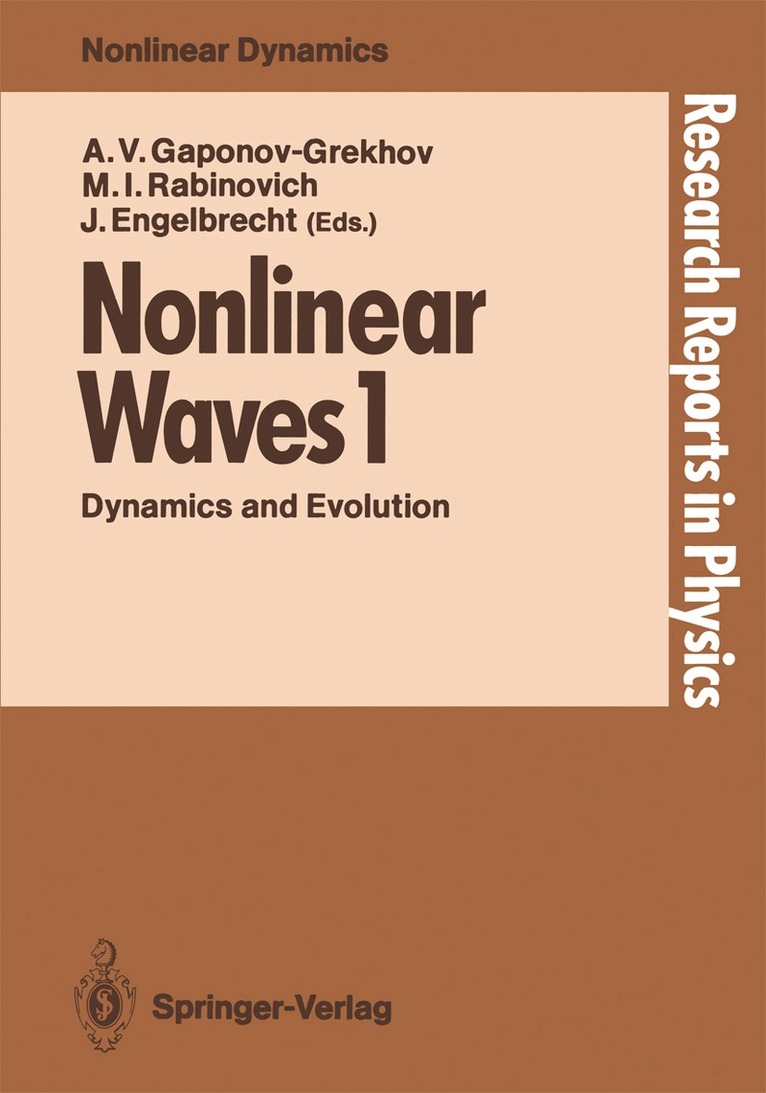
Since 1972 the Schools on Nonlinear Physics in Gorky have been a meeting place for Soviet scientists working in this field. Instead of producing for the first time English proceedings it has been decided to present a good cross section of nonlinear physics in the USSR. Thus the participants at the last School were invited to provide English reviews and research papers for these two volumes (which in the years to come will be followed by the proceedings of forthcoming schools). The first volume starts with a historical overview of nonlinear dynamics from Poincaré to the present day and touches topics like attractors, nonlinear oscillators and waves, turbulence, pattern formation, and dynamics of structures in nonequilibrium dissipative media. It then deals with structures, bistabilities, instabilities, chaos, dynamics of defects in 1d systems, self-organizations, solitons, spatio-temporal structures and wave collapse in optical systems, lasers, plasmas, reaction-diffusion systems and solids.
1 064 kr
Skickas inom 10-15 vardagar
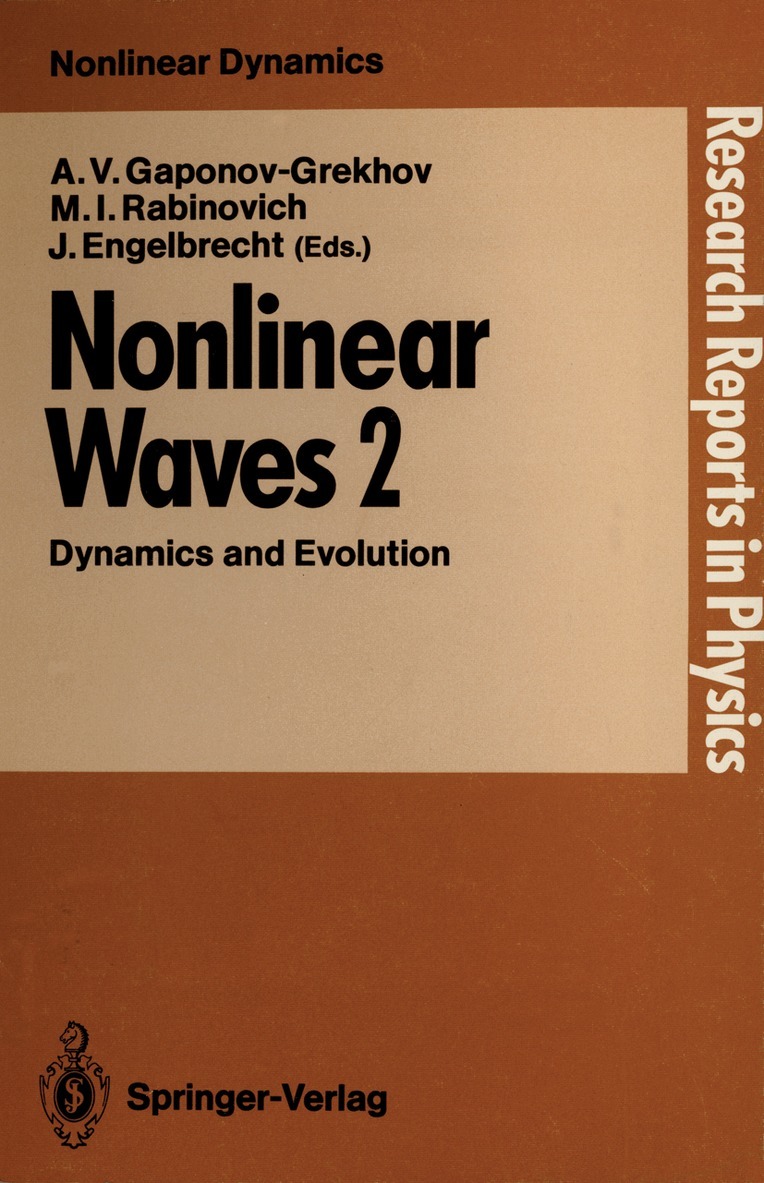
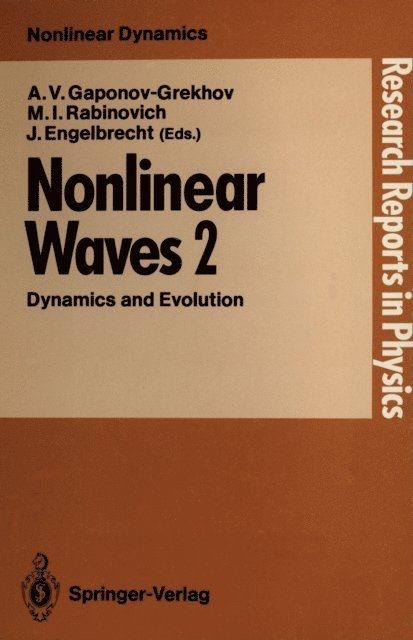
Since 1972 the Schools on Nonlinear Physics in Gorky have been a meeting place for Soviet scientists working in this field. Instead of producing for the first time English proceedings it has been decided to present a good cross section of nonlinear physics in the USSR. Thus the participants at the last School were invited to provide English reviews and research papers for these two volumes (which in the years to come will be followed by the proceedings of forthcoming schools). The second volume deals with dynamical chaos in classical and quantum systems, with evolution in chemical systems and self-organisation in biology, and with applications of nonlinear dynamics to condensed matter, sea waves, and astrophysics.
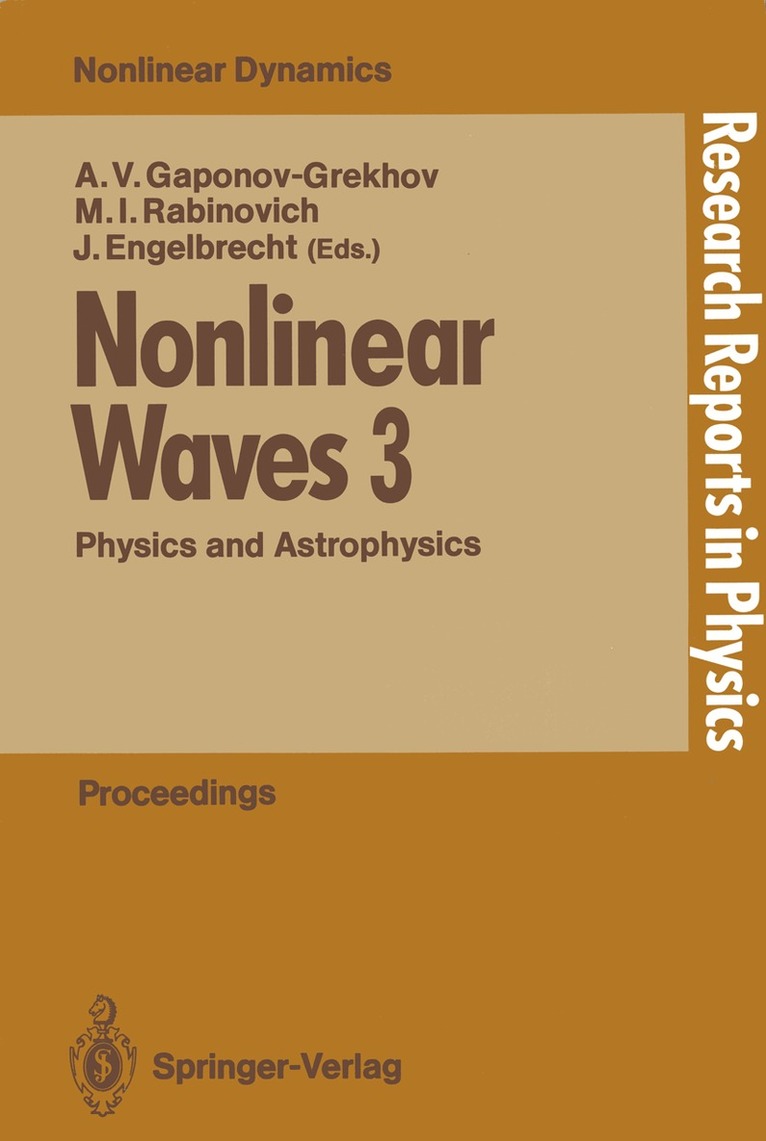
Nonlinear Waves 3
Physics and Astrophysics Proceedings of the Gorky School 1989
Häftad, Engelska, 1990
1 064 kr
Skickas inom 10-15 vardagar
Since 1972 the Schools on Nonlinear Physics in Gorky have been a meeting place for Soviet scientists working in this field. This 3rd volume emerged from material presented at the 1989 School. It contains sections dealing with nonlinear problems in physics and astrophysics, quantum and solid state physics, dynamical chaos and self-organization.
536 kr
Skickas inom 10-15 vardagar
In the dynamics of mankind one can trace out a path of contemplation about the "world", leading from early speculations to today's natural sciences. The endeavour to understand how nature works has led to the construction, still in progress, of an abstract building of great com plexity. To the uninitiated it may look more like a scurrilous sculpture resting on many legs, among them such peculiar ones as probability, relativity, quantum mechanics .... At times problems with the stabil ity of the building or sculpture arise: known facts that won't fit and can no longer be ignored start to undermine the foundations. Then new footings are thought of, constructed and finally cast. In fact, the undermining and casting is often done in one step. This process has already been repeated many times and will un doubtedly repeat itself again and again. At present, one recognizable footing under construction goes by the name of "chaos theory". Physi cists seem to like the word chaos. When they came to recognize that the air is not just empty space but an obviously indescribable dance of myriads of molecules they called that "chaos". What else would fit? In the course of time the name was simplified to "gas". Thus the word chaos became free to serve for the next upsetting experience. That arose in the context of nonlinear dynamical systems, where peculiar motions were detected, ones seemingly beyond human comprehension.
Del 53 - World Scientific Lecture Notes In Physics
Introduction To Nonlinear Dynamics For Physicists
Inbunden, Engelska, 1993
1 135 kr
Tillfälligt slut
This series of lectures aims to address three main questions that anyone interested in the study of nonlinear dynamics should ask and ponder over. What is nonlinear dynamics and how does it differ from linear dynamics which permeates all familiar textbooks? Why should the physicist study nonlinear systems and leave the comfortable territory of linearity? How can one progress in the study of nonlinear systems both in the analysis of these systems and in learning about new systems from observing their experimental behavior? While it is impossible to answer these questions in the finest detail, this series of lectures nonetheless successfully points the way for the interested reader. Other useful problems have also been incorporated as a study guide. By presenting both substantial qualitative information about phenomena in nonlinear systems and at the same time sufficient quantitative material, the author hopes that readers would learn how to progress on their own in the study of such similar material hereon.
Del 53 - World Scientific Lecture Notes In Physics
Introduction To Nonlinear Dynamics For Physicists
Häftad, Engelska, 1993
514 kr
Skickas inom 5-8 vardagar
This series of lectures aims to address three main questions that anyone interested in the study of nonlinear dynamics should ask and ponder over. What is nonlinear dynamics and how does it differ from linear dynamics which permeates all familiar textbooks? Why should the physicist study nonlinear systems and leave the comfortable territory of linearity? How can one progress in the study of nonlinear systems both in the analysis of these systems and in learning about new systems from observing their experimental behavior? While it is impossible to answer these questions in the finest detail, this series of lectures nonetheless successfully points the way for the interested reader. Other useful problems have also been incorporated as a study guide. By presenting both substantial qualitative information about phenomena in nonlinear systems and at the same time sufficient quantitative material, the author hopes that readers would learn how to progress on their own in the study of such similar material hereon.
2 083 kr
Skickas inom 5-8 vardagar
Spirals, vortices, crystalline lattices, and other attractive patterns are prevalent in Nature. How do such beautiful patterns appear from the initial chaos? What universal dynamical rules are responsible for their formation? What is the dynamical origin of spatial disorder in nonequilibrium media? Based on the many visual experiments in physics, hydrodynamics, chemistry, and biology, this invaluable book answers those and related intriguing questions. The mathematical models presented for the dynamical theory of pattern formation are nonlinear partial differential equations. The corresponding theory is not so accessible to a wide audience. Consequently, the authors have made every attempt to synthesize long and complex mathematical calculations to exhibit the underlying physics. The book will be useful for final year undergraduates, but is primarily aimed at graduate students, postdoctoral fellows, and others interested in the puzzling phenomena of pattern formation.
1 066 kr
Tillfälligt slut
Spirals, vortices, crystalline lattices, and other attractive patterns are prevalent in Nature. How do such beautiful patterns appear from the initial chaos? What universal dynamical rules are responsible for their formation? What is the dynamical origin of spatial disorder in nonequilibrium media? Based on the many visual experiments in physics, hydrodynamics, chemistry, and biology, this invaluable book answers those and related intriguing questions. The mathematical models presented for the dynamical theory of pattern formation are nonlinear partial differential equations. The corresponding theory is not so accessible to a wide audience. Consequently, the authors have made every attempt to synthesize long and complex mathematical calculations to exhibit the underlying physics. The book will be useful for final year undergraduates, but is primarily aimed at graduate students, postdoctoral fellows, and others interested in the puzzling phenomena of pattern formation.