Miki Hasegawa – författare
Visar alla böcker från författaren Miki Hasegawa. Handla med fri frakt och snabb leverans.
4 produkter
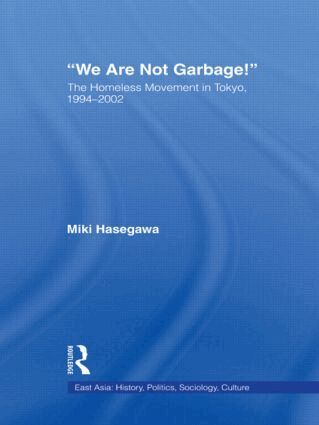
We Are Not Garbage!
The Homeless Movement in Tokyo, 1994-2002
Häftad, 2009
500 kr
Lägg i varukorg
This book offers a full history of a homeless movement in Tokyo that lasted nearly a decade. It shows how homeless people and their external supporters in the city combined their scarce resources to generate and sustain the movement. The study advocates a more nuanced analysis of movement gains to …
We Are Not Garbage!
The Homeless Movement in Tokyo, 1994-2002
Inbunden, 2006
1516 kr
Lägg i varukorg
This book offers a full history of a homeless movement in Tokyo that lasted nearly a decade. It shows how homeless people and their external supporters in the city combined their scarce resources to generate and sustain the movement. The study advocates a more nuanced analysis of movement gains to …
We Are Not Garbage!
The Homeless Movement in Tokyo, 1994-2002
E-bok, 2012
589 kr
Lägg i varukorg
This book offers a full history of a homeless movement in Tokyo that lasted nearly a decade. It shows how homeless people and their external supporters in the city combined their scarce resources to generate and sustain the movement. The study advocates a more nuanced analysis of movement gains to …