Miklos Bodanszky - Böcker
Visar alla böcker från författaren Miklos Bodanszky. Handla med fri frakt och snabb leverans.
6 produkter
6 produkter
2 150 kr
Skickas inom 3-6 vardagar
No detailed description available for "The practice of Peptide Synthesis".
2 150 kr
Skickas inom 3-6 vardagar
No detailed description available for "Principles of Peptide Synthesis".
1 381 kr
Skickas inom 10-15 vardagar
Principles of Peptide Synthesis is a very successful book by one of the pioneers of contemporary bioorganic synthesis. Its first edition proved a valuable source that is kept close to the work bench for frequent consulting. Any researcher planning the formation of the peptide bond, be it for the synthesis of a peptide chain or a cyclic peptide, benefits from the author's experience. The concise and critical treatment of the steps involved: protection, activation and bond formation require careful planning to avoid racemization and undesired side reactions. The second edition has been completely revised and updated. New procedures that have been developed since the first edition was published and that did not fit into the original are added in a separate chapter. This separation of old and new make it possible to assess new ideas and discern novel trends.
800 kr
Skickas inom 10-15 vardagar
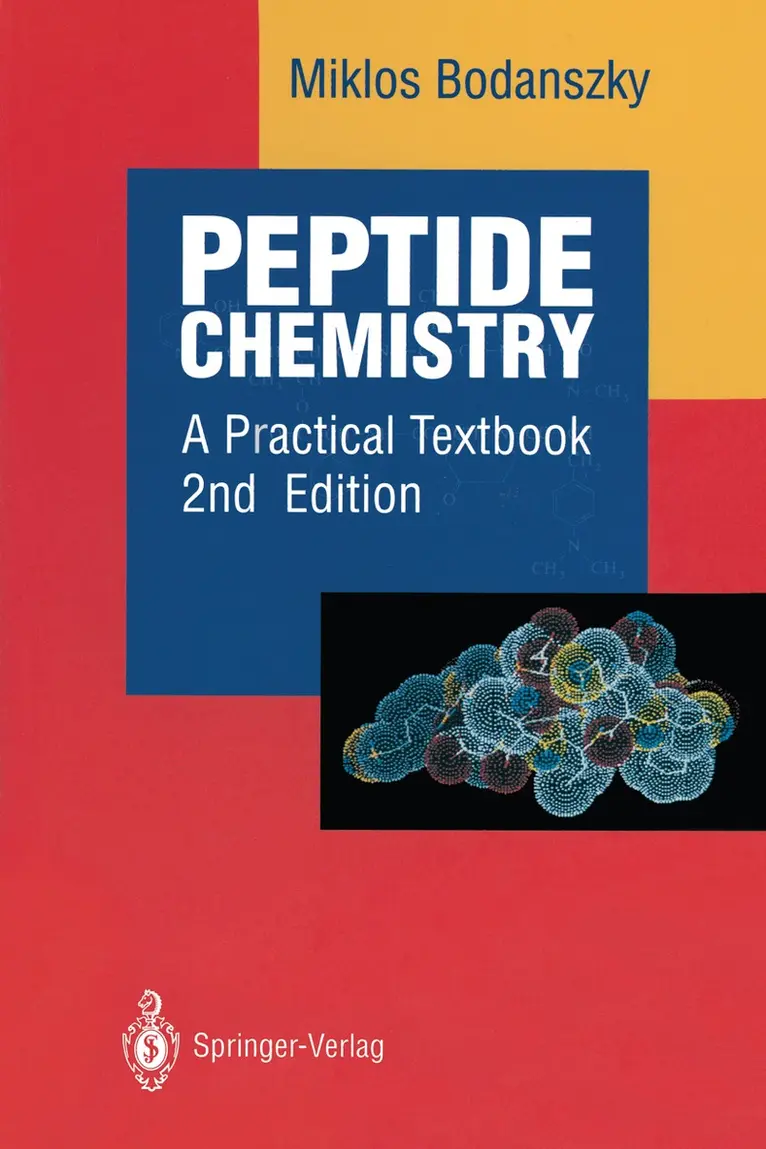
A continued interest in Peptide Chemistry prompted the revision of the first edition of this book. This provided an opportunity to update several details. I am grateful to colleagues who were kind enough to inform me of errors, typographical and other, they had discovered in the first edi tion. These have now been corrected, as were certain shortcomings in language and style pointed out by my daughter, Dr. Eva Bodanszky. In 1991 the excellent The Chemical Synthesis of Peptides by John Jones (Oxford University Press, 1991) appeared. It covers, in part, the same field, but is different enough from Peptide Chemistry, to justify publication of a revised edition of the latter. Princeton, July 1993 M. Bodanszky Preface to the First Edition Nature applied peptides for a great variety of specific functions. The specificity provided by the individual character of each amino acid is further ehanced by the combination of several amino acids into larger molecules. Peptides therefore can act as chemical messengers, neuro transmitters, as highly specific stimulators and inhibitors, regulating var ious life-processes. Entire classes of biologically active compounds, such as the opioid peptides or the gastrointestinal hormones emerged within short periods of time and it is unlikely that the rapid succession of discoveries of important new peptides would come to a sudden halt. In fact, our knowledge of the field is probably still in an early stage of development. Peptides also gained importance in our everyday life.
1 064 kr
Skickas inom 10-15 vardagar
During the years 1980-81, as guests of the Deutsches Wollforschungsinstitut in Aachen, Germany, we were working on a small book entitled, "Principles of Peptide Synthesis". In the library of the Institute we noted that the volumes of Houben-Weyl's Handbuch der Organischen Chemie dealing with peptide synthesis were so much in use that they were ready to fall apart because the researchers of the Institute consulted them with amazing regularity. They were looking for references, but even more for experimental details which could be adapted to the particular problem they happened to face. In planning a new synthetic endeavor they tried to lean on the experience of others in analogous situations. This suggested to us that a smaller and hence more tractable book may be needed, a volume which can be kept on or near the bench to make examples of fundamental methods readily available in the laboratory. Such a collection could save numerous short trips to the library, a point particularly important where a library well equipped with the sources of the literature of peptide synthesis is not near at hand. Also, we thought that the envisaged book may be welcome by those who are more versed in English than in German. To the best of our knowledge no similar publication is available.
1 205 kr
Skickas inom 10-15 vardagar
Almost two centuries ago proteins were recognized as the primary materials (proteios = primary) oflife, but the significance and wide role of peptides (from pepsis = digestion) in practically all life pro cesses has only become apparent in the last few decades. Biologi cally active peptides are now being discovered at rapid intervals in the brain and in other organs including the heart, in the skin of amphibians and many other tissues. Peptides and peptide-like compounds are found among toxins and antibiotics. It is unlikely that this process, an almost explosive broadening of the field, will come to a sudden halt. By now it is obvious that Nature has used the combination of a small to moderate number of amino acids to generate a great variety of agonists with specific and often highly sophisticated functions. Thus, peptide chemistry must be regarded as a discipline in its own right, a major branch of biochemistry, fairly separate from the chemistry of proteins. Because of the important role played by synthesis both in the study and in the practical preparation of peptides, their area can be considered as belonging to bio-organic chemistry as well. The already overwhelming and still increasing body of know ledge renders an account of the history of peptide chemistry more and more difficult. It appears therefore timely to look back, to take stock and to recall the important stages in the development of a new discipline.