Mikolaj Szymanski – författare
Visar alla böcker från författaren Mikolaj Szymanski. Handla med fri frakt och snabb leverans.
5 produkter
Muse at Play
Riddles and Wordplay in Greek and Latin Poetry
Av Jan Kwapisz, David Petrain m. fl.
Inbunden, 2012
1919 kr
Lägg i varukorg
In May 2011, a conference on riddles and word games in Greek and Latin poetry took place at the Institute of Classical Studies of the University of Warsaw. The conference was intended as an open forum where specialists working in different fields of classical studies could meet to discuss the …
Muse at Play
Riddles and Wordplay in Greek and Latin Poetry
Av Mikolaj Szymanski, David Petrain m. fl.
E-bok, 2012
1941 kr
Lägg i varukorg
In May 2011, a conference on riddles and word games in Greek and Latin poetry took place at the Institute of Classical Studies of the University of Warsaw. The conference was intended as an open forum where specialists working in different fields of classical studies could meet to discuss the …
Narses. Politik, Krieg Und Historiographie
Av Dariusz Brodka, Mikolaj Szymański
Inbunden, 2018
874 kr
Lägg i varukorg
Das Buch untersucht die Karriere des Eunuchen Narses und bietet einen Einblick in die Faktoren, die zu seinem politischen Aufstieg beitrugen. Im Fokus der Untersuchung steht sein realer Wirkungskreis, der sich im Laufe vieler Missionen kristallisierte, während er als kaiserlicher Sonderbeauftragter …
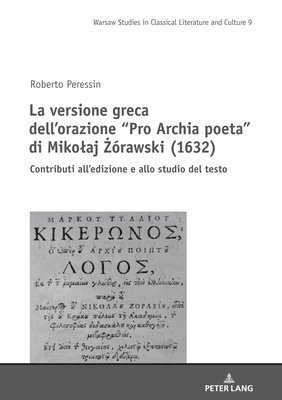
versione greca dell'orazione "Pro Archia poeta" di Mikolaj Żórawski (1632)
Contributi all'edizione e allo studio del testo
Av Roberto Peressin, Mikolaj Szymański
Inbunden, 2020
721 kr
Lägg i varukorg
Nel solco degli studi sul "greco umanistico", che negli ultimi decenni hanno conosciuto un notevole e fervido sviluppo, il volume presenta il caso di una rara traduzione in greco classico della celebre orazione "Pro Archia poeta" di Cicerone. Com’è noto, a partire da Petrarca e per generazioni essa …
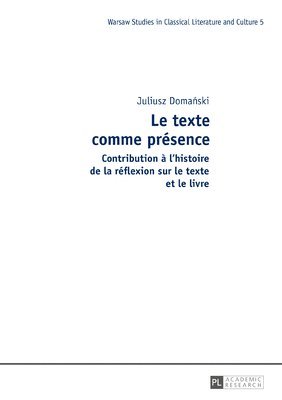
Le Texte Comme Présence
Contribution À l'Histoire de la Réflexion Sur Le Texte Et Le Livre
Av Juliusz Domański, Mikolaj Szymanski
Inbunden, 2017
672 kr
Tillfälligt slut
Commençant par Homère et finissant avec les héritiers de l’humanisme de la Renaissance au XVII e siècle, on suit ici les réflexions sur la puissance particulière des mots écrits, donc du texte. Grâce à sa puissance, il rend effectivement présents pour ses lecteurs tous ceux dont il parle, et qui …