
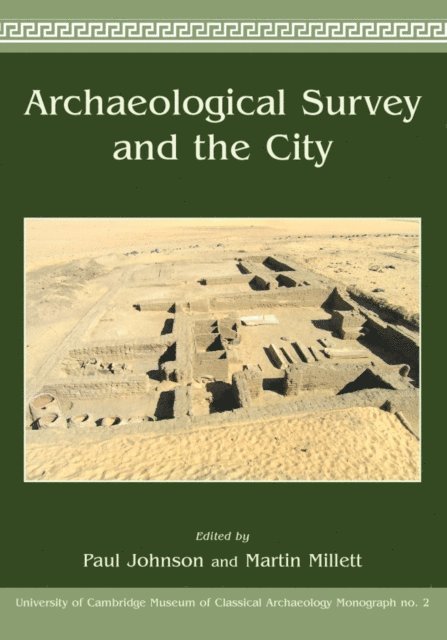
In the past 30 years archaeological field survey has become central to the practice of Classical Archaeology. During this time, approaches have developed from the systematic collection of artefacts to include the routine deployment of various geophysical and remote sensing techniques. The ability of archaeologists to reveal the topography of buried urban sites without excavation has now been demonstrated through a wide range of projects across the ancient world. Archaeological Survey and the City reviews the results of such projects and in particular discusses the ways in which the subject might develop in the future, with an emphasis on the integration of different strands of evidence and issues of archaeological interpretation rather than on the technicalities of particular methodologies. Several themes emerge from the fourteen papers. The first is the increasing number of large-area surveys providing data at a sufficient scale to make a significant contribution to our understanding of classical cities both in the Mediterranean and beyond (eg Baelo Claudia, Caistor-by-Norwich, Xanten, Ammaia). The second theme is the generation of new types of data through the application of specific techniques to address particular questions pertaining to urban life, for instance in identifying particular industrial processes such as metal-working (eg Munigua, Wroxeter) or the increasing success in isolating cemeteries (eg Silchester). The techniques involved in identifying these phenomena complement the use of geochemical survey to characterise particular soil properties related to animal husbandry, cultivation or the creation of domestic waste deposits (eg Faleri Veteres), an area which has considerable future potential. A third theme lies in the application and integration of multiple techniques to provide new dimensions to the information available. The data from a number of survey projects have demonstrated that a single survey technique will rarely, if ever, reveal all of the potential information so there is a significant benefit to be derived from applying multiple survey-strategies to the questions being asked of a site. These themes emphasise the dynamism of research in this area, which continues to revolutionise the study of ancient cities.
Digital reprint of this important collection of papers which form the companion to '' Early Roman Empire in the East'' (Oxbow 1997) . Fourteen contributions examine the interaction of Roman and native peoples in the formative years of the Roman provinces in Italy, Gaul, Spain and Portugal, Germany and Britain. Contents: Introduction ( Thomas Blagg and Martin Millett ); The creation of provincial landscape: the Roman impact on Cisalpine Gaul ( Nicholas Purcell ); Romanization: a point of view ( Richard Reece ); Romanization: historical issues and archaeological interpretation ( Martin Millett ); The romanization of Belgic Gaul ( Colin Haselgrove ); Lower Germany: proto-urban settlement developments and the integration of native society ( J. H. F. Bloemers ); Relations between Roman occupation and the Limesvorland in the province of Germania Inferior ( Jurgen Kunow ); Early Roman military installations and Ubian settlements in the Lower Rhine ( Michael Gechter ); Some observations on acculturation process at the edge of the Roman world ( S. D. Trow ); Processes in the development of the coastal communities of Hispania Citerior in the Republican period ( Simon Keay ); Romanization and urban development in Lusitania ( Jonathan Edmondson ); Urban munificence and the growth of urban consciousness in Roman Spain ( Nicola Mackie ); First-century Roman houses in Gaul and Britain ( T. F. C. Blagg ); Towards an assessment of the economic and social consequences of the Roman conquest of Gaul ( J. F. Drinkwater ); The emergence of Romano-Celtic religion ( Anthony King ).
In the past 30 years archaeological field survey has become central to the practice of Classical Archaeology. During this time, approaches have developed from the systematic collection of artefacts to include the routine deployment of various geophysical and remote sensing techniques. The ability of archaeologists to reveal the topography of buried urban sites without excavation has now been demonstrated through a wide range of projects across the ancient world. Archaeological Survey and the City reviews the results of such projects and in particular discusses the ways in which the subject might develop in the future, with an emphasis on the integration of different strands of evidence and issues of archaeological interpretation rather than on the technicalities of particular methodologies. Several themes emerge from the fourteen papers. The first is the increasing number of large-area surveys providing data at a sufficient scale to make a significant contribution to our understanding of classical cities both in the Mediterranean and beyond (eg Baelo Claudia, Caistor-by-Norwich, Xanten, Ammaia). The second theme is the generation of new types of data through the application of specific techniques to address particular questions pertaining to urban life, for instance in identifying particular industrial processes such as metal-working (eg Munigua, Wroxeter) or the increasing success in isolating cemeteries (eg Silchester). The techniques involved in identifying these phenomena complement the use of geochemical survey to characterise particular soil properties related to animal husbandry, cultivation or the creation of domestic waste deposits (eg Faleri Veteres), an area which has considerable future potential. A third theme lies in the application and integration of multiple techniques to provide new dimensions to the information available. The data from a number of survey projects have demonstrated that a single survey technique will rarely, if ever, reveal all of the potential information so there is a significant benefit to be derived from applying multiple survey-strategies to the questions being asked of a site. These themes emphasise the dynamism of research in this area, which continues to revolutionise the study of ancient cities.
Digital reprint of this important collection of papers which form the companion to '' Early Roman Empire in the East'' (Oxbow 1997) . Fourteen contributions examine the interaction of Roman and native peoples in the formative years of the Roman provinces in Italy, Gaul, Spain and Portugal, Germany and Britain. Contents: Introduction ( Thomas Blagg and Martin Millett ); The creation of provincial landscape: the Roman impact on Cisalpine Gaul ( Nicholas Purcell ); Romanization: a point of view ( Richard Reece ); Romanization: historical issues and archaeological interpretation ( Martin Millett ); The romanization of Belgic Gaul ( Colin Haselgrove ); Lower Germany: proto-urban settlement developments and the integration of native society ( J. H. F. Bloemers ); Relations between Roman occupation and the Limesvorland in the province of Germania Inferior ( Jurgen Kunow ); Early Roman military installations and Ubian settlements in the Lower Rhine ( Michael Gechter ); Some observations on acculturation process at the edge of the Roman world ( S. D. Trow ); Processes in the development of the coastal communities of Hispania Citerior in the Republican period ( Simon Keay ); Romanization and urban development in Lusitania ( Jonathan Edmondson ); Urban munificence and the growth of urban consciousness in Roman Spain ( Nicola Mackie ); First-century Roman houses in Gaul and Britain ( T. F. C. Blagg ); Towards an assessment of the economic and social consequences of the Roman conquest of Gaul ( J. F. Drinkwater ); The emergence of Romano-Celtic religion ( Anthony King ).