Mira Ariel – författare
2 528 kr
Skickas inom 10-15 vardagar
1 323 kr
Skickas inom 7-10 vardagar
1 669 kr
Skickas inom 7-10 vardagar
656 kr
Skickas inom 7-10 vardagar
458 kr
Skickas inom 7-10 vardagar
804 kr
Skickas inom 10-15 vardagar
849 kr
Läs direkt efter köp
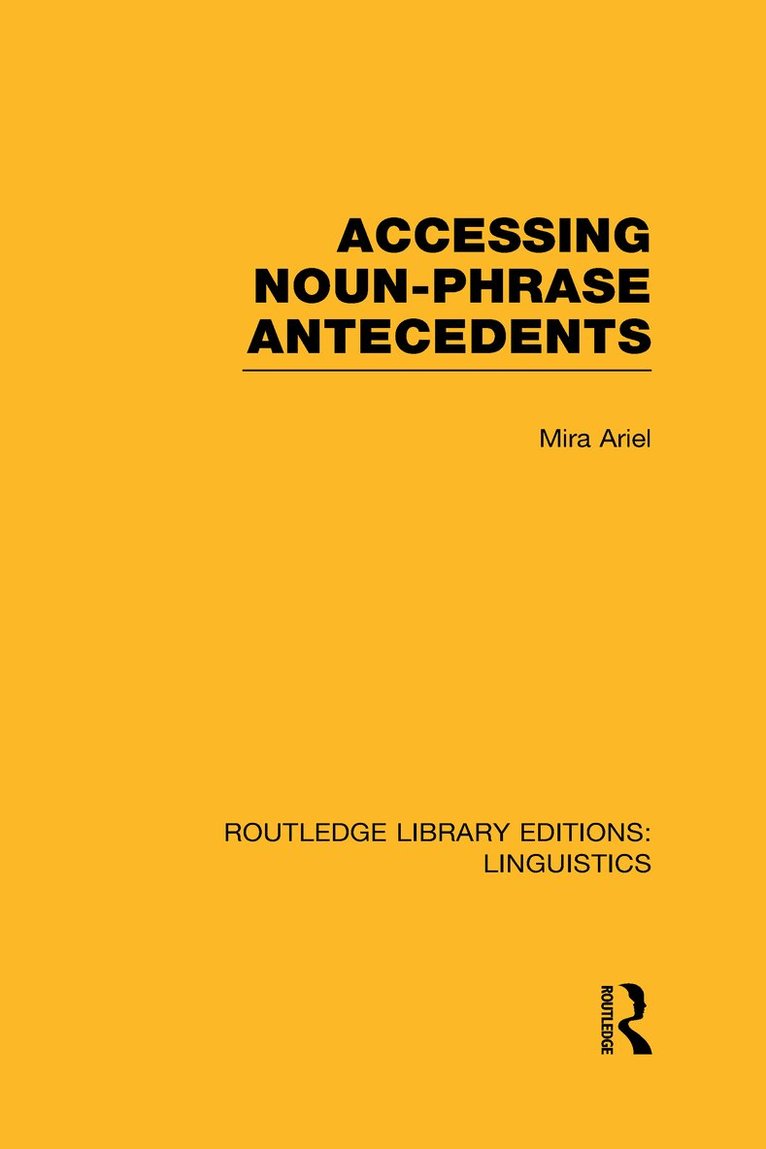
Accessing Noun-Phrase Antecedents offers a radical shift in the analysis of discourse anaphora, from a purely pragmatic account to a cognitive account, in terms of processing procedures. Mira Ariel defines referring expressions as markers signalling the degree of Accessibility in memory of the antecedent. The notion of Accessibility is explicitly defined, the crucial factors being the Salience of the antecedent, and the Unity between the antecedent and the anaphor.
This analysis yields an astonishing array of new results. The precise distribution of referring expressions in actual discourse is directly predicted. Several universals of anaphoric relations are stated. Thus, although not all languages necessarily have the same markers, and nor do they assign them precisely the same function, Ariel shows that they all obey the same Accessibility marking hierarchy.
This book will be compulsory reading for anyone with an interest in the semantics and pragmatics of referring expressions, in the interaction of semantics and pragmatics, and more generally in the interaction between peripheral and central cognitive systems.
849 kr
Läs direkt efter köp
Accessing Noun-Phrase Antecedents offers a radical shift in the analysis of discourse anaphora, from a purely pragmatic account to a cognitive account, in terms of processing procedures. Mira Ariel defines referring expressions as markers signalling the degree of Accessibility in memory of the antecedent. The notion of Accessibility is explicitly defined, the crucial factors being the Salience of the antecedent, and the Unity between the antecedent and the anaphor.
This analysis yields an astonishing array of new results. The precise distribution of referring expressions in actual discourse is directly predicted. Several universals of anaphoric relations are stated. Thus, although not all languages necessarily have the same markers, and nor do they assign them precisely the same function, Ariel shows that they all obey the same Accessibility marking hierarchy.
This book will be compulsory reading for anyone with an interest in the semantics and pragmatics of referring expressions, in the interaction of semantics and pragmatics, and more generally in the interaction between peripheral and central cognitive systems.