Miroslav Hudec – författare
Visar alla böcker från författaren Miroslav Hudec. Handla med fri frakt och snabb leverans.
5 produkter
5 produkter
Inbunden, Engelska, 2025
1 742 kr
Skickas inom 10-15 vardagar
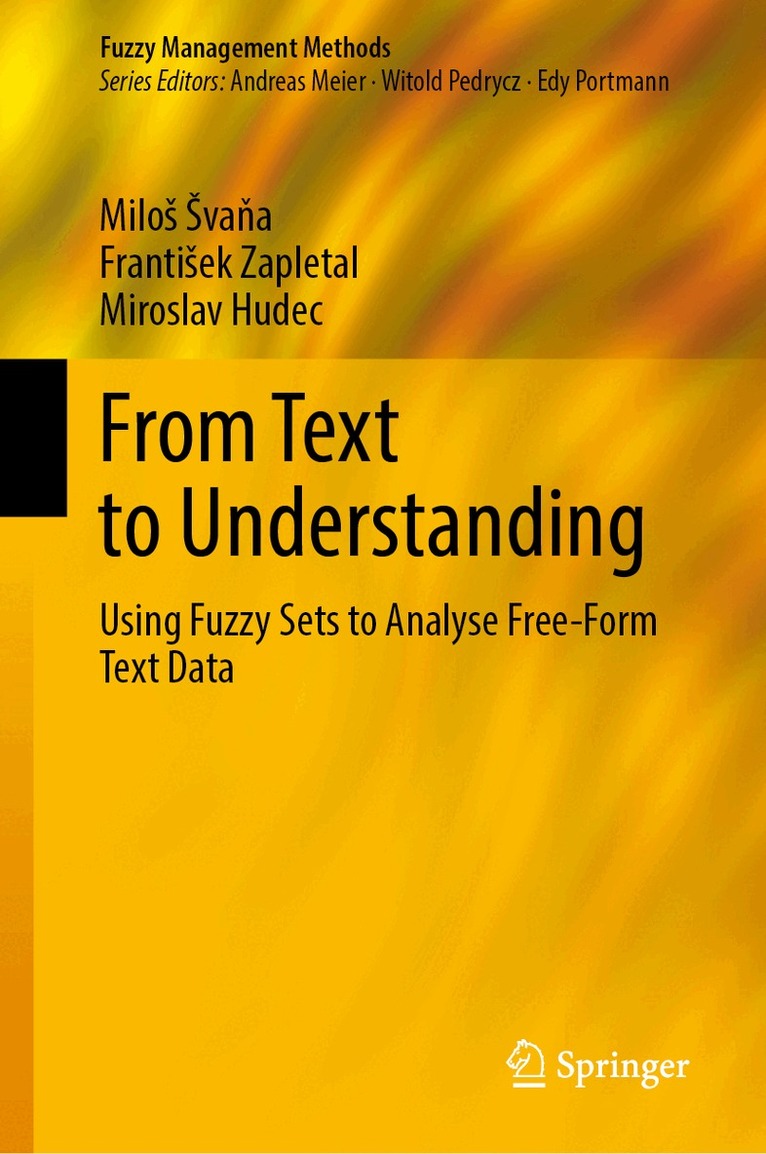
Social media and other sources of text data are still underutilized resources in public decision-making. Most public organizations and governmental bodies rely mainly only surveys, interviews and other traditional methods for gathering opinions. One issues is a lack of easy-to-use tools for mass text data processing that would enable these organizations to process and understand this type of data.This book introduces a novel text data analysis framework designed for public decision making, specifically on the level of municipalities. The framework combines sentiment analysis with topic modelling and a fuzzy-based approach for capturing the diversity in sentiment arising from the fact that different people have different opinions on a given topic.The book is recommended for practitioners in public decision making as well as researchers analyzing large amounts of text data in order to understand people’s opinions.
E-bok
Engelska, 20252 149 kr
Läs direkt efter köp
Social media and other sources of text data are still underutilized resources in public decision-making. Most public organizations and governmental bodies rely mainly only surveys, interviews and other traditional methods for gathering opinions. One issues is a lack of easy-to-use tools for mass text data processing that would enable these organizations to process and understand this type of data.This book introduces a novel text data analysis framework designed for public decision making, specifically on the level of municipalities. The framework combines sentiment analysis with topic modelling and a fuzzy-based approach for capturing the diversity in sentiment arising from the fact that different people have different opinions on a given topic.The book is recommended for practitioners in public decision making as well as researchers analyzing large amounts of text data in order to understand people’s opinions.
Inbunden, Engelska, 2016
1 124 kr
Skickas inom 10-15 vardagar
This book is an essential contribution to the description of fuzziness in information systems. Usually users want to retrieve data or summarized information from a database and are interested in classifying it or building rule-based systems on it. But they are often not aware of the nature of this data and/or are unable to determine clear search criteria. The book examines theoretical and practical approaches to fuzziness in information systems based on statistical data related to territorial units.Chapter 1 discusses the theory of fuzzy sets and fuzzy logic to enable readers to understand the information presented in the book. Chapter 2 is devoted to flexible queries and includes issues like constructing fuzzy sets for query conditions, and aggregation operators for commutative and non-commutative conditions, while Chapter 3 focuses on linguistic summaries. Chapter 4 presents fuzzy logic control architecture adjusted specifically for the aims of business and governmental agencies, and shows fuzzy rules and procedures for solving inference tasks. Chapter 5 covers the fuzzification of classical relational databases with an emphasis on storing fuzzy data in classical relational databases in such a way that existing data and normal forms are not affected. This book also examines practical aspects of user-friendly interfaces for storing, updating, querying and summarizing. Lastly, Chapter 6 briefly discusses possible integration of fuzzy queries, summarization and inference related to crisp and fuzzy databases. The main target audience of the book is researchers and students working in the fields of data analysis, database design and business intelligence. As it does not go too deeply into the foundation and mathematical theory of fuzzy logic and relational algebra, it is also of interest to advanced professionals developing tailored applications based on fuzzy sets.
E-bok
PDF, Engelska, 20161 408 kr
Läs direkt efter köp
This book is an essential contribution to the description of fuzziness in information systems. Usually users want to retrieve data or summarized information from a database and are interested in classifying it or building rule-based systems on it. But they are often not aware of the nature of this data and/or are unable to determine clear search criteria. The book examines theoretical and practical approaches to fuzziness in information systems based on statistical data related to territorial units.Chapter 1 discusses the theory of fuzzy sets and fuzzy logic to enable readers to understand the information presented in the book. Chapter 2 is devoted to flexible queries and includes issues like constructing fuzzy sets for query conditions, and aggregation operators for commutative and non-commutative conditions, while Chapter 3 focuses on linguistic summaries. Chapter 4 presents fuzzy logic control architecture adjusted specifically for the aims of business and governmental agencies, and shows fuzzy rules and procedures for solving inference tasks. Chapter 5 covers the fuzzification of classical relational databases with an emphasis on storing fuzzy data in classical relational databases in such a way that existing data and normal forms are not affected. This book also examines practical aspects of user-friendly interfaces for storing, updating, querying and summarizing. Lastly, Chapter 6 briefly discusses possible integration of fuzzy queries, summarization and inference related to crisp and fuzzy databases. The main target audience of the book is researchers and students working in the fields of data analysis, database design and business intelligence. As it does not go too deeply into the foundation and mathematical theory of fuzzy logic and relational algebra, it is also of interest to advanced professionals developing tailored applications based on fuzzy sets.
Häftad, Engelska, 2018
1 124 kr
Skickas inom 10-15 vardagar
This book is an essential contribution to the description of fuzziness in information systems. Usually users want to retrieve data or summarized information from a database and are interested in classifying it or building rule-based systems on it. But they are often not aware of the nature of this data and/or are unable to determine clear search criteria. The book examines theoretical and practical approaches to fuzziness in information systems based on statistical data related to territorial units.Chapter 1 discusses the theory of fuzzy sets and fuzzy logic to enable readers to understand the information presented in the book. Chapter 2 is devoted to flexible queries and includes issues like constructing fuzzy sets for query conditions, and aggregation operators for commutative and non-commutative conditions, while Chapter 3 focuses on linguistic summaries. Chapter 4 presents fuzzy logic control architecture adjusted specifically for the aims of business and governmental agencies, and shows fuzzy rules and procedures for solving inference tasks. Chapter 5 covers the fuzzification of classical relational databases with an emphasis on storing fuzzy data in classical relational databases in such a way that existing data and normal forms are not affected. This book also examines practical aspects of user-friendly interfaces for storing, updating, querying and summarizing. Lastly, Chapter 6 briefly discusses possible integration of fuzzy queries, summarization and inference related to crisp and fuzzy databases. The main target audience of the book is researchers and students working in the fields of data analysis, database design and business intelligence. As it does not go too deeply into the foundation and mathematical theory of fuzzy logic and relational algebra, it is also of interest to advanced professionals developing tailored applications based on fuzzy sets.