Miroslav N. Jovanovic - Böcker
Visar alla böcker från författaren Miroslav N. Jovanovic. Handla med fri frakt och snabb leverans.
10 produkter
10 produkter
13 509 kr
Tillfälligt slut
This set of contemporary articles provides a uniquely comprehensive survey of international economic integration, covering the full range of theoretical and practical developments in the field over the past fifty years, and suggesting directions for future research. Topics covered in the 120 articles selected include:* the theory and measurement of international integration* monetary aspects and factor mobility* competition and industrial policy* regional policy and location of firms* agriculture* integration schemes.This set will prove an invaluable standard reference for researchers and students of international economics.
4 464 kr
Skickas inom 7-10 vardagar
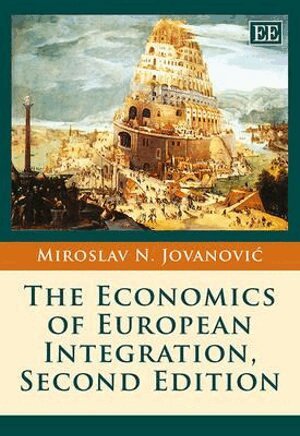
Thoroughly revised and updated, the second edition of this highly acclaimed textbook will be required reading for graduate and undergraduate students on a wide range of courses including: European economics, economic policy, European integration, European studies and international relations. Exploring the EU at an important turning point and during uncertain and turbulent times, the text will also prove an invaluable reference tool for academics and policy makers concerned with any facet of European integration.Comprehensive and accessible, this far-reaching text:- provides in-depth, state-of-the-art analysis of the origins, achievements and prospects of principal EU economic policies- covers all EU member countries as well as candidate countries- sets scenarios for future EU policy and organizational evolution- prescribes possible paths and directions for the EU, not only for economic policies but also for organizational structure;- features supplementary data via a companion website.Topics explored in detail include: EU budget, competition policy, Common Agricultural Policy, fiscal integration, monetary integration, industrial policy in manufacturing and services, trade policy and international economic cooperation, regional policy, social policy, mobility of labour, energy policy, transport policy, environment policy and enlargement.Contents: Preface and Introduction 1. Origin, Evolution and Prospects for the European Union 2. Budget of the European Union 3. Competition Policy 4. Common Agricultural Policy 5. Fiscal Integration 6. European Monetary Integration 7. Industrial Policy in Manufacturing and Services 8. Trade Policy and International Economic Cooperation 9. Regional Policy 10. Social Policy 11. Mobility of Labour 12. Energy Policy 13. Transport Policy 14. Environment Policy 15. Enlargement 16. Conclusions Bibliography Index
3 084 kr
Skickas inom 7-10 vardagar
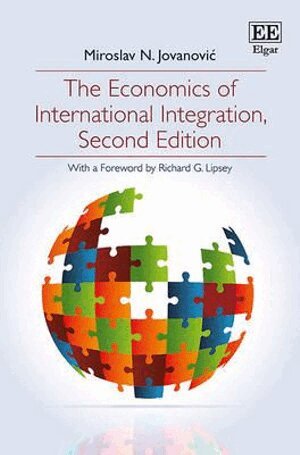
In this comprehensive second edition of The Economics of International Integration, Miroslav N. Jovanovi examines the theory of international economic integration and explores the existing and emerging international integration agreements, their achievements, problems and prospects. One of the most important issues in international economics today concerns the dissipating multilateral trading system and the proliferation of a number of trading blocs and arrangements. This has been particularly the case after the establishment of the World Trade Organization in 1995 and especially during the Doha Round (2001-13).This book takes on those and other important new issues such as integration through spatially fragmented production, and the operation of supply chains. The author argues that international economic integration deals are here to stay, and evolve with variable successes in spite of advantages offered by the multilateral trading system. Jovanovi 's second edition includes up-to-date surveys of economic integration and their agreements, criticism of the eurozone and speculation on the future of integration.This thoroughly revised second edition provides a broad understanding of international economic integration and its complexities, and will be of great interest to students and scholars of international economics, development economics, policy and international business.
840 kr
Skickas inom 7-10 vardagar
Thoroughly revised and updated, the second edition of this highly acclaimed textbook will be required reading for graduate and undergraduate students on a wide range of courses including: European economics, economic policy, European integration, European studies and international relations. Exploring the EU at an important turning point and during uncertain and turbulent times, the text will also prove an invaluable reference tool for academics and policy makers concerned with any facet of European integration.Comprehensive and accessible, this far-reaching text:- provides in-depth, state-of-the-art analysis of the origins, achievements and prospects of principal EU economic policies- covers all EU member countries as well as candidate countries- sets scenarios for future EU policy and organizational evolution- prescribes possible paths and directions for the EU, not only for economic policies but also for organizational structure;- features supplementary data via a companion website.Topics explored in detail include: EU budget, competition policy, Common Agricultural Policy, fiscal integration, monetary integration, industrial policy in manufacturing and services, trade policy and international economic cooperation, regional policy, social policy, mobility of labour, energy policy, transport policy, environment policy and enlargement.Contents: Preface and Introduction 1. Origin, Evolution and Prospects for the European Union 2. Budget of the European Union 3. Competition Policy 4. Common Agricultural Policy 5. Fiscal Integration 6. European Monetary Integration 7. Industrial Policy in Manufacturing and Services 8. Trade Policy and International Economic Cooperation 9. Regional Policy 10. Social Policy 11. Mobility of Labour 12. Energy Policy 13. Transport Policy 14. Environment Policy 15. Enlargement 16. Conclusions Bibliography Index
865 kr
Skickas inom 7-10 vardagar
In this comprehensive second edition of The Economics of International Integration, Miroslav N. Jovanovi examines the theory of international economic integration and explores the existing and emerging international integration agreements, their achievements, problems and prospects. One of the most important issues in international economics today concerns the dissipating multilateral trading system and the proliferation of a number of trading blocs and arrangements. This has been particularly the case after the establishment of the World Trade Organization in 1995 and especially during the Doha Round (2001-13).This book takes on those and other important new issues such as integration through spatially fragmented production, and the operation of supply chains. The author argues that international economic integration deals are here to stay, and evolve with variable successes in spite of advantages offered by the multilateral trading system. Jovanovi 's second edition includes up-to-date surveys of economic integration and their agreements, criticism of the eurozone and speculation on the future of integration.This thoroughly revised second edition provides a broad understanding of international economic integration and its complexities, and will be of great interest to students and scholars of international economics, development economics, policy and international business.
Evolutionary Spatial Economics
Understanding Economic Geography and Location Over Time
Inbunden, Engelska, 2020
3 317 kr
Skickas inom 7-10 vardagar
Technological progress and economic policies have enabled many economic activities to become highly mobile. A crucial question in contemporary economics therefore concerns where they will locate and relocate themselves in the future. This comprehensive, innovative book applies an evolutionary framework to spatial economics, arguing against the prevailing neoclassical equilibrium model and providing important theoretical and concrete insights.Throughout this book, Miroslav N. Jovanovic uses evolutionary concepts to analyse the behaviour of a multitude of players in the economic arena, from individuals to firms, institutions and industries, considering the ways in which they act, react, interact, adapt and change over time. Jovanovic begins with a thorough exploration of the theory underpinning his arguments and the history of the subject. Chapters then apply these concepts to an examination of current topics, including the supply chain economy, market structures, globalisation, international firms and regional policies, creating a strong argument for the importance and utility of an evolutionary model and illuminating areas of future enquiry.This book will be crucial reading for students and scholars working in economic geography, international economics and development, business studies and management. Policymakers will also appreciate its insights into recent developments and relevant policy suggestions.
Del 212 - The International Library of Critical Writings in Economics series
Economic Integration and Spatial Location of Firms and Industries
Inbunden, Engelska, 2007
15 573 kr
Skickas inom 7-10 vardagar
Progress in technology and moves towards a liberal economic policy have caused a number of economic activities to become highly mobile. This raises important questions regarding the future location of economic activity: where will firms locate or relocate and how will firms and industries fit into space that is influenced by economic integration? Through his selection of key previously published articles, Professor Jovanovic aims to provide a survey of the theoretical foundations of spatial location of firms and industries, and to explore the impact of economic integration on this process. Economic Integration and Spatial Location of Firms and Industries will be essential reading for scholars, theorists, policymakers and business executives, who face these new challenges to the economy now and in the future.
International Handbook on the Economics of Integration, Volume I
General Issues and Regional Groups
Inbunden, Engelska, 2011
3 716 kr
Skickas inom 7-10 vardagar
With this Handbook, Miroslav Jovanovic has provided readers with both an excellent stand-alone original reference book as well as the first volume in a comprehensive three-volume set. This introduction into a rich and expanding academic and practical world of international economic integration also provides a theoretical and analytical framework to the reader, presenting select analytical studies and encouraging further research. International Handbook on the Economics of Integration, Volume I covers two broad themes: general integration issues and regional integration groups. The first part discusses topics that range from an overview of the regional integration deals registered with the World Trade Organization, to multilateralism and regionalism, hub-and-spoke integration networks, limits to integration, rules of origin, and globalization. The second part of the Handbook is devoted to an outline of the principal integration arrangements in Europe, the Mediterranean, North and Latin America, East Asia and sub-Saharan Africa, as well as economic integration efforts throughout the Arab world. Contributors to this major reference work include eminent authors, some of whom contributed to the creation of economic integration theory from the outset. The authors not only survey the literature, but also present their own arguments and new ideas in order to offer a new perspective, as well as discussing the issues they believe are essential in the field. Each of the insightful chapters is approachable not only to graduate students, scholars, researchers and policymakers, but also to advanced undergraduate students.
International Handbook on the Economics of Integration, Volume II
Competition, Spatial Location of Economic Activity and Financial Issues
Inbunden, Engelska, 2011
3 932 kr
Skickas inom 7-10 vardagar
With this Handbook, Miroslav Jovanovic has provided readers with both an excellent stand-alone original reference book as well as an integral part of a comprehensive three-volume set. This introduction into a rich and expanding academic and practical world of international economic integration also provides a theoretical and analytical framework to the reader, presenting select analytical studies and encouraging further research. International Handbook on the Economics of Integration, Volume II covers three broad themes: competition, spatial location of economic activity and financial issues. With 20 chapters written by 34 eminent authors, this comprehensive Handbook begins by examining competition and industrial policies from a European perspective. It goes on to discuss the geography of production looking at the spatial (locational) effects of economic integration from various theoretical, regional and practical angles. The third and final part of the Handbook analyses monetary issues linked with economic integration at both the European and global level, as well as fiscal matters dealing with tax competition, taxation puzzles and a review of European experiences. Contributors to this major reference work include eminent authors, some of whom contributed to the creation of economic integration theory from the outset. The authors not only survey the literature, but also present their own arguments and new ideas in order to offer a new perspective, as well as discussing the issues they believe are essential in the field. Each of the insightful chapters is approachable not only to graduate students, scholars, researchers and policymakers, but also to advanced undergraduate students.
International Handbook on the Economics of Integration, Volume III
Factor Mobility, Agriculture, Environment and Quantitative Studies
Inbunden, Engelska, 2011
3 466 kr
Skickas inom 7-10 vardagar
With this Handbook, Miroslav Jovanovic has provided readers with both an excellent stand-alone original reference book as well as an integral part of a comprehensive three-volume set. This introduction into a rich and expanding academic and practical world of international economic integration also provides a theoretical and analytical framework to the reader, presenting select analytical studies and encouraging further research. International Handbook on the Economics of Integration, Volume III covers three broad themes: factor mobility (transnational corporations and labour migration); agriculture and environment; and quantitative studies of integration effects. A removal of barriers for the mobility of factors in certain integration arrangements among countries has an impact on the mobility of capital, firms and individuals within the group. Various aspects of this factor mobility are analysed in eight detailed chapters. The second theme of the Handbook is devoted to agriculture and environment. This is of great global relevance as the Common Agricultural Policy of the EU has been a bone of contention in international relations over several decades. Finally, seven quantitative studies of the effects of integration attempt to measure various potential benefits of regional integration efforts. Contributors to this major reference work include eminent authors, some of whom contributed to the creation of economic integration theory from the outset. The authors not only survey the literature, but also present their own arguments and new ideas in order to offer a new perspective, as well as discussing the issues they believe are essential in the field. Each of the insightful chapters is approachable not only to graduate students, scholars, researchers and policymakers, but also to advanced undergraduate students.