Mohammed R. Milad – Författare
Visar alla böcker från författaren Mohammed R. Milad. Handla med fri frakt och snabb leverans.
4 produkter
4 produkter
1 110 kr
Skickas inom 5-8 vardagar
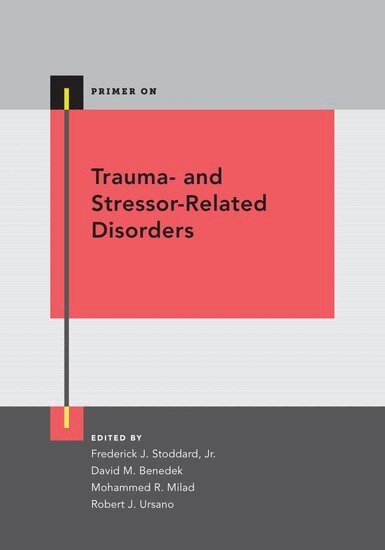
Trauma, stress, and manmade and natural disasters are increasingly impacting individuals and communities. The clinical and scientific advances presented here strive to address the rapidly expanding individual and community burden of disease resulting from the experience of traumatic or stressful events. The authors describe the suffering which trauma- and stressor-related disorders (TSRDs) cause, and explain in 30 concise chapters the state of the science for the DSM-5 trauma- and stressor-related disorders with regard to pathogenesis, diagnostic assessment and approach to treatment. This volume presents the genetic, neurochemical, developmental, and psychological foundations and epidemiology of the trauma- and stressor-related disorders, in addition to specific guidance on screening and evaluation, diagnosis, prevention, and biological, psychological and social treatments. The chapters in this book cover a variety of TSRDs: posttraumatic stress disorder, acute stress disorder, adjustment disorders, persistent complex bereavement disorder, and reactive attachment and disinhibited social engagement disordersd. Graphics, including neuroimaging are integrated for easy reference and to aid grasping of key concepts. The book draws on the current literature and provides brief case scenarios from individuals and families exposed to psychological or physical traumas, including mass trauma events. Factors contributing to susceptibility to these disorders and to resilience are also addressed.Trauma- and Stressor-Related Disorders provides an in-depth yet succinct introduction to current clinical and research knowledge for trainees and for professionals including psychotherapeutic, psychopharmacological, public health, and policy interventions. It addresses the level of evidence for different best practices to target the disabling cognitive, emotional or behavioral symptoms for a specific patient or population.
Del 64 - Current Topics in Behavioral Neurosciences
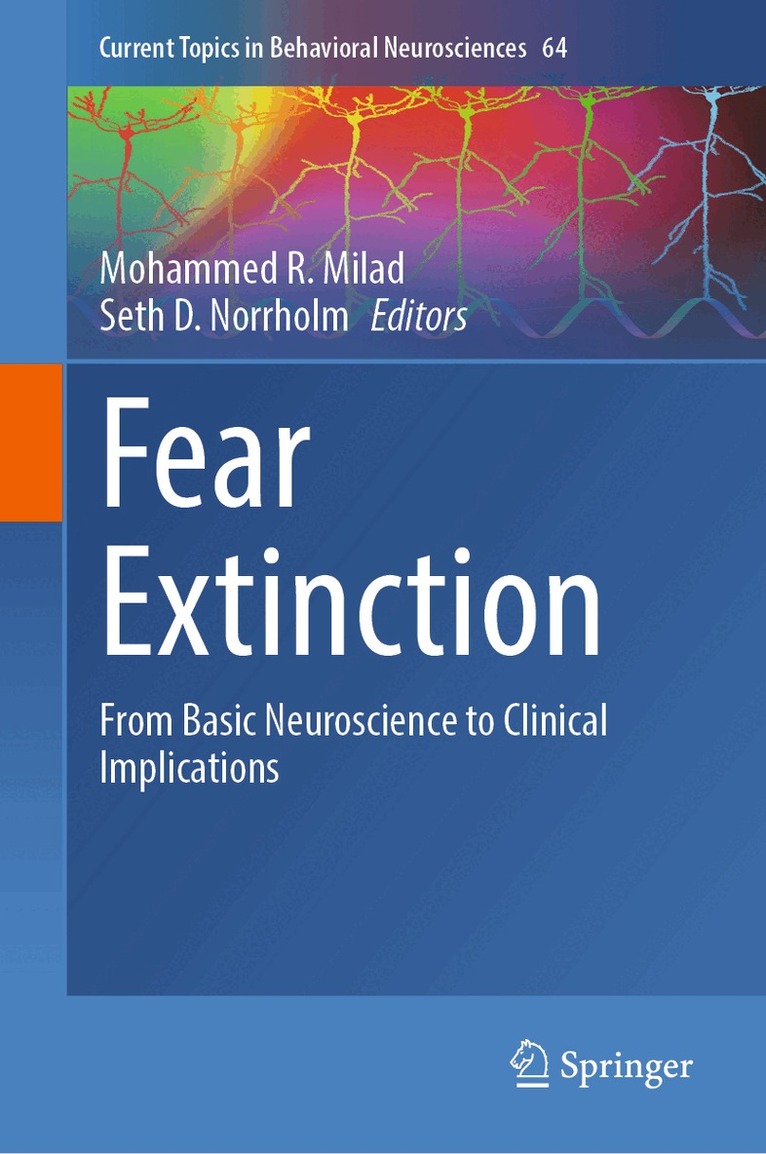
Fear Extinction
From Basic Neuroscience to Clinical Implications
Inbunden, Engelska, 2023
1 963 kr
Skickas inom 10-15 vardagar
This book aims to provide the reader a neuroscientific understanding surrounding a very simple question: how do we learn not to fear? Exploring answers to this question is very important for two reasons. First, learning about the neural mechanisms of fear extinction is of relevance to everyone’s life - it is such a basic yet relevant question to our daily experiences. Therefore, understanding brain mechanisms of fear and its regulation is essential from a basic neuroscience point of view. Second, excessive fear and the inability to regulate its expression is one of the hallmarks of fear-, anxiety-, trauma-, and stressor-related psychopathologies. And as such, learning about how fear is acquired, stored, expressed, and regulated could help advance our understanding of the etiology of psychopathology, the maintenance of symptoms pertaining to failure to regulate fear, and could help us develop novel therapeutics to equip providers and patients with the tools to better quell their fears.The contributions contained in this book are provided by experts in the fields of basic and clinical neuroscience, experimental and clinical psychology, and neuropsychiatry. The contributions are organized to start the reader with basic definitions of how we define fear, how we study its neural circuits at the molecular and cellular levels, how to study human behavior and the brain using state-of-the art experimental and statistical tools, to how much fear contributes to psychopathology. This volume ends with current advances aimed to enhance the capacity to extinguish fear; a clinical result that would aid in the treatment of multiple psychiatric disorders, followed by a discussion on future directions of this highly important and relevant field.
Del 64 - Current Topics in Behavioral Neurosciences
Fear Extinction
From Basic Neuroscience to Clinical Implications
Häftad, Engelska, 2024
1 963 kr
Skickas inom 10-15 vardagar
This book aims to provide the reader a neuroscientific understanding surrounding a very simple question: how do we learn not to fear? Exploring answers to this question is very important for two reasons. First, learning about the neural mechanisms of fear extinction is of relevance to everyone’s life - it is such a basic yet relevant question to our daily experiences. Therefore, understanding brain mechanisms of fear and its regulation is essential from a basic neuroscience point of view. Second, excessive fear and the inability to regulate its expression is one of the hallmarks of fear-, anxiety-, trauma-, and stressor-related psychopathologies. And as such, learning about how fear is acquired, stored, expressed, and regulated could help advance our understanding of the etiology of psychopathology, the maintenance of symptoms pertaining to failure to regulate fear, and could help us develop novel therapeutics to equip providers and patients with the tools to better quell their fears.The contributions contained in this book are provided by experts in the fields of basic and clinical neuroscience, experimental and clinical psychology, and neuropsychiatry. The contributions are organized to start the reader with basic definitions of how we define fear, how we study its neural circuits at the molecular and cellular levels, how to study human behavior and the brain using state-of-the art experimental and statistical tools, to how much fear contributes to psychopathology. This volume ends with current advances aimed to enhance the capacity to extinguish fear; a clinical result that would aid in the treatment of multiple psychiatric disorders, followed by a discussion on future directions of this highly important and relevant field.
Del 73 - Current Topics in Behavioral Neurosciences
New Discoveries in the Brain Sciences of Fear and Anxiety - From Basic to Clinical Neuroscience
Inbunden, Engelska, 2025
2 180 kr
Skickas inom 10-15 vardagar
This book focuses on the latest neuroscience findings about the neurobiology of fear and anxiety. Fear is a highly conserved and evolutionarily adaptive response to threats in the environment. Decades of research have identified the basic underlying neurocircuitry of fear and cutting-edge methods used in both animal models and humans continue to refine and shape our understanding of fear. While fear, when expressed in the appropriate context, is adaptive, excessive responses to threatening cues and contexts and anxiety are maladaptive. Fear-based disorders and anxiety disorders are highly prevalent and impairing. These disorders often begin in childhood, highlighting the importance of genetics, early environment, and risk factors. The contributors to this book are international experts in behavioral neuroscience, cognitive neuroscience, clinical neuroscience, psychiatry and psychology. Collectively, they provide diverse perspectives on the neurobiology of fear and anxiety. The invited contributions are organized to provide a critical review of the recent advances in the neuroscience research and will span the continuum from basic to clinical neuroscience with representation across species, development, and disorders. The sections of this book will a) review the basic mechanisms underlying fear and anxiety, b) describe the factors that contribute to anxiety, including developmental stage, risk factors, sex differences, and genetics, c) elucidate how treatments work and describe novel treatments, and d) demonstrate the role of anxiety in other disorders including autism, substance use disorders, and schizophrenia. This critical and comprehensive collection of chapters will provide a review on the neuroscience of fear and anxiety that will be highly relevant for both scientists and clinicians interested in the brain mechanisms and associated psychopathologies related to fear and anxiety.