Monica L. Wright - Böcker
Visar alla böcker från författaren Monica L. Wright. Handla med fri frakt och snabb leverans.
5 produkter
5 produkter
Del 10 - Penn State Romance Studies
Weaving Narrative
Clothing in Twelfth-Century French Romance
Inbunden, Engelska, 2010
1 119 kr
Skickas inom 5-8 vardagar
Enide's tattered dress and Erec's fabulous coronation robe; Yvain's nudity in the forest that prevents maidens who know him well clothed from identifying him; Lanval's fairy-lady parading about in the Arthurian court, scantily dressed, for all to observe: just why is clothing so important in twelfth-century French romance? This interdisciplinary book explores how writers of this era used clothing as a signifier with multiple meanings for many narrative purposes. Clothing figured prominently in twelfth-century France, where exotic fabrics and furs came to define a social elite. Monica Wright shows that representations of clothing are not mere embellishments to the text; they help form the textual weave of the romances in which they appear. This book is about how these descriptions are constructed, what they mean, and how clothing becomes an active part of romance composition: the ways in which writers use it to develop and elaborate character, to advance or stall the plot, and to structure the narrative generally.
Del 10 - Penn State Romance Studies
Weaving Narrative
Clothing in Twelfth-Century French Romance
Häftad, Engelska, 2010
501 kr
Skickas inom 7-10 vardagar
Enide's tattered dress and Erec's fabulous coronation robe; Yvain's nudity in the forest that prevents maidens who know him well clothed from identifying him; Lanval's fairy-lady parading about in the Arthurian court, scantily dressed, for all to observe: just why is clothing so important in twelfth-century French romance? This interdisciplinary book explores how writers of this era used clothing as a signifier with multiple meanings for many narrative purposes. Clothing figured prominently in twelfth-century France, where exotic fabrics and furs came to define a social elite. Monica Wright shows that representations of clothing are not mere embellishments to the text; they help form the textual weave of the romances in which they appear. This book is about how these descriptions are constructed, what they mean, and how clothing becomes an active part of romance composition: the ways in which writers use it to develop and elaborate character, to advance or stall the plot, and to structure the narrative generally.
818 kr
Skickas inom 7-10 vardagar
The best new research on medieval clothing and textiles, drawing from a variety of angles and approaches.The essays in this volume continue the Journal's tradition of groundbreaking interdisciplinary work. The volume opens with a survey of the discipline of medieval clothing and textiles, written by founding editor Gale R. Owen-Crocker. The range of the other essays extends chronologically from the early Middle Ages through the fifteenth century and covers a variety of disciplines. Topics include the conception of the author as a "wordweaver" in the literatures of Anglo-Saxon England; intertextual literary identities established through clothing in the Nibelungenlied and the Völsunga Saga; the historical record of clothing and textiles at the court of King John of England; medallion silks, their use in Western Europe, and their representation in art; the vestments of Beguines and other penitential movements in the thirteenth and fourteenth centuries; and a depiction of heraldic textile weaving inlate-medieval art.Contributors: Tina Anderlini, Joanne W. Anderson, Maren Clegg Hyer, Alejandra Concha Sahli, Gale R. Owen-Crocker, Elizabeth M. Swedo, Hugh Thomas
818 kr
Skickas inom 7-10 vardagar
The best new research on medieval clothing and textiles, drawing from a range of disciplines.Following the Journal's tradition of drawing on a range of disciplines, the essays here also extend chronologically from the tenth through the sixteenth century and cover a wide geography: from Scandinavia to Spain, with stops in England and the Low Countries. They include an examination of the lexical items for banners in Beowulf, evidence of the use of curved template for the composition in the Bayeux Tapestry, a discussion of medieval cultivation of hemp for use in textiles in Sweden, a reading of the character of Lady Mede (Piers Plowman) in the context of costume history, the historical context of the Spanish verdugados (in English, the farthingale)and its use as political propaganda, an analysis of the sartorial imagery on a tabletop painting (attributed to Bosch) depicting the Seven Deadly Sins, and the reconstruction of one of the sixteenth-century London Livery companies' crowns.
Del 378 - Faux Titre
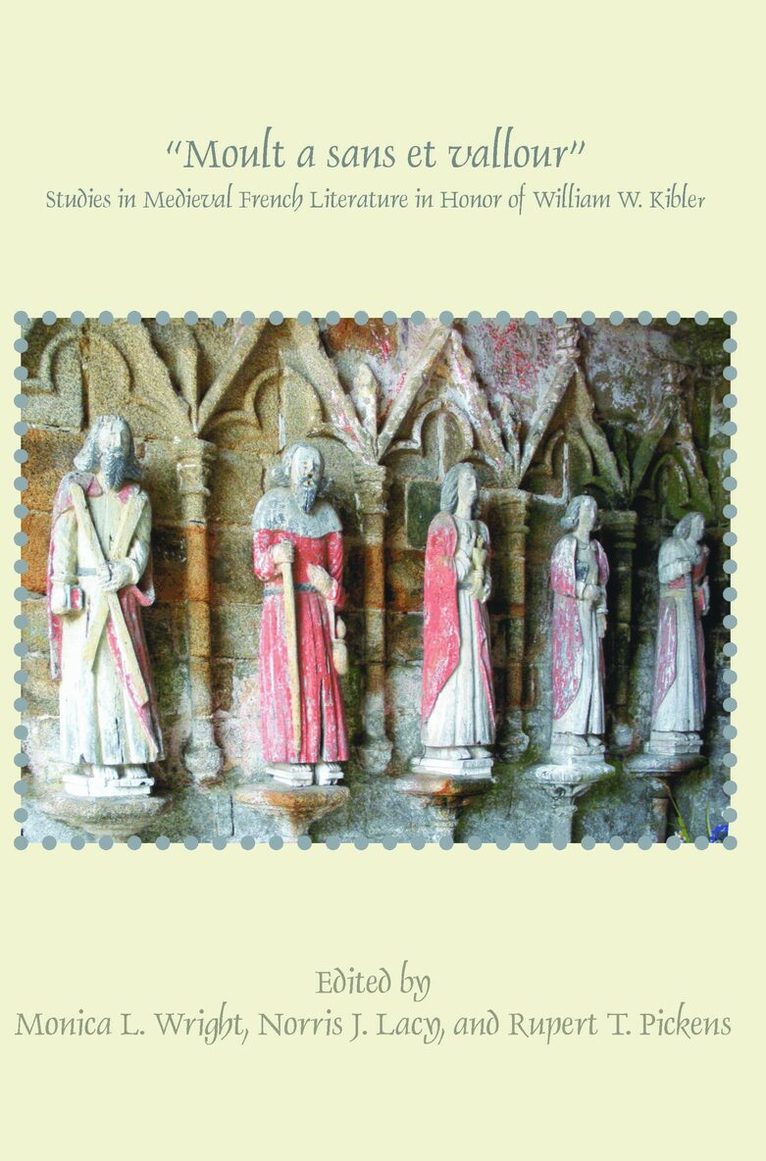
"Moult a sans et vallour"
Studies in Medieval French Literature in Honor of William W. Kibler
Häftad, Engelska, 2012
2 676 kr
Skickas inom 5-8 vardagar
William W. Kibler is one of the most productive and versatile medievalists of his generation. Some scholars and students think of him primarily as a specialist in the medieval epic, whereas others consider him to be an Arthurian scholar. He is of course both, but he is also much more: a consummate philologist and editor of texts and also a prolific and accomplished translator. Above all, those who know him best know him as an extraordinarily generous and modest man. The present volume represents an effort by thirty medievalists, specialists in fields as diverse as William Kibler’s interests, to indicate our respect for him, aptly described in the foreword as “scholar, teacher, friend.”