
Mori Junko Mori – författare
Visar alla böcker från författaren Mori Junko Mori. Handla med fri frakt och snabb leverans.
2 produkter
2 produkter
E-bok
Engelska, 20181 258 kr
Läs direkt efter köp
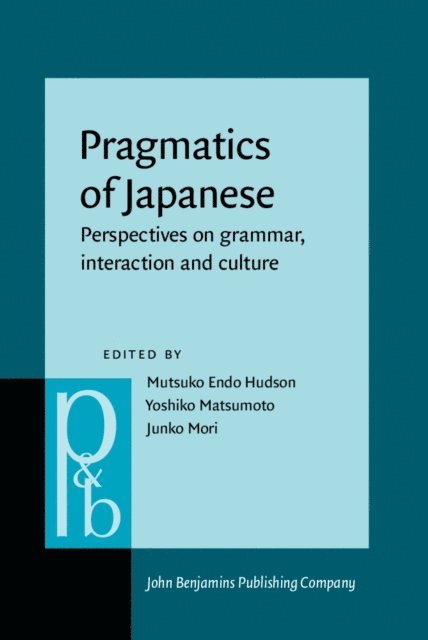
Bringing together the latest studies on Japanese pragmatics, this edited volume showcases the breadth of research conducted in this ever-expanding, interdisciplinary field, with the introductory chapter providing a useful summary of developments in the field in the past decades. The twelve chapters address a variety of traditional and emerging topics by adopting diverse theoretical and methodological frameworks and presenting a range of perspectives on grammar, interaction and culture. They demonstrate a wide scope of pragmatics research informed by, as well as informing, usage-based grammar, cognitive linguistics, conversation analysis, sociolinguistics, linguistic anthropology, and literary and cultural studies. Chapters also consider future directions as to how the study of Japanese language in use will continue to offer critical data and analyses to the field dominated by the study of English and other European languages. This volume is certain to be of interest to students and scholars engaged in pragmatics in general and the Japanese language in particular.

E-bok
PDF, Engelska, 19991 418 kr
Läs direkt efter köp
On the basis of the meticulous transcription/observation process of ‘Conversation Analysis’, this book observes recurrent patterns in sequences where Japanese speakers negotiate agreement and disagreement. It contributes to the growing body of research on ‘interaction and grammar’ by examining how linguistic recourses are utilized for constructing turns and anticipating the upcoming course of interaction. More specifically, it focuses on the recurrent use of two structurally different types of connective expressions: clause-initial connectives and clause-final connective particles. The study examines the occurrences of these causal and contrastive markers with reference to their sequential environment and the resulting interaction. While the introductory chapters situate this approach in the current literature, the main analytical chapters investigate the ways in which ‘delivery of agreement’, ‘delivery of disagreement’, and ‘pursuit for agreement’ are performed with the use of the different types of connective expressions. As one of the earliest conversation analytic studies of Japanese, this book also addresses methodological issues concerning cross-linguistic, cross-cultural studies of human interaction.