Murat Kunt - Böcker
Visar alla böcker från författaren Murat Kunt. Handla med fri frakt och snabb leverans.
3 produkter
3 produkter
2 101 kr
Skickas inom 10-15 vardagar
In recent years there has been an increasing interest in second generation image and video coding techniques. These techniques introduce new concepts from image analysis that greatly improve the performance of the coding schemes for very high compression. This interest has been further emphasized by the future MPEG 4 standard. Second generation image and video coding techniques are the ensemble of approaches proposing new and more efficient image representations than the conventional canonical form. As a consequence, the human visual system becomes a fundamental part of the encoding/decoding chain. More insight to distinguish between first and second generation can be gained if it is noticed that image and video coding is basically carried out in two steps. First, image data are converted into a sequence of messages and, second, code words are assigned to the messages. Methods of the first generation put the emphasis on the second step, whereas methods of the second generation put it on the first step and use available results for the second step.As a result of including the human visual system, second generation can be also seen as an approach of seeing the image composed by different entities called objects. This implies that the image or sequence of images have first to be analyzed and/or segmented in order to find the entities. It is in this context that the book presents three main approaches as second generation video coding techniques: segmentation-based schemes; nobel based schemes; and fractal based schemes.
2 101 kr
Skickas inom 10-15 vardagar
In recent years there has been an increasing interest in Second Generation Image and Video Coding Techniques. These techniques introduce new concepts from image analysis that greatly improve the performance of the coding schemes for very high compression. This interest has been further emphasized by the future MPEG 4 standard. Second generation image and video coding techniques are the ensemble of approaches proposing new and more efficient image representations than the conventional canonical form. As a consequence, the human visual system becomes a fundamental part of the encoding/decoding chain. More insight to distinguish between first and second generation can be gained if it is noticed that image and video coding is basically carried out in two steps. First, image data are converted into a sequence of messages and, second, code words are assigned to the messages. Methods of the first generation put the emphasis on the second step, whereas methods of the second generation put it on the first step and use available results for the second step. As a result of including the human visual system, second generation can be also seen as an approach of seeing the image composed by different entities called objects. This implies that the image or sequence of images have first to be analyzed and/or segmented in order to find the entities. It is in this context that we have selected in this book three main approaches as second generation video coding techniques: Segmentation-based schemes Model Based Schemes Fractal Based Schemes £/LIST£ Video Coding: The Second Generation Approach is an important introduction to the new coding techniques for video. As such, all researchers, students and practitioners working in image processing will find this book of interest.
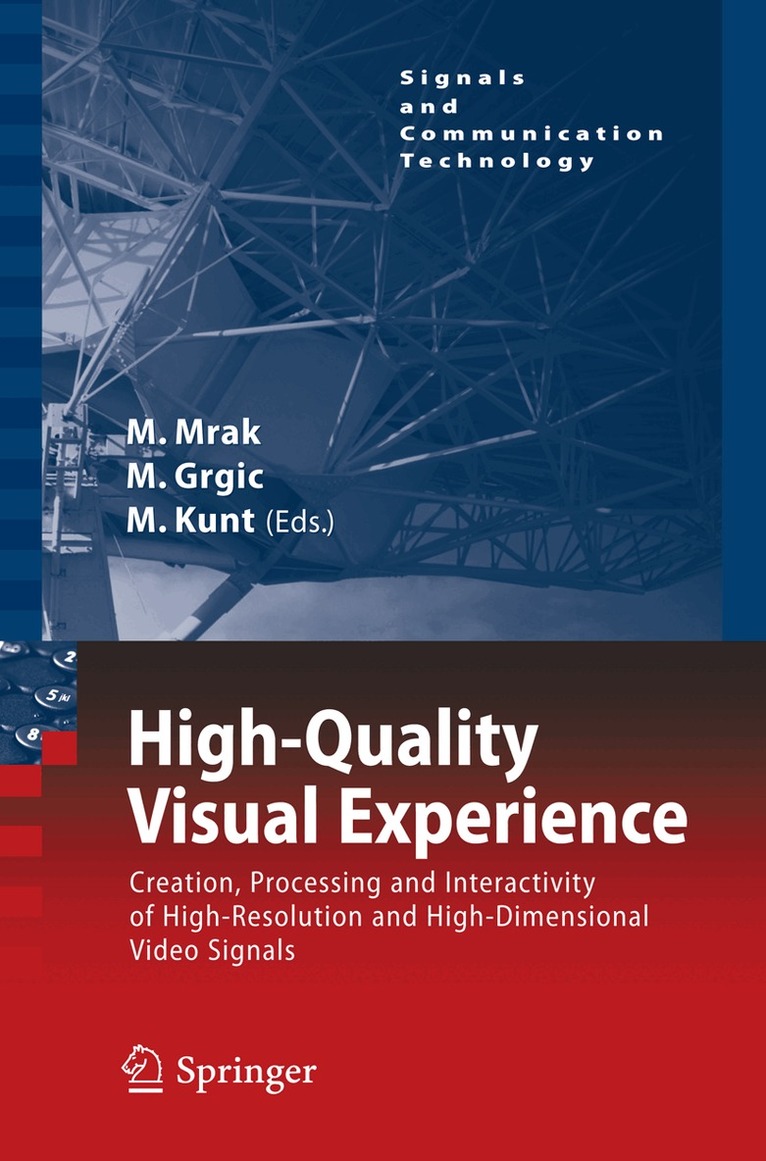
High-Quality Visual Experience
Creation, Processing and Interactivity of High-Resolution and High-Dimensional Video Signals
Häftad, Engelska, 2016
2 160 kr
Skickas inom 10-15 vardagar
Last few years have seen rapid acceptance of high-definition television (HDTV) technology around the world. This technology has been hugely successful in delivering more realistic television experience at home and accurate imaging for professional applications. Adoption of high definition continues to grow as consumers demand enhanced features and greater quality of content.Following this trend, natural evolution of visualisation technologies will be in the direction of fully realistic visual experience and highly precise imaging. However, using the content of even higher resolution and quality is not straightforward as such videos require significantly higher access bandwidth and more processing power. Therefore, methods for radical reduction of video bandwidth are crucial for realisation of high visual quality. Moreover, it is desirable to look into other ways of accessing visual content, solution to which lies in innovative schemes for content delivery and consumption.This book presents selected chapters covering technologies that will enable greater flexibility in video content representation and allow users to access content from any device and to interact with it.