Musgrave – författare
Visar alla böcker från författaren Musgrave. Handla med fri frakt och snabb leverans.
2 produkter
2 produkter
Häftad, Engelska, 2000
764 kr
Skickas inom 5-8 vardagar
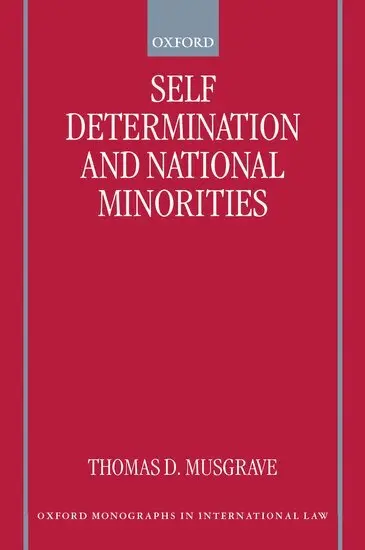
The concept of self-determination has played a very important role in the shaping of the international community in the nineteenth and twentieth centuries. It is closely linked in a number of different ways to the status of minorities and minorities frequently make claims to self-determination as a right for themselves. This meticulously researched book explores the relationship between self-determination and minority rights in international law. It is highly detailed in its treatment of the subject, discussing very recent events, such as the atrocities in the former Yugoslavia, in a valuable historical context. His analysis of the issues provide the reader with a significant clarification of the legal issues involved, especially since the establishment of the UN and the development of international norms of human rights. As such, the book will hold particular appeal for all those who are interested in international law and politics, as well as students of modern history wishing to be informed on this hotly debated issue.
Inbunden, Engelska, 1994
2 230 kr
Skickas inom 10-15 vardagar
This book was prepared mainly for specialists on the assumption that it would provide the background to an important neglected field of discussion in public finance. Since it was first published in 1958, the theory of public goods and its implications for public policy have become incorporated in the main body of the economic analysis of public finance in the literature. A glance at the footnotes of some of the standard textbooks on public finance indicates that this assembly of articles has not been in vain. Probably the most influential part of this collection has been the papers concerned with the theory of public expenditure, which contains two closely related elements. The first is as a part of welfare economics: under what conditions can Pareto optimality be achieved in an economic system in which some goods supplied are indivisible? The other strand of thought is concerned with the positive theory of the public sector: how can economic analysis be used in order to explain how the size and composition of the budget is actually determined?