N. Mukunda - Böcker
Visar alla böcker från författaren N. Mukunda. Handla med fri frakt och snabb leverans.
5 produkter
5 produkter
Del 29 - Fundamental Theories of Physics
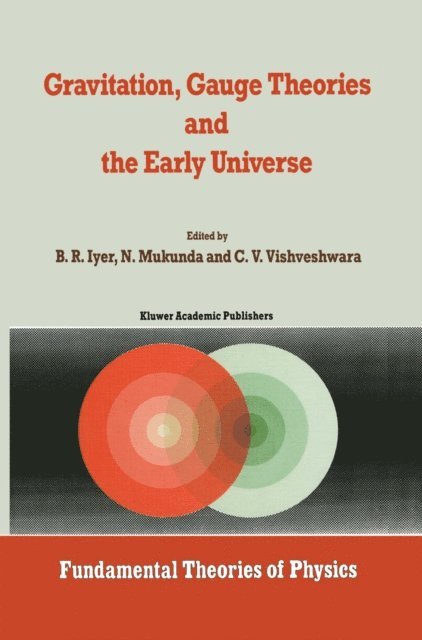
Gravitation, Gauge Theories and the Early Universe
Inbunden, Engelska, 1989
3 178 kr
Skickas inom 10-15 vardagar
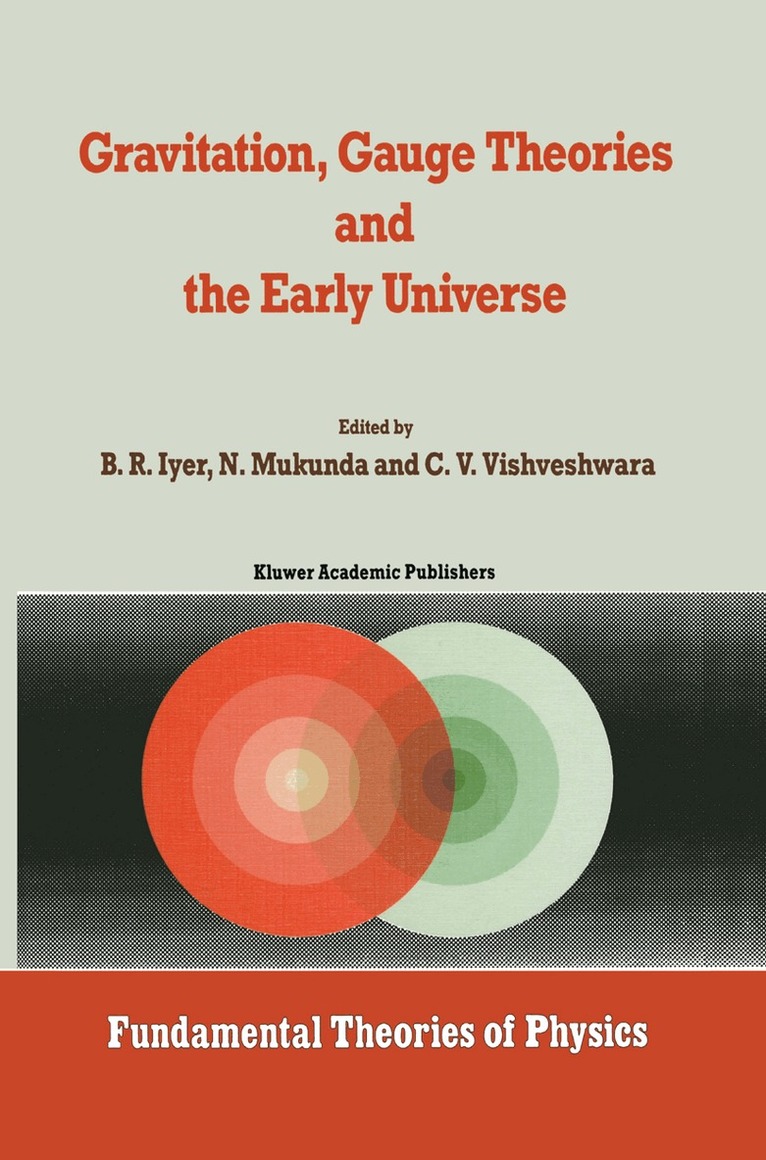
This book evolved out of some one hundred lectures given by twenty experts at a special instructional conference sponsored by the University Grants Commis sion, India. It is pedagogical in style and self-contained in several interrelated areas of physics which have become extremely important in present-day theoretical research. The articles begin with an introduction to general relativity and cosmology as well as particle physics and quantum field theory. This is followed by reviews of the standard gauge models of high-energy physics, renormalization group and grand unified theories. The concluding parts of the book comprise discussions in current research topics such as problems of the early universe, quantum cosmology and the new directions towards a unification of gravitation with other forces. In addition, special concise treatments of mathematical topics of direct relevance are also included. The content of the book was carefully worked out for the mutual education of students and research workers in general relativity and particle physics. This ambitious programe consequently necessitated the involvement of a number of different authors. However, care has been taken to ensure that the material meshes into a unified, cogent and readable book. We hope that the book will serve to initiate and guide a student in these different areas of investigation starting from first principles and leading to the exciting current research problems of an interdisciplinary nature in the context of the origin and structure of the universe.
Del 29 - Fundamental Theories of Physics
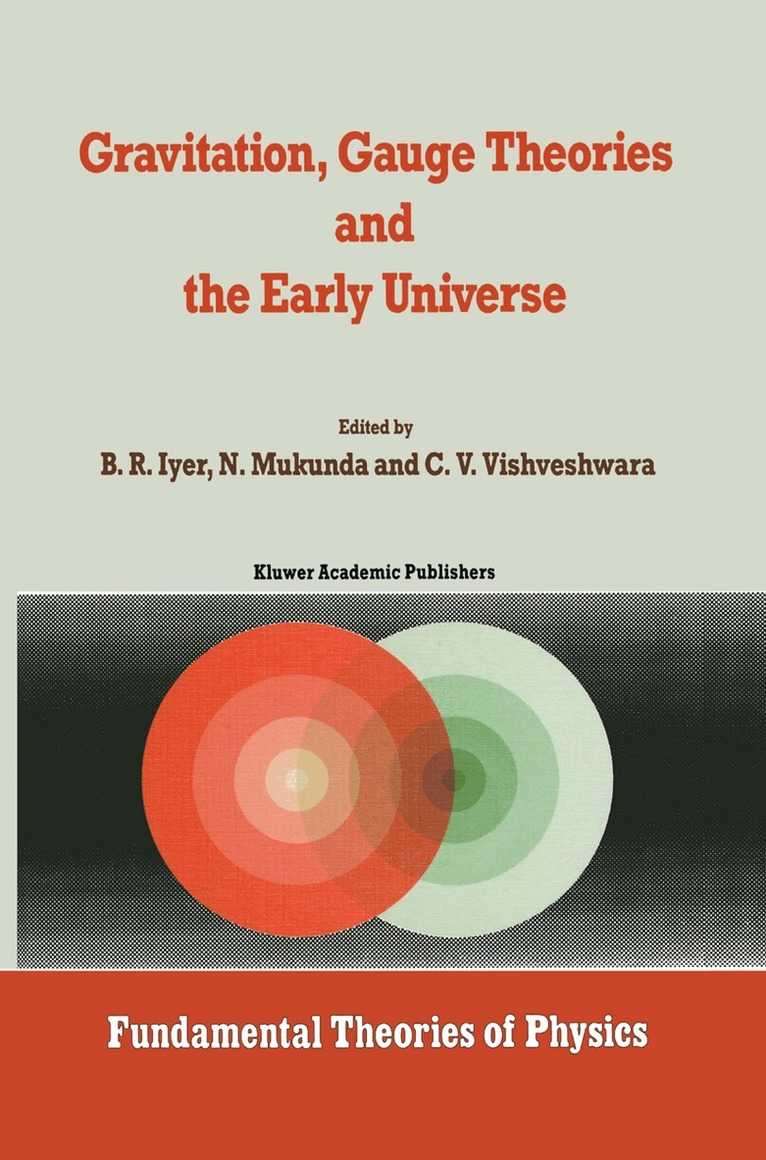
Gravitation, Gauge Theories and the Early Universe
Häftad, Engelska, 2011
3 178 kr
Skickas inom 10-15 vardagar
This book evolved out of some one hundred lectures given by twenty experts at a special instructional conference sponsored by the University Grants Commis sion, India. It is pedagogical in style and self-contained in several interrelated areas of physics which have become extremely important in present-day theoretical research. The articles begin with an introduction to general relativity and cosmology as well as particle physics and quantum field theory. This is followed by reviews of the standard gauge models of high-energy physics, renormalization group and grand unified theories. The concluding parts of the book comprise discussions in current research topics such as problems of the early universe, quantum cosmology and the new directions towards a unification of gravitation with other forces. In addition, special concise treatments of mathematical topics of direct relevance are also included. The content of the book was carefully worked out for the mutual education of students and research workers in general relativity and particle physics. This ambitious programe consequently necessitated the involvement of a number of different authors. However, care has been taken to ensure that the material meshes into a unified, cogent and readable book. We hope that the book will serve to initiate and guide a student in these different areas of investigation starting from first principles and leading to the exciting current research problems of an interdisciplinary nature in the context of the origin and structure of the universe.
1 067 kr
Tillfälligt slut
This book presents a survey of Topology and Differential Geometry and also, Lie Groups and Algebras, and their Representations. The first topic is indispensable to students of gravitation and related areas of modern physics (including string theory), while the second has applications in gauge theory and particle physics, integrable systems and nuclear physics.Part I provides a simple introduction to basic topology, followed by a survey of homotopy. Calculus of differentiable manifolds is then developed, and a Riemannian metric is introduced along with the key concepts of connections and curvature. The final chapters lay out the basic notions of simplicial homology and de Rham cohomology as well as fibre bundles, particularly tangent and cotangent bundles.Part II starts with a review of group theory, followed by the basics of representation theory. A thorough description of Lie groups and algebras is presented with their structure constants and linear representations. Root systems and their classifications are detailed, and this section of the book concludes with the description of representations of simple Lie algebras, emphasizing spinor representations of orthogonal and pseudo-orthogonal groups.The style of presentation is succinct and precise. Involved mathematical proofs that are not of primary importance to physics student are omitted. The book aims to provide the reader access to a wide variety of sources in the current literature, in addition to being a textbook of advanced mathematical methods for physicists.
1 424 kr
Skickas inom 5-8 vardagar
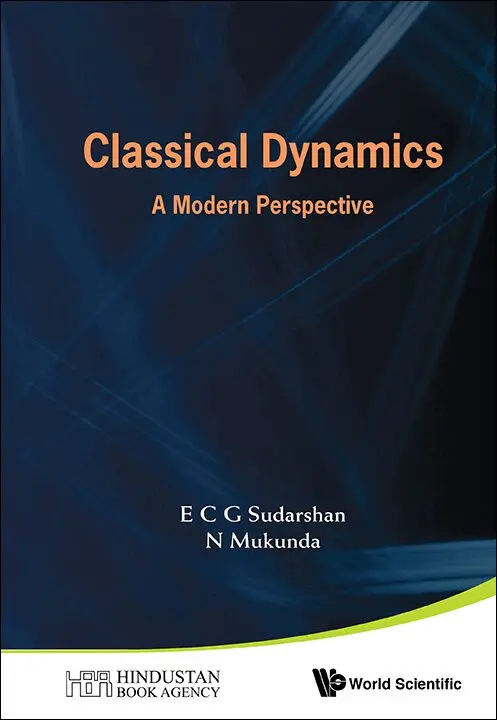
Classical dynamics is traditionally treated as an early stage in the development of physics, a stage that has long been superseded by more ambitious theories. Here, in this book, classical dynamics is treated as a subject on its own as well as a research frontier. Incorporating insights gained over the past several decades, the essential principles of classical dynamics are presented, while demonstrating that a number of key results originally considered only in the context of quantum theory and particle physics, have their foundations in classical dynamics.Graduate students in physics and practicing physicists will welcome the present approach to classical dynamics that encompasses systems of particles, free and interacting fields, and coupled systems. Lie groups and Lie algebras are incorporated at a basic level and are used in describing space-time symmetry groups. There is an extensive discussion on constrained systems, Dirac brackets and their geometrical interpretation. The Lie-algebraic description of dynamical systems is discussed in detail, and Poisson brackets are developed as a realization of Lie brackets. Other topics include treatments of classical spin, elementary relativistic systems in the classical context, irreducible realizations of the Galileo and Poincaré groups, and hydrodynamics as a Galilean field theory. Students will also find that this approach that deals with problems of manifest covariance, the no-interaction theorem in Hamiltonian mechanics and the structure of action-at-a-distance theories provides all the essential preparatory groundwork for a passage to quantum field theory.This reprinting of the original text published in 1974 is a testimony to the vitality of the contents that has remained relevant over nearly half a century.
727 kr
Skickas inom 5-8 vardagar
Classical dynamics is traditionally treated as an early stage in the development of physics, a stage that has long been superseded by more ambitious theories. Here, in this book, classical dynamics is treated as a subject on its own as well as a research frontier. Incorporating insights gained over the past several decades, the essential principles of classical dynamics are presented, while demonstrating that a number of key results originally considered only in the context of quantum theory and particle physics, have their foundations in classical dynamics.Graduate students in physics and practicing physicists will welcome the present approach to classical dynamics that encompasses systems of particles, free and interacting fields, and coupled systems. Lie groups and Lie algebras are incorporated at a basic level and are used in describing space-time symmetry groups. There is an extensive discussion on constrained systems, Dirac brackets and their geometrical interpretation. The Lie-algebraic description of dynamical systems is discussed in detail, and Poisson brackets are developed as a realization of Lie brackets. Other topics include treatments of classical spin, elementary relativistic systems in the classical context, irreducible realizations of the Galileo and Poincaré groups, and hydrodynamics as a Galilean field theory. Students will also find that this approach that deals with problems of manifest covariance, the no-interaction theorem in Hamiltonian mechanics and the structure of action-at-a-distance theories provides all the essential preparatory groundwork for a passage to quantum field theory.This reprinting of the original text published in 1974 is a testimony to the vitality of the contents that has remained relevant over nearly half a century.