N. Vittorio – författare
Visar alla böcker från författaren N. Vittorio. Handla med fri frakt och snabb leverans.
5 produkter
5 produkter
E-bok
Engelska, 20043 974 kr
Läs direkt efter köp
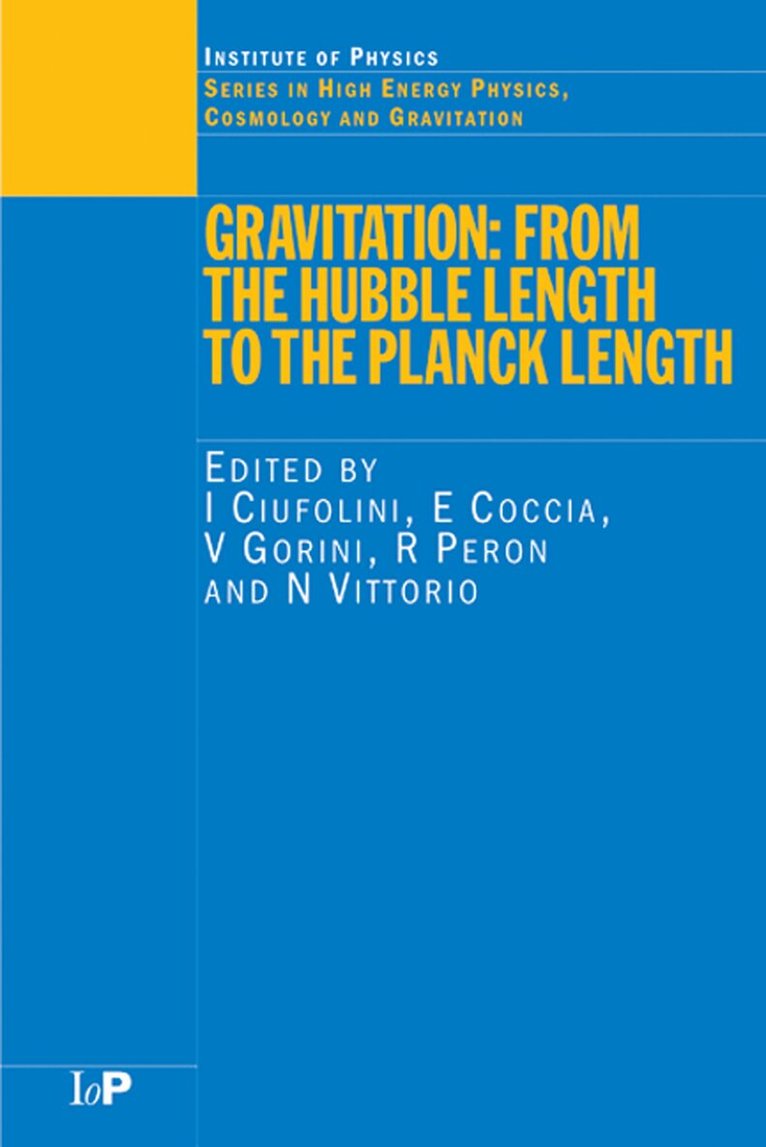
Although gravity is the dominant force of nature at large distances (from intermediate scales to the Hubble length), it is the weakest of forces in particle physics, though it is believed to become important again at very short scales (the Planck length). The conditions created in particle accelerators are similar to those at the time of the early
E-bok
PDF, Engelska, 20043 974 kr
Läs direkt efter köp
Although gravity is the dominant force of nature at large distances (from intermediate scales to the Hubble length), it is the weakest of forces in particle physics, though it is believed to become important again at very short scales (the Planck length). The conditions created in particle accelerators are similar to those at the time of the early
E-bok
PDF, Engelska, 2012673 kr
Läs direkt efter köp
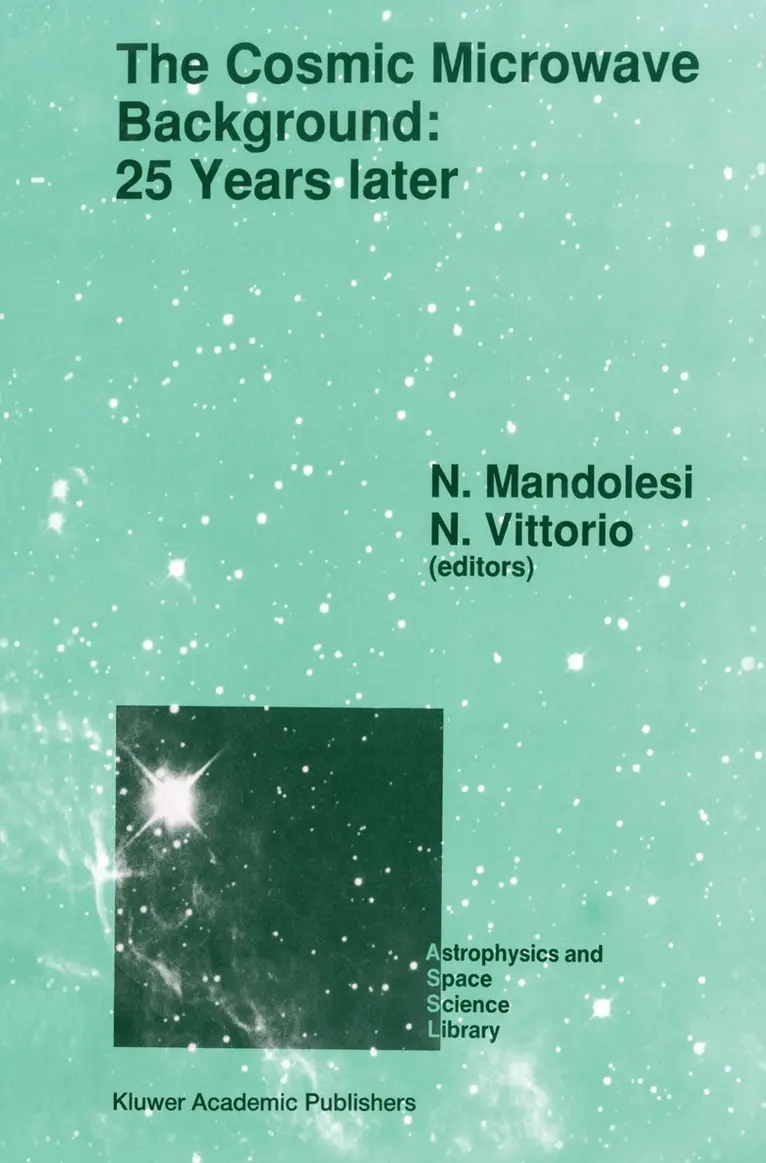
This book is the result of a Meeting held in L''Aquila (Italy) from the 19th to the 23rd of June 1989. The aim of the Meeting was to gather together the people actively working on the Cosmic Microwave Background radiation, both from an experimental and from a theoretical point of view. In view of the intensive current activity in this field, including ongoing (COBE) and forthcoming (RELIC II, ISO, AELITA, etc. ) space missions, a meeting fully dedicated to this important topic was timely. The meeting also celebrated the 25th anniversary of the Microwave Background discovery made in 1964 by the Nobel Prize winners A. Penzias and R. Wilson. We greatly regret that we were not able to have them at the Meeting. There is of course another person whose absence we regret, namely R. H. Dicke, who motivated a generation of experimentalists and theoreticians to open and study this new field of research. As organizers of the Meeting, we would like to express our gratitude to the people who contributed to its success. We want to thank the members of the Scientific Organizing Committee for their assistance, suggestions and encouragement, the invited speakers for their excellent presentations, and the chairmen for their help in handling the various Sessions. We would like to thank P. Palazzi for her help in secretarial work, dr. L.
Del 164 - Astrophysics and Space Science Library
Cosmic Microwave Background: 25 Years Later
Proceedings of a Meeting on ‘The Cosmic Microwave Background: 25 Years Later’, Held in L’Aquila, Italy, June 19–23, 1989
Häftad, Engelska, 2011
540 kr
Skickas inom 10-15 vardagar
This book is the result of a Meeting held in L'Aquila (Italy) from the 19th to the 23rd of June 1989. The aim of the Meeting was to gather together the people actively working on the Cosmic Microwave Background radiation, both from an experimental and from a theoretical point of view. In view of the intensive current activity in this field, including ongoing (COBE) and forthcoming (RELIC II, ISO, AELITA, etc. ) space missions, a meeting fully dedicated to this important topic was timely. The meeting also celebrated the 25th anniversary of the Microwave Background discovery made in 1964 by the Nobel Prize winners A. Penzias and R. Wilson. We greatly regret that we were not able to have them at the Meeting. There is of course another person whose absence we regret, namely R. H. Dicke, who motivated a generation of experimentalists and theoreticians to open and study this new field of research. As organizers of the Meeting, we would like to express our gratitude to the people who contributed to its success. We want to thank the members of the Scientific Organizing Committee for their assistance, suggestions and encouragement, the invited speakers for their excellent presentations, and the chairmen for their help in handling the various Sessions. We would like to thank P. Palazzi for her help in secretarial work, dr. L.
Inbunden, Engelska, 2004
2 383 kr
Tillfälligt slut
Although gravity is the dominant force of nature at large distances (from intermediate scales to the Hubble length), it is the weakest of forces in particle physics, though it is believed to become important again at very short scales (the Planck length). The conditions created in particle accelerators are similar to those at the time of the early universe. While particle physics offers insight to early universe physics, there is a need to understand gravity at extremes of large and short distances to further understand cosmology and the development of the universe. Gravitation: From the Hubble Length to the Planck Length fulfills this need by providing an overview of relativistic astrophysics, early universe physics, cosmology, and their interface with particle physics.Written by international experts, this reference presents up-to-date information on classical relativity, astrophysics, and theoretical and experimental particle physics. The introduction sets the scene and provides a context for the remaining chapters. Chapters cover an extensive array of topics, from refined experimental techniques in gravitational physics to cosmology and the quantum frontier. The book concludes with a discussion of the connection among particles, fields, strings, and branes.This compilation shows how gravity plays a fundamental role in astronomy, astrophysics, and cosmology by exploring domains from the microscopic, such as black holes, to superclusters of galaxies that form the large-scale texture of the present-day cosmos. Moreover, with its theoretical and experimental focus on the foundations of gravity, Gravitation proves to be an invaluable resource for current and future research.