Nadya Fouad – författare
Visar alla böcker från författaren . Handla med fri frakt och snabb leverans.
4 produkter
4 produkter
Del 11 - Multicultural Aspects of Counseling series
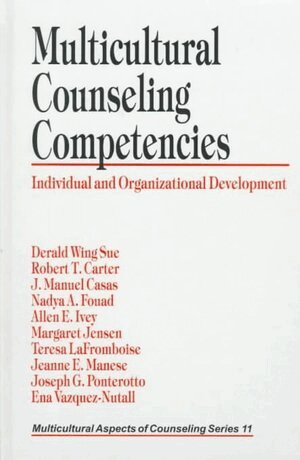
Multicultural Counseling Competencies
Individual and Organizational Development
Inbunden, Engelska, 1998
3 820 kr
Skickas inom 3-6 vardagar
Multicultural Counseling Competencies is a state-of-the-art book integrating the literature and work on multicultural counseling competencies. It draws out implications for individual, professional, and institutional development by identifying the characteristics related to culturally competent mental health care. As such, it has relevance for practitioners who will increasingly encounter client populations who differ from them in terms of race, culture, and ethnicity; it suggests how the mental health profession needs to alter its practices to fit the needs of the culturally different in our society; and it advocates changes in mental health policy, programs, and organization. In a very systematic manner, the text provides a working definition of "multiculturalism" from which counselors, therapists, and social workers can ground their awareness, knowledge, and skills. It presents a new concept called "ethnocentric monoculturalism" and traces how it has inundated our society and the mental health professions. Written by leaders in the field of multicultural counseling, Multicultural Counseling Competencies is a landmark volume in clinical and counseling psychology, educational psychology, gender studies, nursing, social work, psychology, health services, interpersonal violence, and ethnic studies.
Del 11 - Multicultural Aspects of Counseling series
Multicultural Counseling Competencies
Individual and Organizational Development
Häftad, Engelska, 1998
2 682 kr
Skickas inom 3-6 vardagar
Multicultural Counseling Competencies is a state-of-the-art book integrating the literature and work on multicultural counseling competencies. It draws out implications for individual, professional, and institutional development by identifying the characteristics related to culturally competent mental health care. As such, it has relevance for practitioners who will increasingly encounter client populations who differ from them in terms of race, culture, and ethnicity; it suggests how the mental health profession needs to alter its practices to fit the needs of the culturally different in our society; and it advocates changes in mental health policy, programs, and organization. In a very systematic manner, the text provides a working definition of "multiculturalism" from which counselors, therapists, and social workers can ground their awareness, knowledge, and skills. It presents a new concept called "ethnocentric monoculturalism" and traces how it has inundated our society and the mental health professions. Written by leaders in the field of multicultural counseling, Multicultural Counseling Competencies is a landmark volume in clinical and counseling psychology, educational psychology, gender studies, nursing, social work, psychology, health services, interpersonal violence, and ethnic studies.
Inbunden, Engelska, 2006
1 677 kr
Skickas inom 3-6 vardagar
Counseling psychologists often focus on clients′ inner conflicts and avoid getting involved in the clients′ environment. This handbook encourages counseling psychologists to become active participants in changing systems that constrain clients′ ability to function. . . . Besides actual programs, the contributors cover research, training, and ethical issues. The case examples showing how professionals have implemented social action programs are particularly valuable. . . . [T]his book provides an outline for action, not only for psychologists, but also for social workers, politicians, and others interested in improving the lot of disadvantaged populations. Summing up: Recommended. Graduate students, researchers, professionals. -- W. P. Anderson, emeritus, University of Missouri-Columbia, CHOICE The Handbook for Social Justice in Counseling Psychology: Leadership, Vision, and Action provides counseling psychology students, educators, researchers, and practitioners with a conceptual road map of social justice and social action that they can integrate into their professional identity, role, and function. It presents historical, theoretical, and ethical foundations followed by exemplary models of social justice and action work performed by counseling psychologists from interdisciplinary collaborations. The examples in this Handbook explore a wide range of settings with diverse issues and reflect a variety of actions. The book concludes with a chapter reflecting on future directions for the field of counseling psychology beyond individual and traditional practice to macro-level conceptual models. It also explores policy development and implementation, systemic strategies of structural and human change, cultural empowerment and respect, advocacy, technological innovation, and third and fourth generations of human rights activities. Key Features: Integrates research and ethical implications as well as guidelines for developing and evaluating specific types of social justice activities Addresses a comprehensive arena of issues examined from historical, theoretical, systemic, and practical perspectives Clarifies social justice in counseling psychology to distinguish it from other helping professions Provides readers with specific examples and guidelines for integrating social justice into their work supported by a solid theoretical framework and acknowledgement of interdisciplinary influences Includes contributions from prominent authors in counseling psychology to provide expert examples from the fieldThe Handbook for Social Justice in Counseling Psychology is an excellent resource for counseling psychology students, educators, researchers, and practitioners. It will be a welcome addition to any academic library or research institution.
Häftad, Engelska, 2019
1 953 kr
Skickas inom 5-8 vardagar
Career Theory and Practice: Learning Through Case Studies illustrates the process, theories, and application of career development counseling through a series of rich case studies integrated throughout the text. Authors Jane L. Swanson and Nadya A. Fouad use this case study approach to highlight the similarities and differences between the featured theories, as well as to illustrate proper technique and application. The fully revised Fourth Edition reflects a major reorganization of foundational material to highlight the importance of ethical practice, updates to all theory chapters, and the addition of two new chapters discussing recent theories.