Nam-Ho Kim – författare
1 691 kr
Skickas inom 5-8 vardagar
2 360 kr
Skickas inom 10-15 vardagar
1 612 kr
Skickas inom 10-15 vardagar
3 157 kr
Läs direkt efter köp
Structural design sensitivity analysis concerns the relationship between design variables available to the design engineer and structural responses determined by the laws of mechanics. The dependence of response measures such as displacement, stress, strain, natural frequency, buckling load, acoustic response, frequency response, noise-vibration-harshness (NVH), thermo-elastic response, and fatigue life on the material property, sizing, component shape, and configuration design variables is defined through the governing equations of structural mechanics. In this 2-volume set, first- and second- order design sensitivity analyses are presented for static and dynamics responses of both linear and nonlinear elastic structural systems, including elasto-plastic and frictional contact problems.
Book I introduces structural design concepts that include the CAD-based design model, design parameterization, performance measures, costs, and constraints. It also discusses design sensitivity analysis of linear structural systems, and discrete and continuum design sensitivity analysis methods.
2 049 kr
Läs direkt efter köp
Structural design sensitivity analysis concerns the relationship between design variables available to the design engineer and structural responses determined by the laws of mechanics. The dependence of response measures such as displacement, stress, strain, natural frequency, buckling load, acoustic response, frequency response, noise-vibration-harshness (NVH), thermo-elastic response, and fatigue life on the material property, sizing, component shape, and configuration design variables is defined through the governing equations of structural mechanics. In this 2-volume set, first- and second- order design sensitivity analyses are presented for static and dynamics responses of both linear and nonlinear elastic structural systems, including elasto-plastic and frictional contact problems.
Book 2 covers design sensitivity analysis of nonlinear structural systems using continuum design sensitivity analysis methods. It also discusses practical design tools and applications; sizing and shape design parameterization, design velocity field computation, numerical implementation of the sensitivity for general-purpose code development, and various other practical design applications.
1 629 kr
Läs direkt efter köp
Introduces the basic concepts of FEM in an easy-to-use format so that students and professionals can use the method efficiently and interpret results properly
Finite element method (FEM) is a powerful tool for solving engineering problems both in solid structural mechanics and fluid mechanics. This book presents all of the theoretical aspects of FEM that students of engineering will need. It eliminates overlong math equations in favour of basic concepts, and reviews of the mathematics and mechanics of materials in order to illustrate the concepts of FEM. It introduces these concepts by including examples using six different commercial programs online.
The all-new, second edition of Introduction to Finite Element Analysis and Design provides many more exercise problems than the first edition. It includes a significant amount of material in modelling issues by using several practical examples from engineering applications. The book features new coverage of buckling of beams and frames and extends heat transfer analyses from 1D (in the previous edition) to 2D. It also covers 3D solid element and its application, as well as 2D. Additionally, readers will find an increase in coverage of finite element analysis of dynamic problems. There is also a companion website with examples that are concurrent with the most recent version of the commercial programs.
Offers elaborate explanations of basic finite element procedures Delivers clear explanations of the capabilities and limitations of finite element analysis Includes application examples and tutorials for commercial finite element software, such as MATLAB, ANSYS, ABAQUS and NASTRAN Provides numerous examples and exercise problems Comes with a complete solution manual and results of several engineering design projects Introduction to Finite Element Analysis and Design, 2nd Edition is an excellent text for junior and senior level undergraduate students and beginning graduate students in mechanical, civil, aerospace, biomedical engineering, industrial engineering and engineering mechanics.1 629 kr
Läs direkt efter köp
Introduces the basic concepts of FEM in an easy-to-use format so that students and professionals can use the method efficiently and interpret results properly
Finite element method (FEM) is a powerful tool for solving engineering problems both in solid structural mechanics and fluid mechanics. This book presents all of the theoretical aspects of FEM that students of engineering will need. It eliminates overlong math equations in favour of basic concepts, and reviews of the mathematics and mechanics of materials in order to illustrate the concepts of FEM. It introduces these concepts by including examples using six different commercial programs online.
The all-new, second edition of Introduction to Finite Element Analysis and Design provides many more exercise problems than the first edition. It includes a significant amount of material in modelling issues by using several practical examples from engineering applications. The book features new coverage of buckling of beams and frames and extends heat transfer analyses from 1D (in the previous edition) to 2D. It also covers 3D solid element and its application, as well as 2D. Additionally, readers will find an increase in coverage of finite element analysis of dynamic problems. There is also a companion website with examples that are concurrent with the most recent version of the commercial programs.
Offers elaborate explanations of basic finite element procedures Delivers clear explanations of the capabilities and limitations of finite element analysis Includes application examples and tutorials for commercial finite element software, such as MATLAB, ANSYS, ABAQUS and NASTRAN Provides numerous examples and exercise problems Comes with a complete solution manual and results of several engineering design projects Introduction to Finite Element Analysis and Design, 2nd Edition is an excellent text for junior and senior level undergraduate students and beginning graduate students in mechanical, civil, aerospace, biomedical engineering, industrial engineering and engineering mechanics.1 961 kr
Läs direkt efter köp
A clear and accessible overview of the Finite Element Method
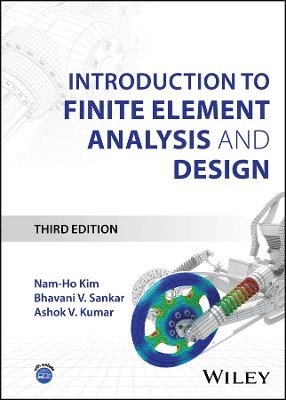
The finite element method (FEM), which involves solutions to partial differential equations and integro-differential equations, is a powerful tool for solving structural mechanics and fluid mechanics problems. FEM results in versatile computer programs with flexible applications, usable with minimal training to solve practical problems in a variety of engineering and design contexts. Introduction to Finite Element Analysis and Design offers a comprehensive yet readable overview of both theoretical and practical elements of FEM. With a greater focus on design aspects than most comparable volumes, it’s an invaluable introduction to a key suite of software and design tools. The third edition has been fully updated to reflect the latest research and applications.
Readers of the third edition of Introduction to Finite Element Analysis and Design will find:
50% more exercise problems than the previous edition, with an accompanying solutions manual for instructorsA brand-new chapter on plate and shell finite elementsTutorials for commercial finite element software, including MATLAB, ANSYS, ABAQUS, and NASTRANIntroduction to Finite Element Analysis and Design is ideal for advanced undergraduate students in finite element analysis- or design-related courses, as well as for researchers and design engineers looking for self-guided tools.
1 961 kr
Läs direkt efter köp
A clear and accessible overview of the Finite Element Method
The finite element method (FEM), which involves solutions to partial differential equations and integro-differential equations, is a powerful tool for solving structural mechanics and fluid mechanics problems. FEM results in versatile computer programs with flexible applications, usable with minimal training to solve practical problems in a variety of engineering and design contexts. Introduction to Finite Element Analysis and Design offers a comprehensive yet readable overview of both theoretical and practical elements of FEM. With a greater focus on design aspects than most comparable volumes, it’s an invaluable introduction to a key suite of software and design tools. The third edition has been fully updated to reflect the latest research and applications.
Readers of the third edition of Introduction to Finite Element Analysis and Design will find:
50% more exercise problems than the previous edition, with an accompanying solutions manual for instructorsA brand-new chapter on plate and shell finite elementsTutorials for commercial finite element software, including MATLAB, ANSYS, ABAQUS, and NASTRANIntroduction to Finite Element Analysis and Design is ideal for advanced undergraduate students in finite element analysis- or design-related courses, as well as for researchers and design engineers looking for self-guided tools.
1 406 kr
Skickas inom 5-8 vardagar
1 629 kr
Läs direkt efter köp
An expert reference on building surrogate models, using them for optimization, their associated prediction uncertainty, and potential failures, with practical implementation in MATLAB
Surrogate Modeling and Optimization explains the meaning of different surrogate models and provides an in-depth understanding of such surrogates, emphasizing how much uncertainty is associated with them, and when and how a surrogate model can fail in approximating complex functions, helping readers understand theory through practical implementation in MATLAB. This book enables readers to obtain an accurate approximate function using as few samples as possible, thereby allowing them to replace expensive computer simulations and experiments during design optimization, sensitivity analysis, and/or uncertainty quantification.
The book is organized into three parts. Part I introduces the basics of surrogate modeling. Part II reviews various theories and algorithms of design optimization. Part III presents advanced topics in surrogate modeling, including the Kriging surrogate, neural network models, multi-fidelity surrogates, and efficient global optimization using Kriging surrogates.
Each chapter contains a multitude of examples and exercise problems. Lecture slides and a solution manual for exercise problems are available for instructors on a companion website.
Topics discussed in Surrogate Modeling and Optimization include:
Various designs of experiments, such as those developed for linear and quadratic polynomial response surfaces (PRS) in a boxlike design space Criteria for constrained and unconstrained optimization and the most important optimization theories Various numerical algorithms for gradient-based optimization Gradient-free optimization algorithms, often referred to as global search algorithms, which do not require gradient or Hessian information Detailed explanations and implementation on Kriging surrogates, often referred to as Gaussian Process, especially when samples include noise The combination of a small number of high-fidelity samples with many low-fidelity samples to improve prediction accuracy Neural network models, focusing on training uncertainty and its effect on prediction uncertainty Efficient global optimization using either polynomial response surfaces or Kriging surrogatesSurrogate Modeling and Optimization is an essential learning companion for senior-level undergraduate and graduate students in all engineering disciplines, including mechanical, aerospace, civil, biomedical, and electrical engineering. The book is also valuable for industrial practitioners who apply surrogate models to solve their optimization problems.
1 614 kr
Läs direkt efter köp
1 597 kr
Skickas inom 5-8 vardagar
1 179 kr
Läs direkt efter köp
This book introduces the key concepts of nonlinear finite element analysis procedures. The book explains the fundamental theories of the field and provides instructions on how to apply the concepts to solving practical engineering problems. Instead of covering many nonlinear problems, the book focuses on three representative problems: nonlinear elasticity, elastoplasticity, and contact problems. The book is written independent of any particular software, but tutorials and examples using four commercial programs are included as appendices: ANSYS, NASTRAN, ABAQUS, and MATLAB. In particular, the MATLAB program includes all source codes so that students can develop their own material models, or different algorithms. Please visit the author''s website for supplemental material, including PowerPoint presentations and MATLAB codes, at http://www2.mae.ufl.edu/nkim/INFEM/
2 071 kr
Skickas inom 5-8 vardagar
1 612 kr
Skickas inom 10-15 vardagar
1 122 kr
Skickas inom 5-8 vardagar
505 kr
Skickas inom 10-15 vardagar
534 kr
Läs direkt efter köp
1 219 kr
Skickas inom 10-15 vardagar
1 622 kr
Läs direkt efter köp
1 825 kr
Skickas inom 10-15 vardagar
1 733 kr
Läs direkt efter köp
1 291 kr
Skickas inom 10-15 vardagar
377 kr
Skickas inom 3-6 vardagar
367 kr
Skickas inom 3-6 vardagar
356 kr
Skickas inom 3-6 vardagar
377 kr
Skickas inom 3-6 vardagar
1 210 kr
Tillfälligt slut