Nancee Blum - Böcker
Visar alla böcker från författaren Nancee Blum. Handla med fri frakt och snabb leverans.
2 produkter
2 produkter
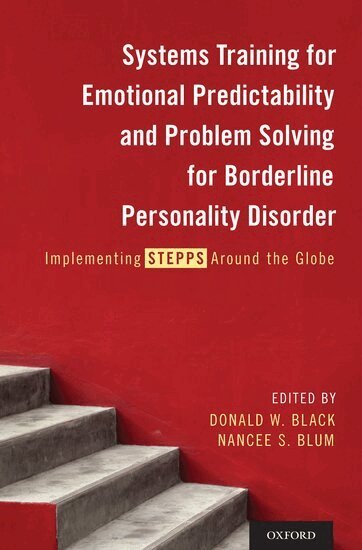
Systems Training for Emotional Predictability and Problem Solving for Borderline Personality Disorder
Implementing STEPPS Around the Globe
Inbunden, Engelska, 2017
1 020 kr
Skickas inom 5-8 vardagar
Borderline personality disorder (BPD) is a potentially severely debilitating psychiatric diagnosis that may affect up to 2% of the general population. Hallmarks of BPD include impulsivity, emotional instability, and poor self-image, and those with BPD have increased risk for self-harm and suicide.Systems Training for Emotional Predictability and Problem Solving (STEPPS) brings together research findings and information on implementation and best practices for a group treatment program for outpatients with BPD. A five-month long program easily learned and delivered by therapists from a wide range of theoretical orientations, STEPPS combines cognitive behavioral therapy, emotion management and behavioral skills training, and psychoeducation with a systems component that involves professional care providers, family, friends, and significant others of persons with BPD. The book provides a detailed description of the program, reviews the body of evidence supporting its use and implementation, and describes its dissemination worldwide and in different settings. Empirical data show that STEPPS is effective and produces clinically important improvement in mood and behavior, while reducing health care utilization. Unique among programs for BPD, STEPPS has been exhaustively studied in correctional systems (both prisons and community corrections), where it is shown to be as effective as in community settings. This volume will be a valuable guide to those in psychiatry, psychology, social work, nursing, and the counseling professions who treat people with BPD.
759 kr
Skickas inom 7-10 vardagar
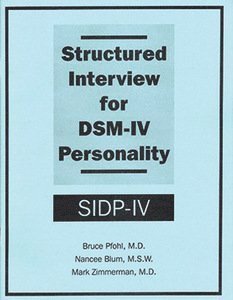
Updated for DSM-IV, the "Structured Interview for DSM-IV Personality (SIDP-IV)" is a semi-structured interview that uses non-perjorative questions to examine behaviours and personality traits from the patient's perspective. The SIDP-IV is organized by topic sections rather than disorder to allow for a more natural conversational flow, a method that gleans useful information from related interview questions and produces a more accurate diagnosis. Designed as a follow-up to a general psychiatric interview and chart review that assesses episodic psychiatric disorders, the SIDP-IV helps the interviewer to more easily distinguish lifelong behaviour from temporary states that result from an episodic psychiatric disorder. During the session, the interviewer can also refer to the specific DSM-IV criterion associated with that question set. In the event that the clinician decides to interview a third-party informant such as family members or close friends, a consent form is provided at the end of the interview.