Nancy A. Lever – författare
1 190 kr
Läs direkt efter köp
With the growing challenges that children confront daily, schools must be prepared at any given moment to intervene on their behalf. And school professionals must be well trained to attend not only to the most routine mental health needs of its students but also to respond quickly and effectively to significant traumatic events. All this in addition to addressing demands to narrow the achievement gap, increase the rate of school success, and lower the dropout rate.
Along with an introductory chapter that focuses on advancing school-based mental health practice and research, the Handbook of School Mental Health addresses a broad range of issues, including how to: Build and enhance collaborative approaches among the various individual, group, system, and agency stakeholders; Ensure best practices are used in all systems of care; provide effective training for all professionals; introduce strength-based approaches to assessment in schools; and facilitate the implementation of evidence-based practices; Prevent and effectively manage crises and violence in schools while addressing the unique ethical, cultural, and legal challenges of school mental health.
This volume is an essential resource for the diverse coalition of school mental health staff and advocates including educators, social workers, school psychologists, school counselors and other professionals who work with and are concerned with the well-being of children.
4 305 kr
Läs direkt efter köp
With so few therapeutic outlets readily available to young people, schools have evolved into mental health centers for many students. Yet schools are hampered by limited access to resources needed to provide mental health promotion, prevention, and intervention services.
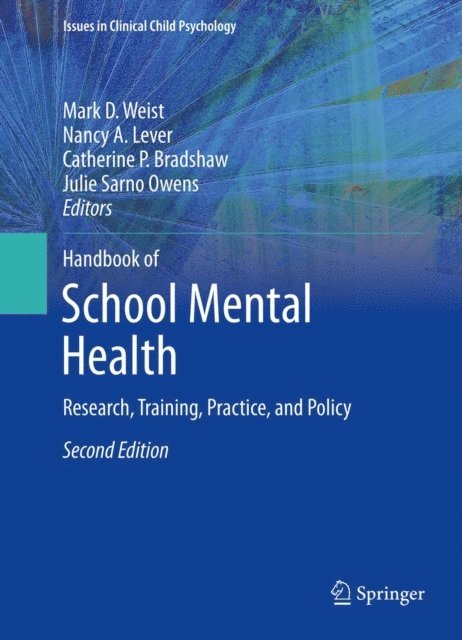
Like its acclaimed predecessor, the Second Edition of the Handbook of School Mental Health offers ways for professionals to maximize resources, make and strengthen valuable connections, and attain more effective school-based services and programming. At the same time, the Handbook provides strategies and recommendations in critical areas, such as workforce development, interdisciplinary collaborations, youth/family engagement, consultation, funding, and policy concerns, summarizes the state of current research, and offers directions for further study. Chapters model best practices for promoting wellness and safety, early detection of emotional and behavioral problems, and school-based interventions for students with anxiety, depression, attention deficit hyperactivity disorder, and other common challenges. In spotlighting this range of issues, the contributors have created a comprehensive game plan for advancing the field.
Among the Handbook''s topics:
Pre-service training for school mental health clinicians.Cognitive-behavioral interventions for trauma in schools. Increasing parental engagement in school-based interventions.Models of psychiatric consultation to schools.Culturally competent behavioral and emotional screening. Bullying from a school mental health perspective.Prevention and intervention strategies related to a variety of mental health problems in schools.The Second Edition of the Handbook of School Mental Health is an essential reference for researchers, graduate students, and other professionals in child and school psychology, special and general education, public health, school nursing, occupational therapy, psychiatry, social work and counseling, educational policy, and family advocacy.