Naresh Thadani – författare
Visar alla böcker från författaren Naresh Thadani. Handla med fri frakt och snabb leverans.
3 produkter
3 produkter
Inbunden, Engelska, 2003
866 kr
Skickas inom 10-15 vardagar
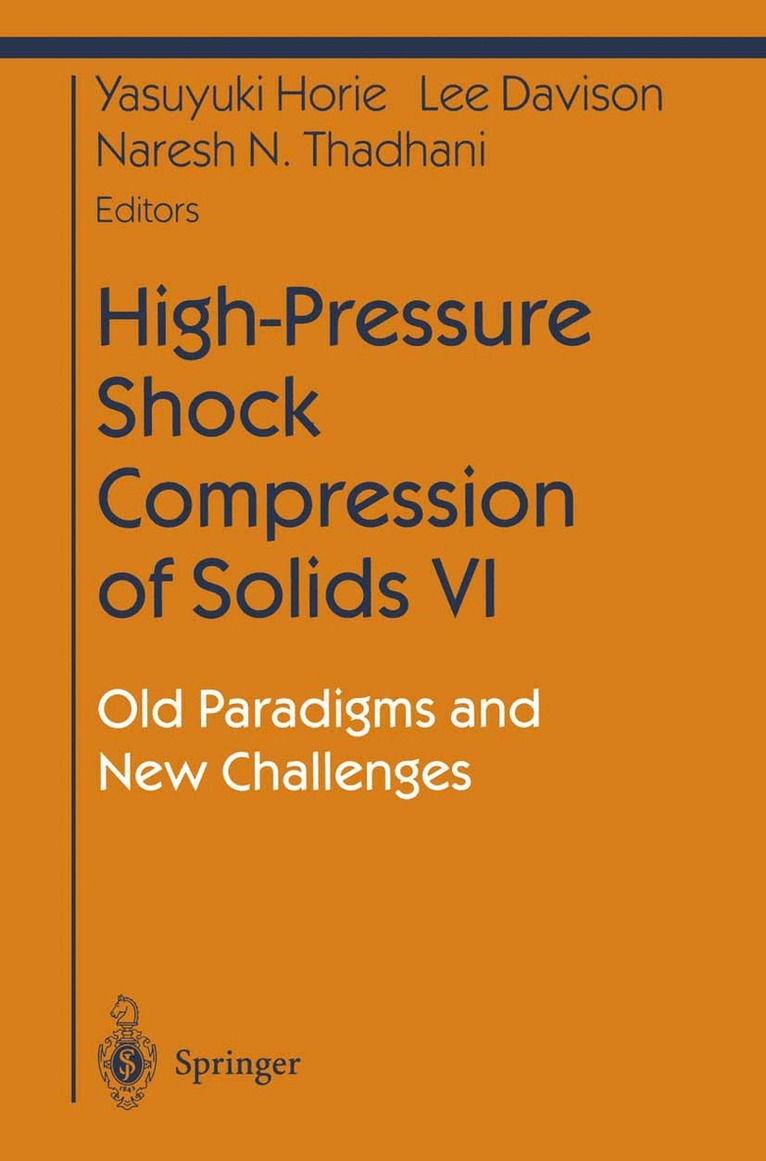
Both experimental and theoretical investigations make it clear that mesoscale materials, that is, materials at scales intermediate between atomic and bulk matter, do not always behave in ways predicted by conventional theories of shock compression. At these scales, shock waves interact with local material properties and microstructure to produce a hierarchy of dissipative structures such as inelastic deformation fields, randomly distributed lattice defects, and residual stresses. A macroscopically steady planar shock wave is neither plane nor steady at the mesoscale. The chapters in this book examine the assumptions underlying our understanding of shock phenomena and present new measurements, calculations, and theories that challenge these assumptions. They address such questions as: - What are the experimental data on mesoscale effects of shocks, and what are the implications? - Can one formulate new mesoscale theories of shock dynamics? - How would new mesoscale theories affect our understanding of shock-induced phase transitions or fracture? - What new computational models will be needed for investigating mesoscale shocks?
Häftad, Engelska, 2013
544 kr
Skickas inom 10-15 vardagar
Both experimental and theoretical investigations make it clear that mesoscale materials, that is, materials at scales intermediate between atomic and bulk matter, do not always behave in ways predicted by conventional theories of shock compression. At these scales, shock waves interact with local material properties and microstructure to produce a hierarchy of dissipative structures such as inelastic deformation fields, randomly distributed lattice defects, and residual stresses. A macroscopically steady planar shock wave is neither plane nor steady at the mesoscale. The chapters in this book examine the assumptions underlying our understanding of shock phenomena and present new measurements, calculations, and theories that challenge these assumptions. They address such questions as: - What are the experimental data on mesoscale effects of shocks, and what are the implications? - Can one formulate new mesoscale theories of shock dynamics? - How would new mesoscale theories affect our understanding of shock-induced phase transitions or fracture? - What new computational models will be needed for investigating mesoscale shocks?
E-bok
PDF, Engelska, 2012687 kr
Läs direkt efter köp
Both experimental and theoretical investigations make it clear that mesoscale materials, that is, materials at scales intermediate between atomic and bulk matter, do not always behave in ways predicted by conventional theories of shock compression. At these scales, shock waves interact with local material properties and microstructure to produce a hierarchy of dissipative structures such as inelastic deformation fields, randomly distributed lattice defects, and residual stresses. A macroscopically steady planar shock wave is neither plane nor steady at the mesoscale. The chapters in this book examine the assumptions underlying our understanding of shock phenomena and present new measurements, calculations, and theories that challenge these assumptions. They address such questions as: - What are the experimental data on mesoscale effects of shocks, and what are the implications? - Can one formulate new mesoscale theories of shock dynamics? - How would new mesoscale theories affect our understanding of shock-induced phase transitions or fracture? - What new computational models will be needed for investigating mesoscale shocks?