Nathalie Revol – författare
Visar alla böcker från författaren Nathalie Revol. Handla med fri frakt och snabb leverans.
6 produkter
6 produkter
E-bok
PDF, Engelska, 20092 130 kr
Läs direkt efter köp
Floating-point arithmetic is the most widely used way of implementing real-number arithmetic on modern computers. However, making such an arithmetic reliable and portable, yet fast, is a very difficult task. As a result, floating-point arithmetic is far from being exploited to its full potential. This handbook aims to provide a complete overview of modern floating-point arithmetic. So that the techniques presented can directly be put into practice in actual coding or design, they are illustrated, whenever possible, by a corresponding program in C.The handbook is designed for programmers of numerical applications, compiler designers, programmers of floating-point algorithms, designers of arithmetic operators, and more generally, students and researchers in numerical analysis who wish to better understand a tool used in their daily work and research.
Häftad, Engelska, 2019
1 619 kr
Skickas inom 10-15 vardagar
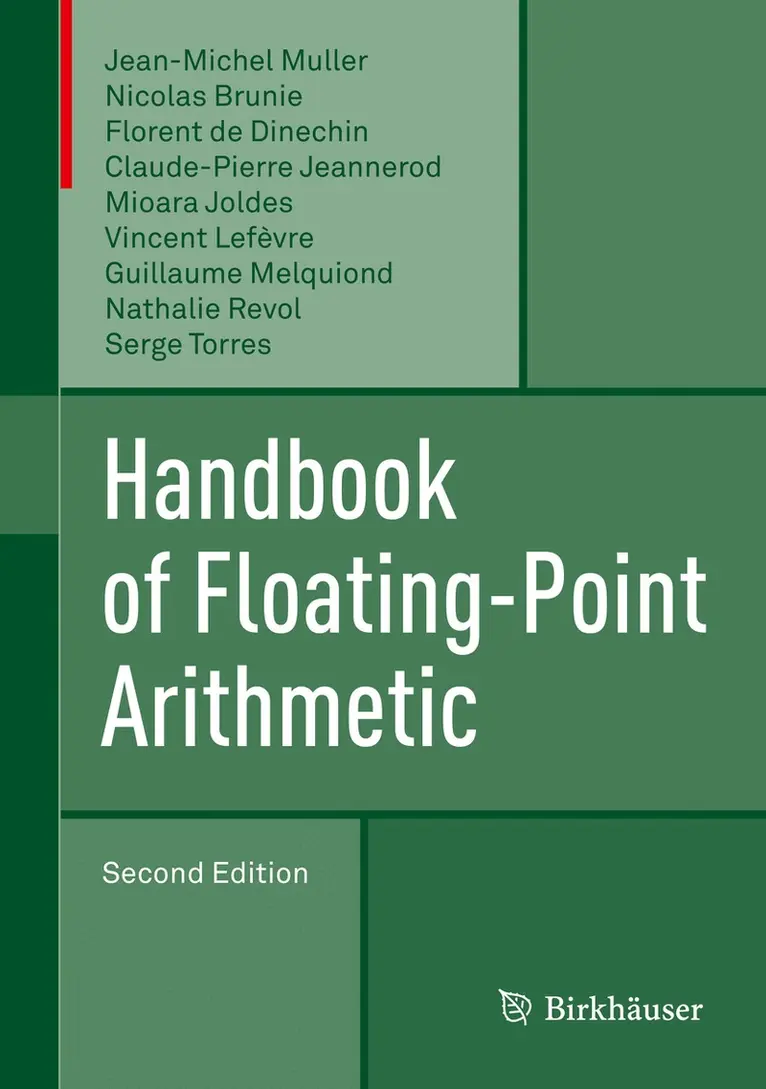
This handbook is a definitive guide to the effective use of modern floating-point arithmetic, which has considerably evolved, from the frequently inconsistent floating-point number systems of early computing to the recent IEEE 754-2008 standard. Most of computational mathematics depends on floating-point numbers, and understanding their various implementations will allow readers to develop programs specifically tailored for the standard’s technical features. Algorithms for floating-point arithmetic are presented throughout the book and illustrated where possible by example programs which show how these techniques appear in actual coding and design.The volume itself breaks its core topic into four parts: the basic concepts and history of floating-point arithmetic; methods of analyzing floating-point algorithms and optimizing them; implementations of IEEE 754-2008 in hardware and software; and useful extensions to the standard floating-point system, such as interval arithmetic, double- and triple-word arithmetic, operations on complex numbers, and formal verification of floating-point algorithms. This new edition updates chapters to reflect recent changes to programming languages and compilers and the new prevalence of GPUs in recent years. The revisions also add material on fused multiply-add instruction, and methods of extending the floating-point precision. As supercomputing becomes more common, more numerical engineers will need to use number representation to account for trade-offs between various parameters, such as speed, accuracy, and energy consumption. The Handbook of Floating-Point Arithmetic is designed for students and researchers in numerical analysis, programmers of numerical algorithms, compiler designers, and designers of arithmetic operators.
Inbunden, Engelska, 2018
1 619 kr
Skickas inom 10-15 vardagar
This handbook is a definitive guide to the effective use of modern floating-point arithmetic, which has considerably evolved, from the frequently inconsistent floating-point number systems of early computing to the recent IEEE 754-2008 standard. Most of computational mathematics depends on floating-point numbers, and understanding their various implementations will allow readers to develop programs specifically tailored for the standard’s technical features. Algorithms for floating-point arithmetic are presented throughout the book and illustrated where possible by example programs which show how these techniques appear in actual coding and design.The volume itself breaks its core topic into four parts: the basic concepts and history of floating-point arithmetic; methods of analyzing floating-point algorithms and optimizing them; implementations of IEEE 754-2008 in hardware and software; and useful extensions to the standard floating-point system, such as interval arithmetic, double- and triple-word arithmetic, operations on complex numbers, and formal verification of floating-point algorithms. This new edition updates chapters to reflect recent changes to programming languages and compilers and the new prevalence of GPUs in recent years. The revisions also add material on fused multiply-add instruction, and methods of extending the floating-point precision. As supercomputing becomes more common, more numerical engineers will need to use number representation to account for trade-offs between various parameters, such as speed, accuracy, and energy consumption. The Handbook of Floating-Point Arithmetic is designed for students and researchers in numerical analysis, programmers of numerical algorithms, compiler designers, and designers of arithmetic operators.
E-bok
Engelska, 20181 985 kr
Läs direkt efter köp
This handbook is a definitive guide to the effective use of modern floating-point arithmetic, which has considerably evolved, from the frequently inconsistent floating-point number systems of early computing to the recent IEEE 754-2008 standard. Most of computational mathematics depends on floating-point numbers, and understanding their various implementations will allow readers to develop programs specifically tailored for the standard’s technical features. Algorithms for floating-point arithmetic are presented throughout the book and illustrated where possible by example programs which show how these techniques appear in actual coding and design.The volume itself breaks its core topic into four parts: the basic concepts and history of floating-point arithmetic; methods of analyzing floating-point algorithms and optimizing them; implementations of IEEE 754-2008 in hardware and software; and useful extensions to the standard floating-point system, such as interval arithmetic, double- and triple-word arithmetic, operations on complex numbers, and formal verification of floating-point algorithms. This new edition updates chapters to reflect recent changes to programming languages and compilers and the new prevalence of GPUs in recent years. The revisions also add material on fused multiply-add instruction, and methods of extending the floating-point precision. As supercomputing becomes more common, more numerical engineers will need to use number representation to account for trade-offs between various parameters, such as speed, accuracy, and energy consumption. The Handbook of Floating-Point Arithmetic is designed for students and researchers in numerical analysis, programmers of numerical algorithms, compiler designers, and designers of arithmetic operators.
Häftad, Engelska, 2008
561 kr
Skickas inom 10-15 vardagar
A large amount of the capacity of today’s computers is used for computations that can be described as computations involving real numbers. In this book, the focus is on a problem arising particularly in real number computations: the problem of veri?edor reliablecomputations. Since real numbersare objects c- taining an in?nite amount of information, they cannot be represented precisely on a computer. This leads to the well-known problems caused by unveri?ed - plementations of real number algorithms using ?nite precision. While this is t- ditionally seen to be a problem in numerical mathematics, there are also several scienti?c communities in computer science that are dealing with this problem. This book is a follow-up of the Dagstuhl Seminar 06021 on “Reliable Imp- mentation of Real Number Algorithms: Theory and Practice,” which took place January 8–13, 2006. It was intended to stimulate an exchange of ideas between the di?erent communities that deal with the problem of reliable implementation of real number algorithms either from a theoretical or from a practical point of view. Forty-eight researchers from many di?erent countries and many di?erent disciplines gathered in the castle of Dagstuhl to exchange views and ideas, in a relaxed atmosphere. The program consisted of 35 talks of 30 minutes each, and of three evening sessions with additional presentations and discussions. There were also lively discussions about di?erent theoretical models and practical - proaches for reliable real number computations.
E-bok
PDF, Engelska, 2008687 kr
Läs direkt efter köp
A large amount of the capacity of today’s computers is used for computations that can be described as computations involving real numbers. In this book, the focus is on a problem arising particularly in real number computations: the problem of veri?edor reliablecomputations. Since real numbersare objects c- taining an in?nite amount of information, they cannot be represented precisely on a computer. This leads to the well-known problems caused by unveri?ed - plementations of real number algorithms using ?nite precision. While this is t- ditionally seen to be a problem in numerical mathematics, there are also several scienti?c communities in computer science that are dealing with this problem. This book is a follow-up of the Dagstuhl Seminar 06021 on “Reliable Imp- mentation of Real Number Algorithms: Theory and Practice,” which took place January 8–13, 2006. It was intended to stimulate an exchange of ideas between the di?erent communities that deal with the problem of reliable implementation of real number algorithms either from a theoretical or from a practical point of view. Forty-eight researchers from many di?erent countries and many di?erent disciplines gathered in the castle of Dagstuhl to exchange views and ideas, in a relaxed atmosphere. The program consisted of 35 talks of 30 minutes each, and of three evening sessions with additional presentations and discussions. There were also lively discussions about di?erent theoretical models and practical - proaches for reliable real number computations.