N.D. Carter – författare
Visar alla böcker från författaren N.D. Carter. Handla med fri frakt och snabb leverans.
4 produkter
4 produkter
1 589 kr
Skickas inom 10-15 vardagar
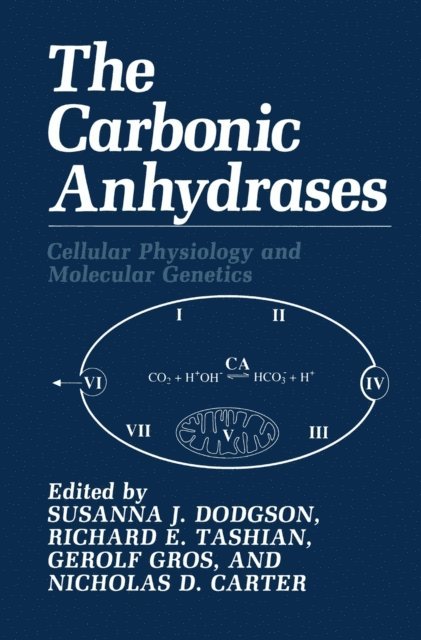
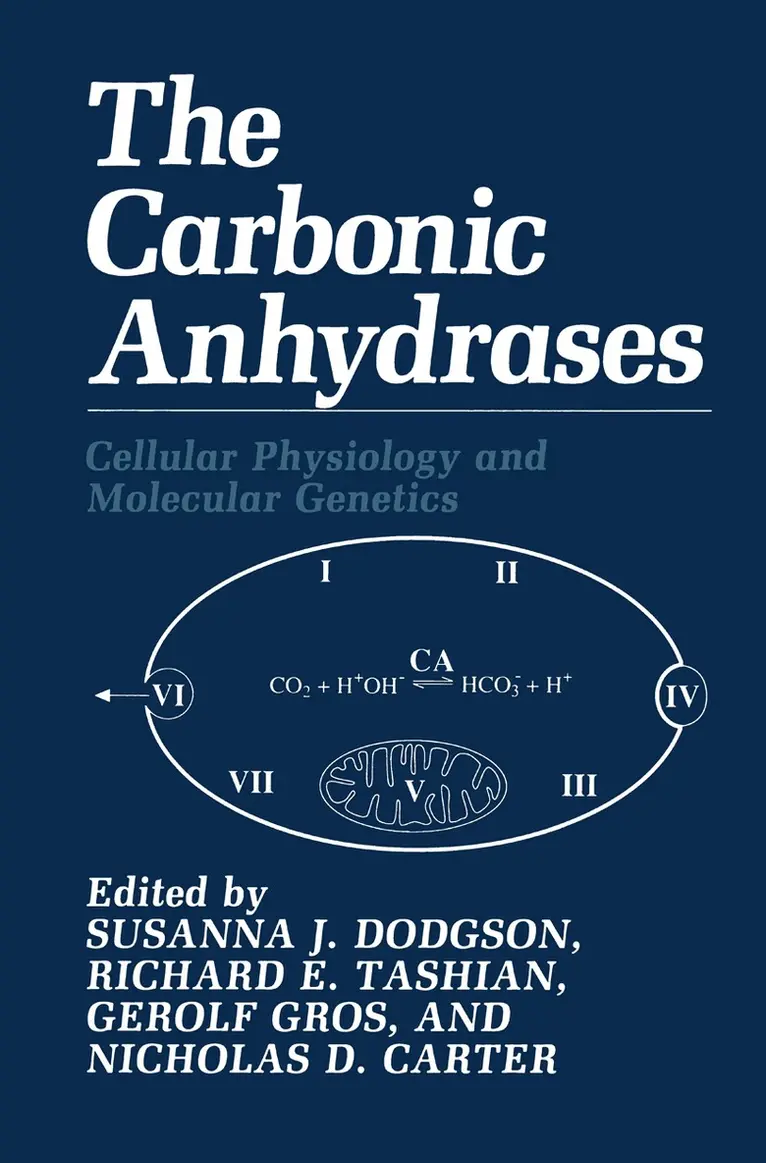
As we approach the twenty-first century the problems of industrialization are evident: we find there is a greenhouse effect, the ozone layer is being depleted, the rain is acidified, and there is a terrible problem of increasing C0 concentrations in the atmo 2 sphere. The carbonic anhydrases are a unique family of enzymes that solve these problems in the human body: they are responsible for converting C0 (a gas) to 2 HC0-, which is the biggest intracellular buffer, with a concomitant decrease in a 3 hydroxyl ion. Globally, the functions of the carbonic anhydrases in photosynthesis in rain forests and in the algae and plankton that cover our oceans indicate that they are also of utmost importance in the maintenance of the acid-base balance on our planet. Although the whole field of C0 metabolism is enormous and still rapidly 2 expanding, because of the research interests of the editors this book is mainly concerned with mammalian carbonic anhydrases. However, if the interested reader intends to purify carbonic anhydrases from nonmammalian sources, Dr. Cheg widden has provided the necessary information in Chapter 7. The carbonic anhydrases were first discovered in 1933; until1976 there were thought to be only two isozymes. Since then CA ill, IY, V, VI, and Vll have been discovered and well characterized. There is, of course, no reason to believe that we have found them all.
1 589 kr
Skickas inom 10-15 vardagar
As we approach the twenty-first century the problems of industrialization are evident: we find there is a greenhouse effect, the ozone layer is being depleted, the rain is acidified, and there is a terrible problem of increasing C0 concentrations in the atmo 2 sphere. The carbonic anhydrases are a unique family of enzymes that solve these problems in the human body: they are responsible for converting C0 (a gas) to 2 HC0-, which is the biggest intracellular buffer, with a concomitant decrease in a 3 hydroxyl ion. Globally, the functions of the carbonic anhydrases in photosynthesis in rain forests and in the algae and plankton that cover our oceans indicate that they are also of utmost importance in the maintenance of the acid-base balance on our planet. Although the whole field of C0 metabolism is enormous and still rapidly 2 expanding, because of the research interests of the editors this book is mainly concerned with mammalian carbonic anhydrases. However, if the interested reader intends to purify carbonic anhydrases from nonmammalian sources, Dr. Cheg widden has provided the necessary information in Chapter 7. The carbonic anhydrases were first discovered in 1933; until1976 there were thought to be only two isozymes. Since then CA ill, IY, V, VI, and Vll have been discovered and well characterized. There is, of course, no reason to believe that we have found them all.
3 266 kr
Skickas inom 10-15 vardagar
Carbonic anhydrase (CA) is a seemingly ubiquitous enzyme of profound physiological importance, which plays essential roles in respiration, acid-base homeostasis, bone resorption, calcification, photosynthesis, several biosynthetic pathways and a variety of processes involving ion, gas and fluid transfer.
3 266 kr
Skickas inom 10-15 vardagar
The carbonic anhydrases play important roles in respiration, acid-base homeostasis, bone resorption, calcification, photosynthesis, several biosynthetic pathways and a variety of processes involving ion, gas and fluid transfer. This text examines the role of carbonic anhydrases. The enzyme is present in three known gene families: the a-CAs (animals and algae) of which seven isozymes have been characterized; the b-CAs (plants and bacteria); and the recently discovered g-CAs (archaebacteria). In addition to their clinical and applied physiological importance, the carbonic anhydrases have become accepted as a model for the study of evolution of gene families and also used as model systems in site-directed mutagenesis in structure/function relationships, protein folding and transgenic and gene target analysis.