Neil E. Harrison - Böcker
Visar alla böcker från författaren Neil E. Harrison. Handla med fri frakt och snabb leverans.
7 produkter
7 produkter
2 098 kr
Skickas inom 10-15 vardagar
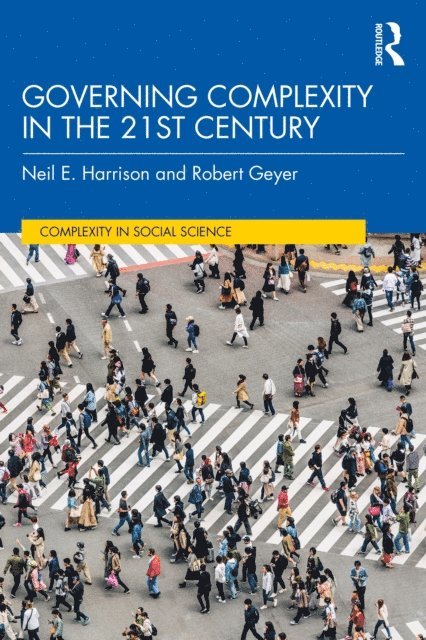
Governing Complexity in the 21st Century surveys the ways in which social systems are becoming more complex. It shows how this complexity impacts every aspect of life for individuals, governments and societies in most social systems at individual, regional, national and global scales and explores how embracing ‘complexity thinking’ can greatly improve the art of governance in all policy areas. The book clearly explains the ideas and methods of complexity science—widely accepted in both the natural and social sciences—then demonstrates how ‘complexity thinking’ can be applied to improve our understanding of governance and policy actions. Providing a deep analysis of many governance challenges, including economic development and technological innovation, environment management, climate change and development in the Middle East, the book also compares national responses to the COVID-19 pandemic. Clear and jargon-free, this book is accessible to undergraduates and scholars alike. It is essential reading for policymakers everywhere, showcasing methods for governing effectively and efficiently in our increasingly complex world. It brings together the broad range of social and environmental science fields and will be useful for those studying or working in policy, politics and international relations, environmental issues, business management, philosophy, history and sociology.
565 kr
Skickas inom 10-15 vardagar
Governing Complexity in the 21st Century surveys the ways in which social systems are becoming more complex. It shows how this complexity impacts every aspect of life for individuals, governments and societies in most social systems at individual, regional, national and global scales and explores how embracing ‘complexity thinking’ can greatly improve the art of governance in all policy areas. The book clearly explains the ideas and methods of complexity science—widely accepted in both the natural and social sciences—then demonstrates how ‘complexity thinking’ can be applied to improve our understanding of governance and policy actions. Providing a deep analysis of many governance challenges, including economic development and technological innovation, environment management, climate change and development in the Middle East, the book also compares national responses to the COVID-19 pandemic. Clear and jargon-free, this book is accessible to undergraduates and scholars alike. It is essential reading for policymakers everywhere, showcasing methods for governing effectively and efficiently in our increasingly complex world. It brings together the broad range of social and environmental science fields and will be useful for those studying or working in policy, politics and international relations, environmental issues, business management, philosophy, history and sociology.
347 kr
Skickas inom 7-10 vardagar
Defines, analyzes, critiques, and proposes new policy solutions for achieving sustainable development.Through a critique of the economic, technological, political, and ethical theories that are the basis for current policy, this book shows that sustainable development proposals are at least incomplete or impractical and at worst dangerously misleading.The concept of sustainable development presents a problem for theorists and policy makers because it cannot be objectively defined and subjective understandings vary widely. For the capitalist, sustainable development is a problem of production efficiency and technological innovation; for the environmentalist, a more appropriate ethic is a necessity; and for the developing country policy maker, a more equitable distribution of power over resources is imperative.Harrison shows how sustainable development can be constructed from policy principles derived from ongoing adaptations to changes in values, beliefs, and scientific knowledge, and applied in both developed and developing nations and communities large and small.
1 057 kr
Tillfälligt slut
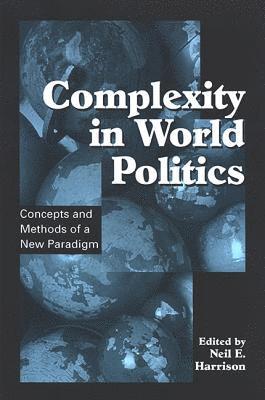
Demonstrates that world politics is more complex than conventional models can account for.Despite one hundred years of theorizing, scholars and practitioners alike are constantly surprised by international and global political events. The collapse of communism in Europe, the 1997 Asian financial crisis, and 9/11 have demonstrated the inadequacy of current models that depict world politics as a simple, mechanical system. Complexity in World Politics shows how conventional theories oversimplify reality and illustrates how concepts drawn from complexity science can be adapted to increase our understanding of world politics and improve policy. In language free of jargon, the book's distinguished contributors explain and illustrate a complexity paradigm of world politics and define its central concepts. They show how these concepts can improve conventional models as well as generate new ideas, hypotheses, and empirical approaches, and conclude by outlining an agenda of theoretical development and empirical research to create and test complex systems theories of issue-areas of world politics.
382 kr
Tillfälligt slut
Demonstrates that world politics is more complex than conventional models can account for.Despite one hundred years of theorizing, scholars and practitioners alike are constantly surprised by international and global political events. The collapse of communism in Europe, the 1997 Asian financial crisis, and 9/11 have demonstrated the inadequacy of current models that depict world politics as a simple, mechanical system. Complexity in World Politics shows how conventional theories oversimplify reality and illustrates how concepts drawn from complexity science can be adapted to increase our understanding of world politics and improve policy. In language free of jargon, the book's distinguished contributors explain and illustrate a complexity paradigm of world politics and define its central concepts. They show how these concepts can improve conventional models as well as generate new ideas, hypotheses, and empirical approaches, and conclude by outlining an agenda of theoretical development and empirical research to create and test complex systems theories of issue-areas of world politics.
1 499 kr
Skickas inom 3-6 vardagar
Demonstrates that a true liberal capitalism has the capacity to enable personal well-being while dealing with new challenges such as pandemics, climate change, and automation.Capitalism has lost its glamor. In just three decades since it "defeated" a totalitarian Soviet Union, capitalism is today blamed for slowing growth, a dangerously changing climate, inequality, social misery, and a rise in nationalist populism. How did capitalism fall so far from grace? Capitalism for All show how, quite simply, the governments of the world's wealthiest countries have forgotten capitalism's initial purpose. It was born out of a liberal philosophy that values the competition of ideas and goods in the service of social progress while respecting the individual and preventing excessive power. Yet, with the aid of governments, giant corporations, or "MegaCorps," have usurped power, dominated markets, and reduced competition. The result is not liberal capitalism but what Neil E. Harrison and John Mikler term "CorpoCapitalism," which results in an unhappy populace seeking radical political change while challenges like climate change continue to race forward largely unchecked. Capitalism for All explores how CorpoCapitalism came to be, argues that it is not inevitable, and explains how governments can wrest back power and create a capitalism for all.
583 kr
Skickas inom 3-6 vardagar
Demonstrates that a true liberal capitalism has the capacity to enable personal well-being while dealing with new challenges such as pandemics, climate change, and automation.Capitalism has lost its glamor. In just three decades since it "defeated" a totalitarian Soviet Union, capitalism is today blamed for slowing growth, a dangerously changing climate, inequality, social misery, and a rise in nationalist populism. How did capitalism fall so far from grace? Capitalism for All show how, quite simply, the governments of the world's wealthiest countries have forgotten capitalism's initial purpose. It was born out of a liberal philosophy that values the competition of ideas and goods in the service of social progress while respecting the individual and preventing excessive power. Yet, with the aid of governments, giant corporations, or "MegaCorps," have usurped power, dominated markets, and reduced competition. The result is not liberal capitalism but what Neil E. Harrison and John Mikler term "CorpoCapitalism," which results in an unhappy populace seeking radical political change while challenges like climate change continue to race forward largely unchecked. Capitalism for All explores how CorpoCapitalism came to be, argues that it is not inevitable, and explains how governments can wrest back power and create a capitalism for all.