Nelson Rangel-Buitrago - Böcker
Visar alla böcker från författaren Nelson Rangel-Buitrago. Handla med fri frakt och snabb leverans.
3 produkter
3 produkter
534 kr
Skickas inom 10-15 vardagar
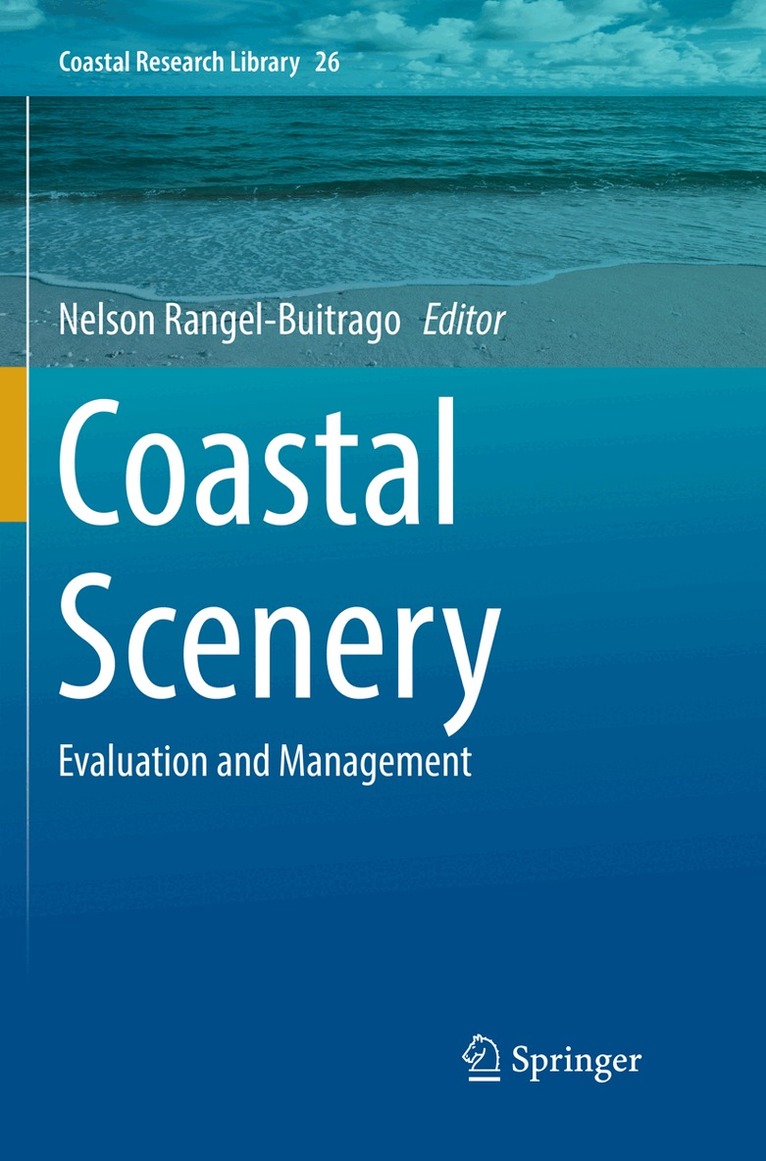
This book describes an easy to apply methodology to determine the scenic value of a coast. As one of the most critical aspects of beach user choice, the determination of coastal area scenic quality is of primordial importance. This book is, therefore, an extremely useful tool for any coastal lovers, being them users, teachers, researchers, or managers.In particular, this work is the first book to present a semi-quantitative analysis of coastal scenery based on more than 4,000 interviews about people’s desired coastal imaginary. Twenty-six parameters can be used to identify any coastal scene, which have then been sub-divided into five attribute categories, weighted and subjected to fuzzy logic mathematics to obtain a decision number (D). This number D represents the coastal scenery at that point, and Five D classes are then presented (from I-excellent, to V-poor). Heritage areas, like National Parks should lie in Class I, which infers top scenic quality.Overa time span of a decade or so, the authors of this book have assessed more than 900 global locations using the technique given in this book. One of the main aims of this method is to point out how scenic areas may be improved by judicious intervention relating to parameters, mainly anthropogenic, chosen for assessment.The content of this book opens perspectives for analysis of the potential for coastal tourism development in natural areas and for landscape quality improvement in current coastal tourist developed areas.“In a very comprehensive way, this book reviews the main concepts about coastal scenery and through the vast global work experience of the authors, presents different methodologies, as well as introducing a novel methodology, using parameter weightings and fuzzy logic mathematics.”Carlos Pereira da Silva, CICS.NOVA, Universidade Nova de Lisboa, Lisbon, Portugal“Our lives will be greatly enriched by finding beauty,but we can use help in defining the many ways beauty can be manifested. This book can help us by informing us of the ways landscapes can be viewed and described from many viewpoints to place our own understanding in better perspective.”Karl Nordstrom, Geography Department, Rutgers University, New Jersey, USA “How do we define and quantify a coast’s scenic value? This is the book. It begins by defining coastal scenery, then reviews the approaches to quantifying it, followed by a new fuzzy logic approach and examples. It finishes with a chapter on how to manage these attractive landscapes, many of which are being overrun and ruined by development. This is a must read for researchers who wish to evaluate and managers who wish to maintain this valuable yet intangible coastal resource.”Andrew Short, Coastal Studies Unit, Sydney University, Australia
Risk Assessment of Storms in Coastal Zones: Case Studies from Cartagena (Colombia) and Cadiz (Spain)
Häftad, Engelska, 2015
534 kr
Skickas inom 10-15 vardagar
This book assists the reader in determining storm risks, focussing on sandy coasts and cliff coasts in the context of expected sea level rise from littoral transformation and climate change. It examines storm impacts through matrixes concerning physical parameters, socio-economic activities, ecological and historic resources, and it presents the Coastline Risk to Storms Index as a single numerical measure of the risk for a given area.The methodology is described and tested against two coastal areas: one in the Caribbean Sea (Cartagena, Colombia) and the other on the coast of the Atlantic Ocean (Cadiz, Spain). Both areas record an important flow of tourists associated with the “sun, sea and sand market” which represents an economic recourse for the hinterland too.Chapters describe this approach and explore three particular types of variables: i) the forcing variables contributing to storm-induced erosion, ii) dynamic variables that determine the resilience to erosion (Susceptibility) and iii) the vulnerable targets grouped in three different contexts (socio-economic, ecological and heritage). These are combined into two separate indices, the Hazard Index (combining forcing and susceptibility) and the Vulnerability Index, which together constitute the Coastline Risk to Storms Index.Maps created using this semi-quantitative approximation method can help to determine the causes, processes and consequences of storm-related processes. This book is therefore important to anyone considering coastal development programs, especially decision-makers: the work presented here can assist in the development of preventative management strategies for the most vulnerable areas.
534 kr
Skickas inom 10-15 vardagar
This book describes an easy to apply methodology to determine the scenic value of a coast. As one of the most critical aspects of beach user choice, the determination of coastal area scenic quality is of primordial importance. This book is, therefore, an extremely useful tool for any coastal lovers, being them users, teachers, researchers, or managers.In particular, this work is the first book to present a semi-quantitative analysis of coastal scenery based on more than 4,000 interviews about people’s desired coastal imaginary. Twenty-six parameters can be used to identify any coastal scene, which have then been sub-divided into five attribute categories, weighted and subjected to fuzzy logic mathematics to obtain a decision number (D). This number D represents the coastal scenery at that point, and Five D classes are then presented (from I-excellent, to V-poor). Heritage areas, like National Parks should lie in Class I, which infers top scenic quality.Overa time span of a decade or so, the authors of this book have assessed more than 900 global locations using the technique given in this book. One of the main aims of this method is to point out how scenic areas may be improved by judicious intervention relating to parameters, mainly anthropogenic, chosen for assessment.The content of this book opens perspectives for analysis of the potential for coastal tourism development in natural areas and for landscape quality improvement in current coastal tourist developed areas.“In a very comprehensive way, this book reviews the main concepts about coastal scenery and through the vast global work experience of the authors, presents different methodologies, as well as introducing a novel methodology, using parameter weightings and fuzzy logic mathematics.”Carlos Pereira da Silva, CICS.NOVA, Universidade Nova de Lisboa, Lisbon, Portugal“Our lives will be greatly enriched by finding beauty,but we can use help in defining the many ways beauty can be manifested. This book can help us by informing us of the ways landscapes can be viewed and described from many viewpoints to place our own understanding in better perspective.”Karl Nordstrom, Geography Department, Rutgers University, New Jersey, USA “How do we define and quantify a coast’s scenic value? This is the book. It begins by defining coastal scenery, then reviews the approaches to quantifying it, followed by a new fuzzy logic approach and examples. It finishes with a chapter on how to manage these attractive landscapes, many of which are being overrun and ruined by development. This is a must read for researchers who wish to evaluate and managers who wish to maintain this valuable yet intangible coastal resource.”Andrew Short, Coastal Studies Unit, Sydney University, Australia