Nicola Grandi – författare
Visar alla böcker från författaren Nicola Grandi. Handla med fri frakt och snabb leverans.
2 produkter
2 produkter
Inbunden, Engelska, 2015
2 307 kr
Skickas inom 11-20 vardagar
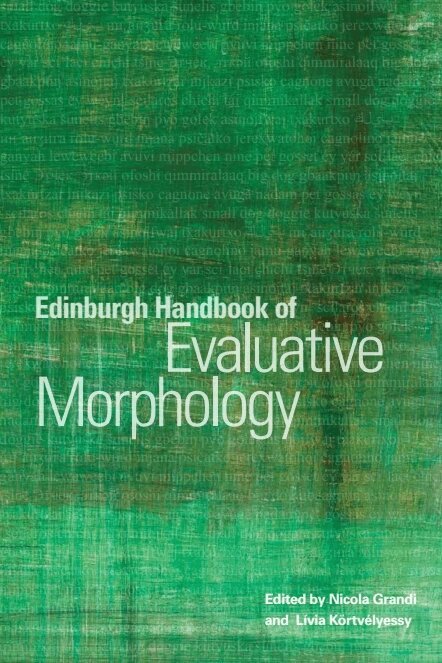
With examples drawn from over 200 world languages, this ground-breaking volume presents a state-of-the-art overview of evaluative morphology. Offering an innovative approach to major theoretical questions, the Edinburgh Handbook analyses the field from a cross-linguistic perspective, considering semantic, pragmatic and sociolinguistic aspects, as well as word-formation processes and evaluative morphology acquisition. Complementing the synchronic approach with a diachronic perspective, this study establishes a picture of intriguing diversity in evaluative morphology manifestations, and offers a comprehensive analysis of the situation in dozens of languages and language families.Divided into 2 distinct parts, the handbook begins with 13 chapters discussing evaluative morphology in relation to areas such as pragmatics, semantics, linguistic universals and sociolinguistics. The second part is comprised of descriptive chapters, broken into the following subsets: Eurasia, South- East Asia and Oceania, Australia-New Guinea, Africa, North America and South America.
Häftad, Engelska, 2026
420 kr
Kommande
With examples drawn from over 200 world languages, this ground-breaking volume presents a state-of-the-art overview of evaluative morphology. Offering an innovative approach to major theoretical questions, the Edinburgh Handbook analyses the field from a cross-linguistic perspective, considering semantic, pragmatic and sociolinguistic aspects, as well as word-formation processes and evaluative morphology acquisition. Complementing the synchronic approach with a diachronic perspective, this study establishes a picture of intriguing diversity in evaluative morphology manifestations, and offers a comprehensive analysis of the situation in dozens of languages and language families.Divided into 2 distinct parts, the handbook begins with 13 chapters discussing evaluative morphology in relation to areas such as pragmatics, semantics, linguistic universals and sociolinguistics. The second part is comprised of descriptive chapters, broken into the following subsets: Eurasia, South- East Asia and Oceania, Australia-New Guinea, Africa, North America and South America.