Nicole Howard - Böcker
Visar alla böcker från författaren Nicole Howard. Handla med fri frakt och snabb leverans.
4 produkter
4 produkter
568 kr
Skickas inom 10-15 vardagar
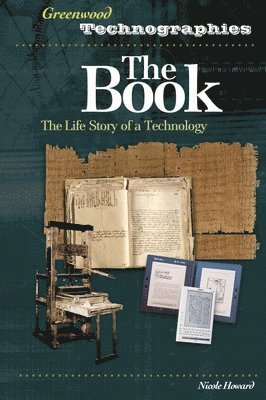
One of life's most frequently encountered technologies is perhaps the one most often taken for granted: the printed book. Daily contact with books makes these everyday objects so familiar that one is apt to forget that the invention of the book has more profoundly altered civilization than almost any other invention. This volume provides a broad overview of the printed book's development across many centuries, cultures, and in a variety of fields. It highlights the forerunners and offshoots of books that have come from and been dispersed to all corners of the globe. The creation of a single book requires diverse skills and techniques that have taken centuries to develop. This addition to the Greenwood Technographies series will give readers of all ages a greater appreciation for this familiar phenomenon that is part of everyone's life.The Book: The Life Story of a Technology provides a concise overview of many of the most compelling and important stories of the history of book printing: • The history of books, from papyrus scrolls to e-books• The importance of Gutenberg and his historical context• The development of book materials, bindings, typefaces, and printing methods• The book's social and cultural influences, from scientific research and religious beliefs to the structure of government• Modern technological advances in book printing technology, from linotype and lithography to computer composition and electronic publishingThe volume includes a glossary of terms, a timeline of important events, and a selected bibliography of useful resources for further information.
341 kr
Skickas inom 7-10 vardagar
The printed book is one of life's most frequently encountered technologies. Historian Nicole Howard provides a comprehensive survey of the evolution of this technology, tracing its development across many centuries and cultures. No other technology in human history, declares Howard, has had the impact of this invention. By examining the book as a technology, Howard reveals how profoundly information and media have shaped history and how vital the technology of the book has been to cultural and intellectual change. This engaging study extends from clay tablets and rolls of papyrus to bound folio sheets, from inks and scripts to lead type and printing presses, from the Linotype machine to the laptop. Cross-cultural in scope, it examines innovations in the production and manufacture of books from the Middle and Far East, Europe, and the Americas. Howard recounts printing techniques from Gutenberg's first press to 21st-century electronic publishing. Howard's broad overview and accessible writing style make this book ideal for students and bibliophiles alike.The volume includes a glossary of terms, a timeline of important events, and a selected bibliography of useful resources for further information.
404 kr
Skickas
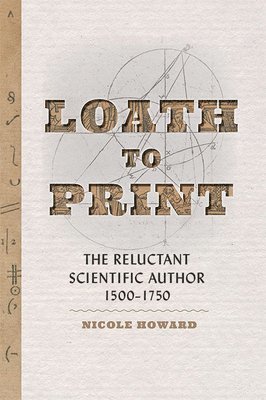
Why did so many early modern scientific authors dislike and distrust the printing press?While there is no denying the importance of the printing press to the scientific and medical advances of the early modern era, a closer look at authorial attitudes toward this technology refutes simplistic interpretations of how print was viewed at the time. Rather than embracing the press, scientific authors often disliked and distrusted it. In many cases, they sought to avoid putting their work into print altogether. In Loath to Print, Nicole Howard takes a fresh look at early modern printing technology from the perspective of the natural philosophers and physicians who relied on it to share ideas. She offers a new perspective on scientific publishing in the early modern period, one that turns the celebration of print on its head. Exploring both these scholars' attitudes and their strategies for navigating the publishing world, Howard argues that scientists had many concerns, including the potential for errors to be introduced into their works by printers, the prospect of having their work pirated, and most worrisome, the likelihood that their works would be misunderstood by an audience ill-prepared to negotiate the complexities of the ideas, particularly those that were mathematical or philosophical. Revealing how these concerns led authors in the sciences to develop strategies for controlling, circumventing, or altogether avoiding the broad readership that print afforded, Loath to Print explains how quickly a gap opened between those with scientific knowledge and a lay public—and how such a gap persists today. Scholars of the early modern period and the history of the book, as well as those interested in communication and technology studies, will find this an accessible and engaging look at the complexities of sharing scientific ideas in this rich period.
163 kr
Skickas inom 5-8 vardagar