Nikhil Pal – författare
Visar alla böcker från författaren Nikhil Pal. Handla med fri frakt och snabb leverans.
4 produkter
4 produkter
Del 4 - Handbooks of Fuzzy Sets
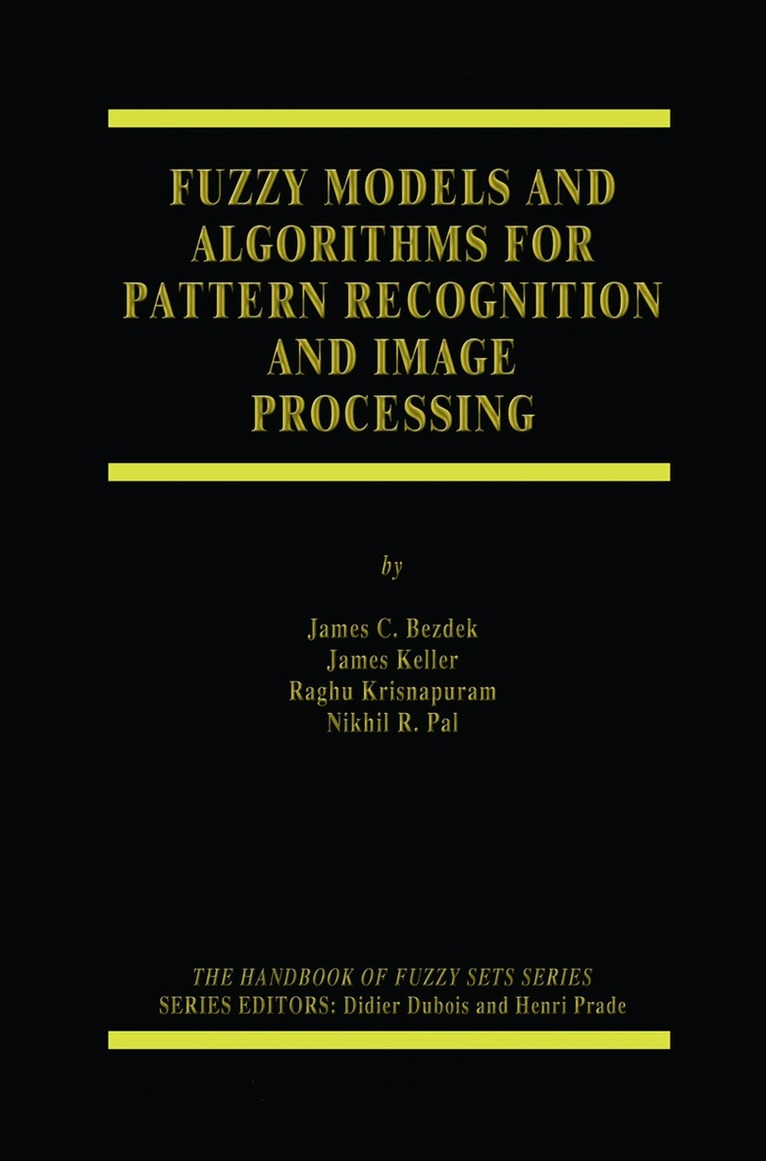
Fuzzy Models and Algorithms for Pattern Recognition and Image Processing
Häftad, Engelska, 2005
3 204 kr
Skickas inom 10-15 vardagar
Fuzzy Models and Algorithms for Pattern Recognition and Image Processing presents a comprehensive introduction of the use of fuzzy models in pattern recognition and selected topics in image processing and computer vision. Unique to this volume in the Kluwer Handbooks of Fuzzy Sets Series is the fact that this book was written in its entirety by its four authors. A single notation, presentation style, and purpose are used throughout. The result is an extensive unified treatment of many fuzzy models for pattern recognition. The main topics are clustering and classifier design, with extensive material on feature analysis relational clustering, image processing and computer vision. Also included are numerous figures, images and numerical examples that illustrate the use of various models involving applications in medicine, character and word recognition, remote sensing, military image analysis, and industrial engineering.
Del 4 - Handbooks of Fuzzy Sets
Fuzzy Models and Algorithms for Pattern Recognition and Image Processing
Inbunden, Engelska, 1999
3 204 kr
Skickas inom 10-15 vardagar
Fuzzy Models and Algorithms for Pattern Recognition and Image Processing presents a comprehensive introduction of the use of fuzzy models in pattern recognition and selected topics in image processing and computer vision. Unique to this volume in the Kluwer Handbooks of Fuzzy Sets Series is the fact that this book was written in its entirety by its four authors. A single notation, presentation style, and purpose are used throughout. The result is an extensive unified treatment of many fuzzy models for pattern recognition. The main topics are clustering and classifier design, with extensive material on feature analysis relational clustering, image processing and computer vision. Also included are numerous figures, images and numerical examples that illustrate the use of various models involving applications in medicine, character and word recognition, remote sensing, military image analysis, and industrial engineering.
Häftad, Engelska, 2014
1 105 kr
Skickas inom 10-15 vardagar
Data mining and knowledge discovery (DMKD) is a rapidly expanding field in computer science. It has become very important because of an increased demand for methodologies and tools that can help the analysis and understanding of huge amounts of data generated on a daily basis by institutions like hospitals, research laboratories, banks, insurance companies, and retail stores and by Internet users. This explosion is a result of the growing use of electronic media. But what is data mining (DM)? A Web search using the Google search engine retrieves many (really many) definitions of data mining. We include here a few interesting ones. One of the simpler definitions is: “As the term suggests, data mining is the analysis of data to establish relationships and identify patterns” [1]. It focuses on identifying relations in data. Our next example is more elaborate: An information extraction activity whose goal is to discover hidden facts contained in databases. Using a combination of machine learning, statistical analysis, modeling techniques and database technology, data mining finds patterns and subtle relationships in data and infers rules that allow the prediction of future results. Typical applications include market segmentation, customer profiling, fraud detection, evaluation of retail promotions, and credit risk analysis [2].
Inbunden, Engelska, 2005
1 105 kr
Skickas inom 10-15 vardagar
Data mining and knowledge discovery (DMKD) is a rapidly expanding field in computer science. It has become very important because of an increased demand for methodologies and tools that can help the analysis and understanding of huge amounts of data generated on a daily basis by institutions like hospitals, research laboratories, banks, insurance companies, and retail stores and by Internet users. This explosion is a result of the growing use of electronic media. But what is data mining (DM)? A Web search using the Google search engine retrieves many (really many) definitions of data mining. We include here a few interesting ones. One of the simpler definitions is: “As the term suggests, data mining is the analysis of data to establish relationships and identify patterns” [1]. It focuses on identifying relations in data. Our next example is more elaborate: An information extraction activity whose goal is to discover hidden facts contained in databases. Using a combination of machine learning, statistical analysis, modeling techniques and database technology, data mining finds patterns and subtle relationships in data and infers rules that allow the prediction of future results. Typical applications include market segmentation, customer profiling, fraud detection, evaluation of retail promotions, and credit risk analysis [2].