Nikolaus Beck – författare
Visar alla böcker från författaren Nikolaus Beck. Handla med fri frakt och snabb leverans.
6 produkter
Institutions of the Market
Organizations, Social Systems, and Governance
Av Nikolaus Beck, Alexander Ebner
E-bok, 2008
655 kr
Lägg i varukorg
This book approaches markets as a dynamic ensemble of institutions; and as a set of rules or norms, that contribute to the evolution of social systems of governance, and can be analysed as a structured social system. It tackles such questions as:* Where do markets come from and what drives their …
Institutions of the Market
Organizations, Social Systems, and Governance
Av Nikolaus Beck, Alexander Ebner
E-bok, 2008
721 kr
Lägg i varukorg
This book approaches markets as a dynamic ensemble of institutions; and as a set of rules or norms, that contribute to the evolution of social systems of governance, and can be analysed as a structured social system. It tackles such questions as:* Where do markets come from and what drives their …
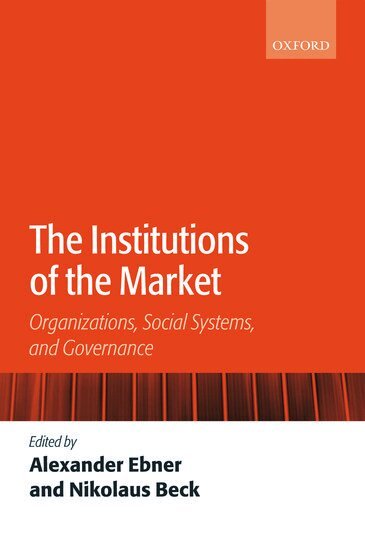
The Institutions of the Market
Organizations, Social Systems, and Governance
Av Alexander Ebner, Nikolaus Beck
Inbunden, 2008
1523 kr
Lägg i varukorg
This book approaches markets as a dynamic ensemble of institutions; and as a set of rules or norms, that contribute to the evolution of social systems of governance, and can be analysed as a structured social system. It tackles such questions as:* Where do markets come from and what drives their …
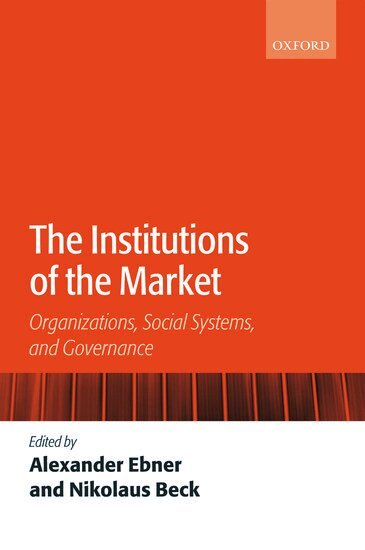
The Institutions of the Market
Organizations, Social Systems, and Governance
Av Alexander Ebner, Nikolaus Beck
Häftad, 2008
1013 kr
Lägg i varukorg
This book approaches markets as a dynamic ensemble of institutions; and as a set of rules or norms, that contribute to the evolution of social systems of governance, and can be analysed as a structured social system. It tackles such questions as:* Where do markets come from and what drives their …
Kontinuität des Wandels
Inkrementale Änderungen einer Organisation
E-bok, 2013
462 kr
Lägg i varukorg
Organisatorische Regeln sind ein recht ungewöhnliches Untersuchungsobjekt für eine wissenschaftliche Untersuchung. Häufig werden sie vor allem als bürokratische Hemmnisse der Kreativität von Organisationsmitgliedern betrachtet. Eine möglichst regelarme Organisation und Organisationsmitglieder, die …
Kontinuität des Wandels
Inkrementale Änderungen einer Organisation
Häftad, 2001
567 kr
Lägg i varukorg
Organisatorische Regeln sind ein recht ungewöhnliches Untersuchungsobjekt für eine wissenschaftliche Untersuchung. Häufig werden sie vor allem als bürokratische Hemmnisse der Kreativität von Organisationsmitgliedern betrachtet. Eine möglichst regelarme Organisation und Organisationsmitglieder, die …