Niranjan Suri – författare
Visar alla böcker från författaren Niranjan Suri. Handla med fri frakt och snabb leverans.
7 produkter
7 produkter
Häftad, Engelska, 2019
882 kr
Skickas inom 10-15 vardagar
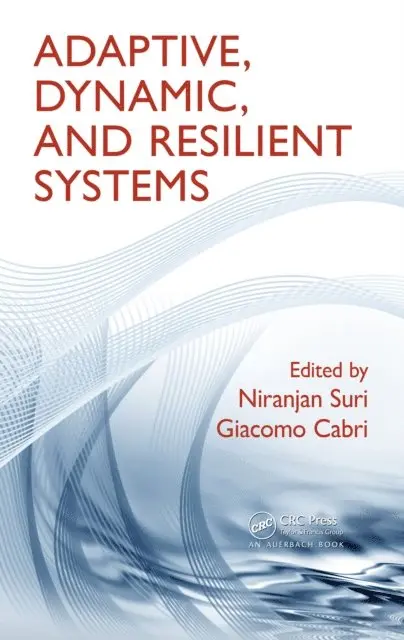
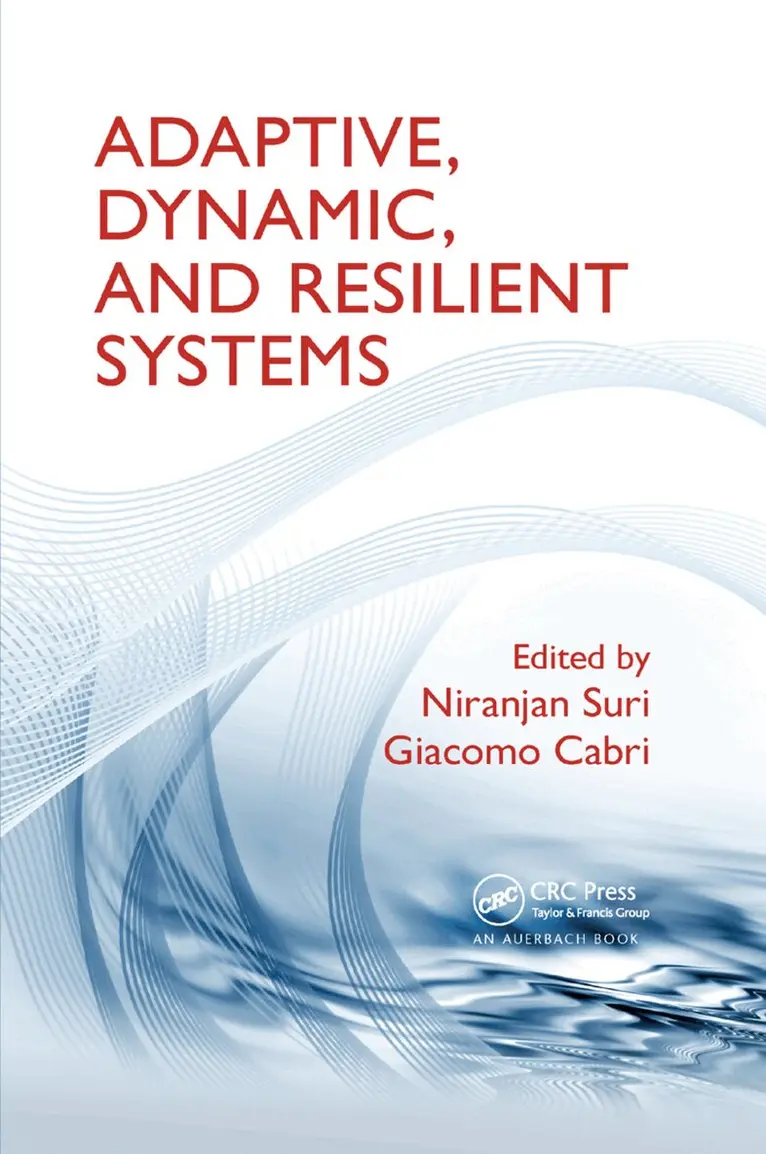
As the complexity of today’s networked computer systems grows, they become increasingly difficult to understand, predict, and control. Addressing these challenges requires new approaches to building these systems. Adaptive, Dynamic, and Resilient Systems supplies readers with various perspectives of the critical infrastructure that systems of networked computers rely on. It introduces the key issues, describes their interrelationships, and presents new research in support of these areas.The book presents the insights of a different group of international experts in each chapter. Reporting on recent developments in adaptive systems, it begins with a survey of application fields. It explains the requirements of such fields in terms of adaptation and resilience. It also provides some abstract relationship graphs that illustrate the key attributes of distributed systems to supply you with a better understanding of these factors and their dependencies.The text examines resilient adaptive systems from the perspectives of mobile, infrastructure, and enterprise systems and protecting critical infrastructure. It details various approaches for building adaptive, dynamic, and resilient systems—including agile, grid, and autonomic computing; multi-agent-based and biologically inspired approaches; and self-organizing systems.The book includes many stories of successful applications that illustrate a diversified range of cutting-edge approaches. It concludes by covering related topics and techniques that can help to boost adaptation and resilience in your systems.
E-bok
Engelska, 20141 074 kr
Läs direkt efter köp
As the complexity of today''s networked computer systems grows, they become increasingly difficult to understand, predict, and control. Addressing these challenges requires new approaches to building these systems. Adaptive, Dynamic, and Resilient Systems supplies readers with various perspectives of the critical infrastructure that systems of netwo
Inbunden, Engelska, 2014
1 903 kr
Skickas inom 10-15 vardagar
As the complexity of today’s networked computer systems grows, they become increasingly difficult to understand, predict, and control. Addressing these challenges requires new approaches to building these systems. Adaptive, Dynamic, and Resilient Systems supplies readers with various perspectives of the critical infrastructure that systems of networked computers rely on. It introduces the key issues, describes their interrelationships, and presents new research in support of these areas.The book presents the insights of a different group of international experts in each chapter. Reporting on recent developments in adaptive systems, it begins with a survey of application fields. It explains the requirements of such fields in terms of adaptation and resilience. It also provides some abstract relationship graphs that illustrate the key attributes of distributed systems to supply you with a better understanding of these factors and their dependencies.The text examines resilient adaptive systems from the perspectives of mobile, infrastructure, and enterprise systems and protecting critical infrastructure. It details various approaches for building adaptive, dynamic, and resilient systems—including agile, grid, and autonomic computing; multi-agent-based and biologically inspired approaches; and self-organizing systems.The book includes many stories of successful applications that illustrate a diversified range of cutting-edge approaches. It concludes by covering related topics and techniques that can help to boost adaptation and resilience in your systems.
E-bok
PDF, Engelska, 20141 043 kr
Läs direkt efter köp
As the complexity of today''s networked computer systems grows, they become increasingly difficult to understand, predict, and control. Addressing these challenges requires new approaches to building these systems. Adaptive, Dynamic, and Resilient Systems supplies readers with various perspectives of the critical infrastructure that systems of netwo
Inbunden, Engelska, 2026
543 kr
Skickas inom 10-15 vardagar
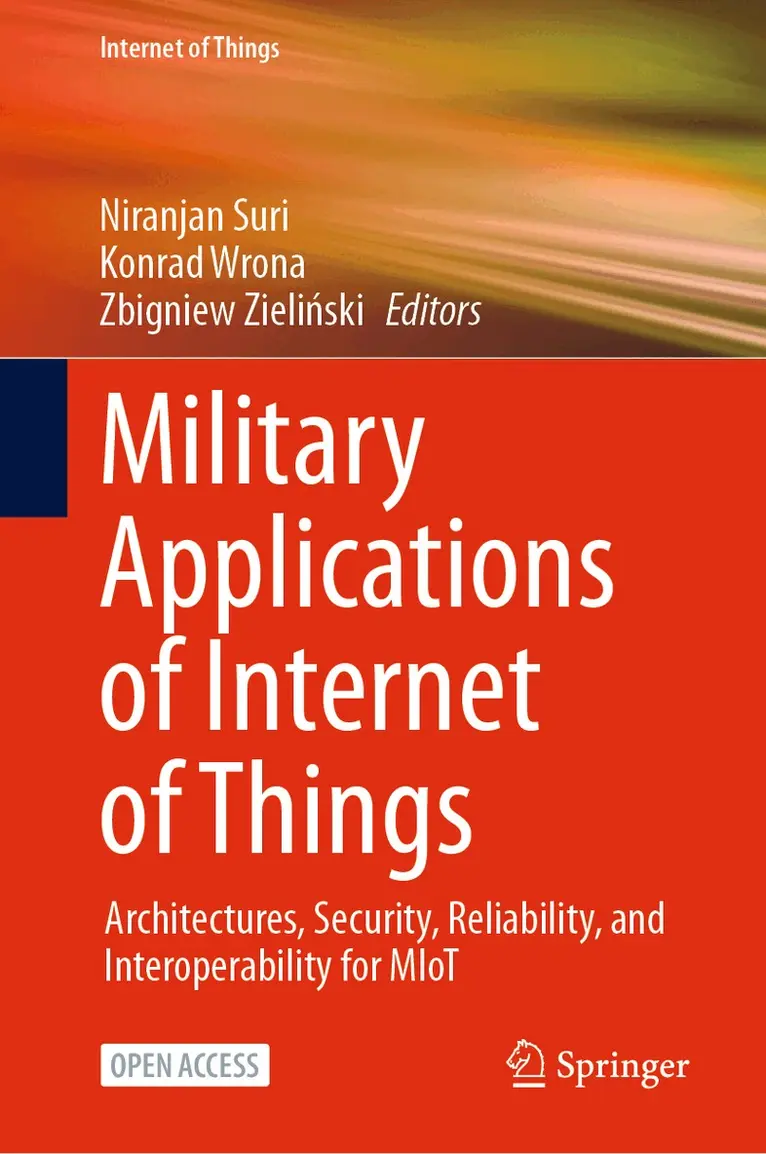
This open-access book examines the military applications of the Internet of Things in three main parts: (I) Motivation and Use Cases, (II) Challenges and Solutions, and (III) Experimental Results and Recommendations. The first part describes the motivation and selected Military IoT (MIoT) application areas. The second part provides an overview of the specific requirements that MIoT applications must meet, including the ability to process large volumes of diverse data, support for increased automation, robust device and network security, and resilience against electronic warfare measures. It examines existing architectural frameworks for IoT ecosystems and the challenges of integrating these frameworks into current military infrastructure, including communications, and proposes architectural patterns for integrating IoT into the military domain. Part II evaluates current IoT-related technologies for sensing, actuation, and communication relevant to the military domain. It also offers a comprehensive overview of various aspects of IT network security in military applications, including the concept of Data-Centric Security, which is viewed as a promising security model for future NATO operations. Other security considerations include securing data exchange between the IoT networks and federated C2 systems, leveraging publish-subscribe services, and incorporating trusted hardware components, such as TPM, into IoT devices to improve security. Part II also outlines a comprehensive approach to ensuring reliability and security across all layers and stages of the MIoT lifecycle and evaluates the suitability of selected fault-tolerance techniques in MIoT, including the need for fault-tolerance methods to be consistently applied across all layers. Part III summarizes five different categories of experiments conducted by the authors on a distributed NATO testbed at multiple physical locations to test and validate IoT technologies and their applications within the military domain.
Häftad, Engelska, 2002
559 kr
Skickas inom 10-15 vardagar
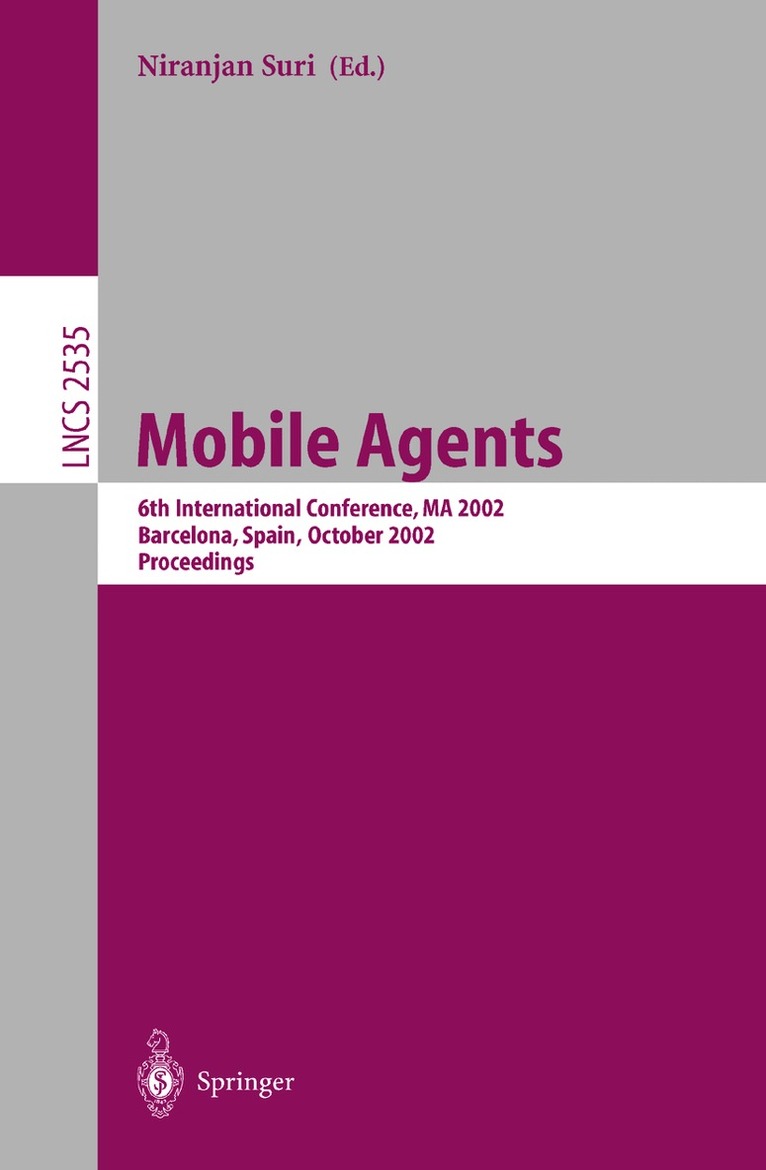
Welcome to the proceedings of the 6th IEEE International Conference on Mobile Agents. MA 2002 took place in Barcelona, Spain and was co-located with the 4th International Workshop on Mobile Agents for Telecommunications Applications. Both events were held at the Universitat Pompeu Fabra, October 22–25, 2002. Mobile agents may be de?ned as programs that, with varying degree of - tonomy, can move between hosts across a network. Mobile agents combine the notions of mobile code, mobile computation, and mobile state. Capabilities of mobile agents include: – Supporting unrealiable networks and disconnected operation – Counteracting low-bandwidth, high-latency communication links – Deploying newbehaviour (through mobile code) and recon?guring systems on-the-?y – Distributing processing load across systems – Improving survivability in the face of network and system failure. Given the above capabilities, mobile agents (while they may not be referred to as such) are nowbecoming accepted as a fundamental architectural construct for the design and development of complex adaptive systems that need to operate in highly dynamic environments. Mobile agents also support applications in several domains such as ubiquitous computing, grid computing, remote sensing, data mining, system management, and agile computing.
E-bok
PDF, Engelska, 2003734 kr
Läs direkt efter köp
Welcome to the proceedings of the 6th IEEE International Conference on Mobile Agents. MA 2002 took place in Barcelona, Spain and was co-located with the 4th International Workshop on Mobile Agents for Telecommunications Applications. Both events were held at the Universitat Pompeu Fabra, October 22–25, 2002. Mobile agents may be de?ned as programs that, with varying degree of - tonomy, can move between hosts across a network. Mobile agents combine the notions of mobile code, mobile computation, and mobile state. Capabilities of mobile agents include: – Supporting unrealiable networks and disconnected operation – Counteracting low-bandwidth, high-latency communication links – Deploying newbehaviour (through mobile code) and recon?guring systems on-the-?y – Distributing processing load across systems – Improving survivability in the face of network and system failure. Given the above capabilities, mobile agents (while they may not be referred to as such) are nowbecoming accepted as a fundamental architectural construct for the design and development of complex adaptive systems that need to operate in highly dynamic environments. Mobile agents also support applications in several domains such as ubiquitous computing, grid computing, remote sensing, data mining, system management, and agile computing.