Nisuke Ando – författare
Visar alla böcker från författaren Nisuke Ando. Handla med fri frakt och snabb leverans.
5 produkter
5 produkter
Inbunden, Engelska, 1991
1 348 kr
Skickas inom 3-6 vardagar
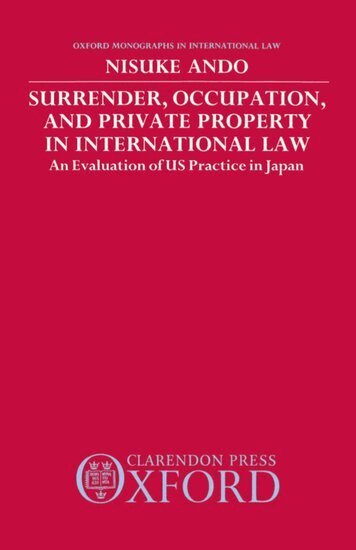
The most recent title to appear in the Oxford Monographs in International Law series, Surrender, Occupation, and Private Property in International Law examines the legal situation which arises during periods of occupation in respect of private property which is temporarily used, annexed, or destroyed by occupying forces. It asks what happens to that property after occupation ceases, and addresses the issues of restitution and compensation which may sometimes arise. The author focuses upon the post-war occupation of Japan by American forces as the principal example around which to develop his arguments, and makes extensive use of documents from this period. Relatively little has been written about this crucial period in Japanese history, and the successful linking of the historical and legal aspects in this study will make this book of considerable interest to international lawyers and modern historians.
Inbunden, Engelska, 2004
4 794 kr
Skickas inom 3-6 vardagar
E-bok
PDF, Engelska, 20224 707 kr
Läs direkt efter köp
Judge Shigeru Oda, having served since 1976 in three successive nine-year terms on the International Court of Justice, has helped to shape the Court's jurisprudence for over a quarter century. His influence on the law of the sea spans an even longer period, beginning with his doctoral dissertation at Yale Law school in the 1950s and continuing with his involvement in the First, Second and Third UN Conferences on the Law of the Sea. In a tribute to Judge Oda's significant contributions to international law, leading scholars on the law of the sea, international dispute settlement and the ICJ itself have produced a Festschrift in his honour that promises to be a standard reference work on these topics for years to come. This two volume work, containing over 95 articles, begins by examining the role of the international judge and the jurisdiction of international tribunals (including reservations to jurisdiction, the Optional Clause, the Special Agreement, and the power to indicate special measures). It contains a particularly lively debate regarding the proliferation of international tribunals and whether the potential for conflicting decisions is problematic or productive. Other areas of focus include the history and current development of the law of the sea; the first in-depth examination of the establishment and first decisions of the International Tribunal for the Law of the Sea; and the ICJ's treatment of the development, doctrines and sources of international law. Further sections are devoted to International Litigation as analysed by leading practitioners; Land and Maritime Boundaries, International Watercourses and Other Waters; and Defence, the Use of Force and the Law of Armed Conflict. The composition of the editorial team - Nisuke Ando of Kyoto, Edward McWhinney of Ottawa and Rudiger Wolfrum of Heidelberg - reflects Judge Oda's truly international career and the extent to which his work has drawn from and contributed to diverse legal traditions. The print edition is available as a set of two volumes (9789041117908).
E-bok
PDF, Engelska, 20233 847 kr
Läs direkt efter köp
This book is a record of the international symposium held at the Kyoto International Conference Hall to mark the centennial of the Japanese Association of International Law. The purpose of the symposium was to reflect on past Japanese practice, to analyze current problems affecting Japan, and to seek to clarify the future role of Japan in the global community, in terms of international law. After joining the international community in the middle of the nineteenth century, Japan adopted a policy of wealth creation and armament in order to maintain its independence against the expanding Western States. At the same time, on the domestic scene, Japan vigorously promoted the modernization - Westernization - of its political, economic, and social institutions. Japan emerged as one of the victorious `Principal Allied and Associated Powers' in World War I, and started asserting its place in the international order. However, in the aftermath of the Great Depression, Japan failed to reach agreement with the international community, eventually left the League of Nations, invaded the Asian continent, and met with complete military defeat in World War II. In the subsequent years, Japan toiled to rebuild its economy and to rejoin the world community, but despite its miraculous economic recovery and expansion, Japan remains ambivalent in its policy of contributing to the maintenance of international peace and security. During these one and a half centuries the Japanese practice of international law has covered a wide range of fields. From these various fields, the symposium took up three specific topics: War and Peace, Economy, and Human Rights, because of their relevance to past Japanese practice and because future Japanese practice in these areas would be bound to affect international law in the coming century. In addition, the symposium discussed Japanese transactions, in general, with international law. The period covered by the symposium has witnessed many drastic changes in the world, and international law, which used to be applied almost exclusively to relations among the Western States, has now come to be applied universally. The Association wished to emphasize that an analysis of Japanese practice should be of significance for anyone interested in promoting and consolidating the rule of law in the world community at large.
E-bok
PDF, Engelska, 20044 670 kr
Läs direkt efter köp
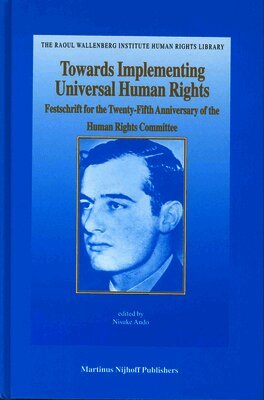
This unique collection has been compiled to mark the occasion of the 25th anniversary of the activities of the Human Rights Committee established under the International Covenant on Civil and Political Rights. It reflects various aspects of the Committee and its activities and is comprised of articles contributed exclusively by its members, past and present.The Festschrift is divided into five chapters. Chapter I comprises four articles dealing with the UN system of human rights protection in general and the role and work of the Human Rights Committee in particular. Chapter II contains two articles on the historical aspects of the Committee, both in retrospect and prospect. Chapter III covers three articles, each dealing with the Committee's different activities of a general nature, whereas Chapter IV includes six articles, each analyzing Committee activities of a specific nature. Chapter V is composed of only one article, a case study of domestic implementation of the Covenant. This is a must-have collection for government officials, academics, NGO personnel and students interested in studying human rights in a worldwide perspective.