Nitesh Chawla - Böcker
Visar alla böcker från författaren Nitesh Chawla. Handla med fri frakt och snabb leverans.
5 produkter
5 produkter
847 kr
Skickas inom 10-15 vardagar
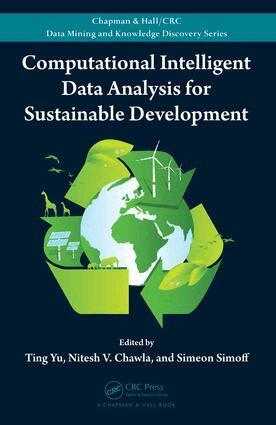
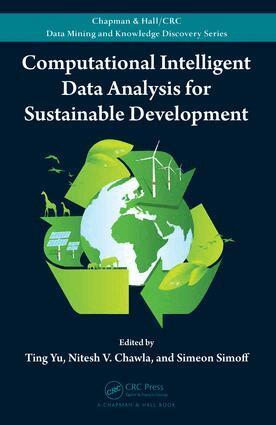
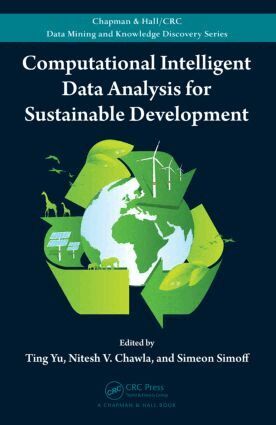
Going beyond performing simple analyses, researchers involved in the highly dynamic field of computational intelligent data analysis design algorithms that solve increasingly complex data problems in changing environments, including economic, environmental, and social data. Computational Intelligent Data Analysis for Sustainable Development presents novel methodologies for automatically processing these types of data to support rational decision making for sustainable development. Through numerous case studies and applications, it illustrates important data analysis methods, including mathematical optimization, machine learning, signal processing, and temporal and spatial analysis, for quantifying and describing sustainable development problems.With a focus on integrated sustainability analysis, the book presents a large-scale quadratic programming algorithm to expand high-resolution input-output tables from the national scale to the multinational scale to measure the carbon footprint of the entire trade supply chain. It also quantifies the error or dispersion between different reclassification and aggregation schemas, revealing that aggregation errors have a high concentration over specific regions and sectors.The book summarizes the latest contributions of the data analysis community to climate change research. A profuse amount of climate data of various types is available, providing a rich and fertile playground for future data mining and machine learning research. The book also pays special attention to several critical challenges in the science of climate extremes that are not handled by the current generation of climate models. It discusses potential conceptual and methodological directions to build a close integration between physical understanding, or physics-based modeling, and data-driven insights. The book then covers the conservation of species and ecologically valuable land. A case study on the Pennsylvania Dirt and Gravel Roads Program demonstrates that multiple-objective linear programming is a more versatile and efficient approach than the widely used benefit targeting selection process.Moving on to renewable energy and the need for smart grids, the book explores how the ongoing transformation to a sustainable energy system of renewable sources leads to a paradigm shift from demand-driven generation to generation-driven demand. It shows how to maximize renewable energy as electricity by building a supergrid or mixing renewable sources with demand management and storage. It also presents intelligent data analysis for real-time detection of disruptive events from power system frequency data collected using an existing Internet-based frequency monitoring network as well as evaluates a set of computationally intelligent techniques for long-term wind resource assessment.In addition, the book gives an example of how temporal and spatial data analysis tools are used to gather knowledge about behavioral data and address important social problems such as criminal offenses. It also applies constraint logic programming to a planning problem: the environmental and social impact assessment of the regional energy plan of the Emilia-Romagna region of Italy.Sustainable development problems, such as global warming, resource shortages, global species loss, and pollution, push researchers to create powerful data analysis approaches that analysts can then use to gain insight into these issues to support rational decision making. This volume shows both the data analysis and sustainable development communities how to use intelligent data analysis tools to address practical problems and encourages researchers to develop better methods.
2 358 kr
Skickas inom 10-15 vardagar
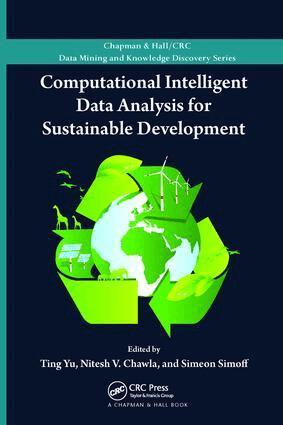
Going beyond performing simple analyses, researchers involved in the highly dynamic field of computational intelligent data analysis design algorithms that solve increasingly complex data problems in changing environments, including economic, environmental, and social data. Computational Intelligent Data Analysis for Sustainable Development presents novel methodologies for automatically processing these types of data to support rational decision making for sustainable development. Through numerous case studies and applications, it illustrates important data analysis methods, including mathematical optimization, machine learning, signal processing, and temporal and spatial analysis, for quantifying and describing sustainable development problems.With a focus on integrated sustainability analysis, the book presents a large-scale quadratic programming algorithm to expand high-resolution input-output tables from the national scale to the multinational scale to measure the carbon footprint of the entire trade supply chain. It also quantifies the error or dispersion between different reclassification and aggregation schemas, revealing that aggregation errors have a high concentration over specific regions and sectors.The book summarizes the latest contributions of the data analysis community to climate change research. A profuse amount of climate data of various types is available, providing a rich and fertile playground for future data mining and machine learning research. The book also pays special attention to several critical challenges in the science of climate extremes that are not handled by the current generation of climate models. It discusses potential conceptual and methodological directions to build a close integration between physical understanding, or physics-based modeling, and data-driven insights. The book then covers the conservation of species and ecologically valuable land. A case study on the Pennsylvania Dirt and Gravel Roads Program demonstrates that multiple-objective linear programming is a more versatile and efficient approach than the widely used benefit targeting selection process.Moving on to renewable energy and the need for smart grids, the book explores how the ongoing transformation to a sustainable energy system of renewable sources leads to a paradigm shift from demand-driven generation to generation-driven demand. It shows how to maximize renewable energy as electricity by building a supergrid or mixing renewable sources with demand management and storage. It also presents intelligent data analysis for real-time detection of disruptive events from power system frequency data collected using an existing Internet-based frequency monitoring network as well as evaluates a set of computationally intelligent techniques for long-term wind resource assessment.In addition, the book gives an example of how temporal and spatial data analysis tools are used to gather knowledge about behavioral data and address important social problems such as criminal offenses. It also applies constraint logic programming to a planning problem: the environmental and social impact assessment of the regional energy plan of the Emilia-Romagna region of Italy.Sustainable development problems, such as global warming, resource shortages, global species loss, and pollution, push researchers to create powerful data analysis approaches that analysts can then use to gain insight into these issues to support rational decision making. This volume shows both the data analysis and sustainable development communities how to use intelligent data analysis tools to address practical problems and encourages researchers to develop better methods.
1 064 kr
Skickas inom 10-15 vardagar
This collection of contributed chapters demonstrates a wide range of applications within two overlapping research domains: social media analysis and social network analysis. Various methodologies were utilized in the twelve individual chapters including static, dynamic and real-time approaches to graph, textual and multimedia data analysis. The topics apply to reputation computation, emotion detection, topic evolution, rumor propagation, evaluation of textual opinions, friend ranking, analysis of public transportation networks, diffusion in dynamic networks, analysis of contributors to communities of open source software developers, biometric template generation as well as analysis of user behavior within heterogeneous environments of cultural educational centers. Addressing these challenging applications is what makes this edited volume of interest to researchers and students focused on social media and social network analysis.
1 064 kr
Skickas inom 10-15 vardagar
This collection of contributed chapters demonstrates a wide range of applications within two overlapping research domains: social media analysis and social network analysis. Various methodologies were utilized in the twelve individual chapters including static, dynamic and real-time approaches to graph, textual and multimedia data analysis. The topics apply to reputation computation, emotion detection, topic evolution, rumor propagation, evaluation of textual opinions, friend ranking, analysis of public transportation networks, diffusion in dynamic networks, analysis of contributors to communities of open source software developers, biometric template generation as well as analysis of user behavior within heterogeneous environments of cultural educational centers. Addressing these challenging applications is what makes this edited volume of interest to researchers and students focused on social media and social network analysis.
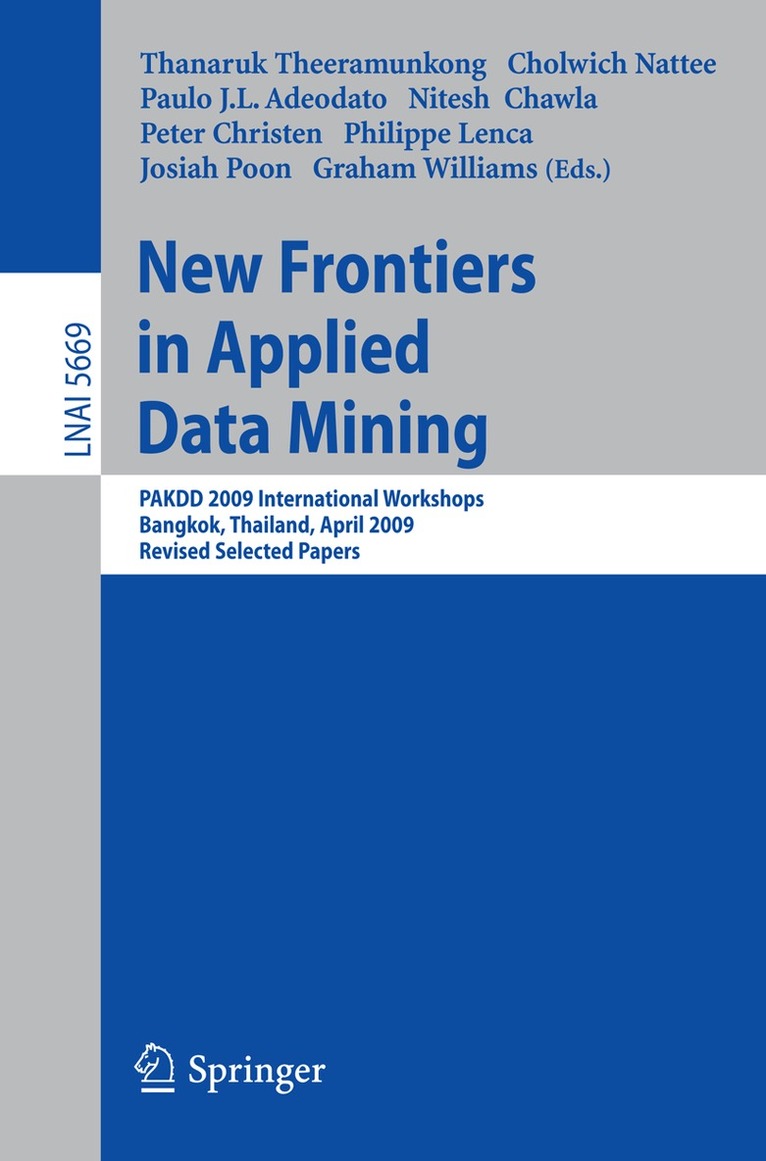
New Frontiers in Applied Data Mining
PAKDD 2009 International Workshops, Bangkok, Thailand, April 27-30, 2010. Revised Selected Papers
Häftad, Engelska, 2010
551 kr
Skickas inom 10-15 vardagar
Five high-quality workshops were held at the 13th Paci?c-Asia Conference on Knowledge Discovery and Data Mining (PAKDD 2009) in Bangkok, Thailand during April 27-30, 2009. There were 17, 6, 9, 4 and 5 accepted papers to be presented at the Paci?c Asia Workshop on Intelligence and Security Informatics (PAISI 2009), the workshop on Advances and Issues in Biomedical Data Mining (AIBDM 2009), the workshop on Data Mining with Imbalanced Classes and Error Cost (ICEC 2009),the workshopon Open Source in Data Mining (OSDM 2009), and the workshop on Quality Issues, Measures of Interestingness and Evaluation of Data Mining Models (QIMIE 2009). One competition, PAKDD 2009 Data Mining Competition, and one local workshop, Thai Track Session, were arranged. From these workshops (except PAISI which published its works in separate LNCS proceedings), we selected two or three best papers for this LNCS publication. PAKDD is a major international conference in the areas of data mining (DM) and knowledge discovery in database (KDD).It provides an internationalforum for researchersand industry practitioners to share their new ideas, original research results and practical development experiences from all KDD-related areas including data mining, data warehousing, machine learning, databases, statistics, knowledge acquisition and automatic scienti?c discovery, data visualization, causal induction and knowledge-based systems. In general,we wish to thank our General WorkshopCo-chairs,Manabu O- mura and Bernhard Pfahringe, for selecting and coordinating the great wo- shops. WewouldliketothankJunbinGao(CharlesSturtUniversity),PaulKwan (UniversityofNewEngland,Australia),JosiahPoon(UniversityofSydney),and Simon Poon (University of Sydney), for their arrangement of AIBDM 2009.