Niyazi Serdar Sariciftci – författare
1 217 kr
Skickas inom 5-8 vardagar
947 kr
Skickas inom 10-15 vardagar
3 587 kr
Skickas inom 10-15 vardagar
1 127 kr
Läs direkt efter köp
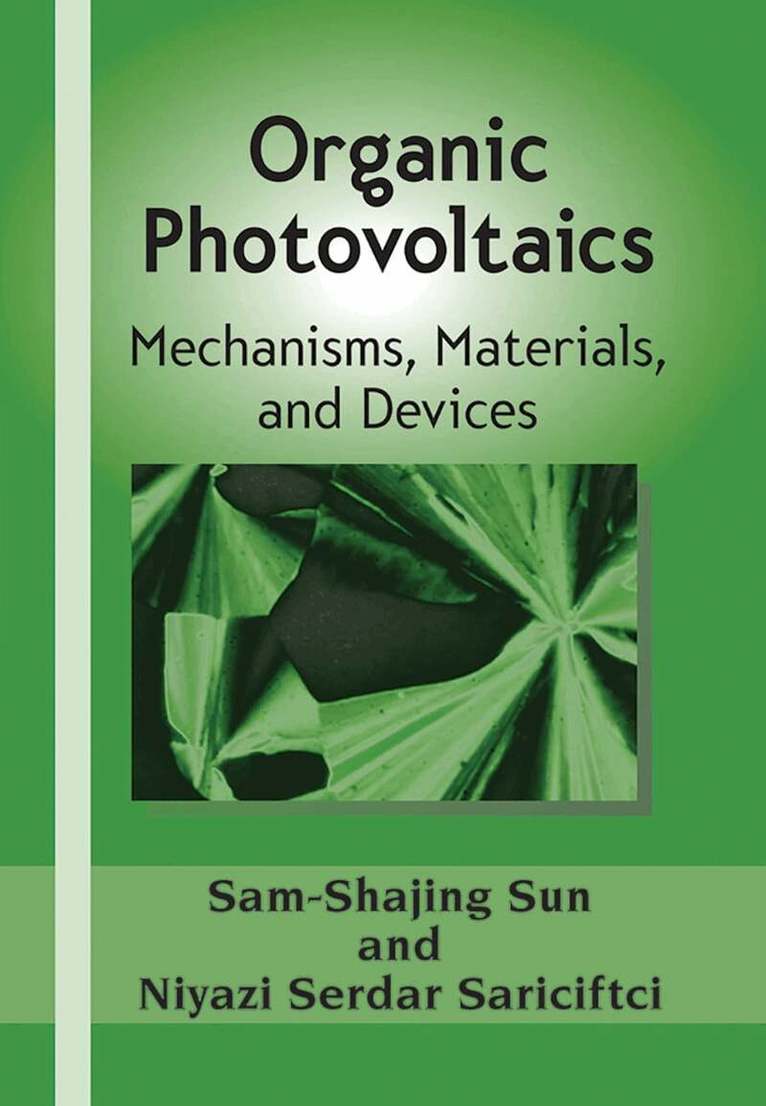
Recently developed organic photovoltaics (OPVs) show distinct advantages over their inorganic counterparts due to their lighter weight, flexible shape, versatile materials synthesis and device fabrication schemes, and low cost in large-scale industrial production. Although many books currently exist on general concepts of PV and inorganic PV materials and devices, few are available that offer a comprehensive overview of recently fast developing organic and polymeric PV materials and devices.
Organic Photovoltaics: Mechanisms, Materials, and Devices fills this gap. The book provides an international perspective on the latest research in this rapidly expanding field with contributions from top experts around the world. It presents a unified approach comprising three sections: General Overviews; Mechanisms and Modeling; and Materials and Devices. Discussions include sunlight capture, exciton diffusion and dissociation, interface properties, charge recombination and migration, and a variety of currently developing OPV materials/devices. The book also includes two forewords: one by Nobel Laureate Dr. Alan J. Heeger, and the other by Drs. Aloysius Hepp and Sheila Bailey of NASA Glenn Research Center.
Organic Photovoltaics equips students, researchers, and engineers with knowledge of the mechanisms, materials, devices, and applications of OPVs necessary to develop cheaper, lighter, and cleaner renewable energy throughout the coming decades.
1 451 kr
Läs direkt efter köp
Recently developed organic photovoltaics (OPVs) show distinct advantages over their inorganic counterparts due to their lighter weight, flexible shape, versatile materials synthesis and device fabrication schemes, and low cost in large-scale industrial production. Although many books currently exist on general concepts of PV and inorganic PV materials and devices, few are available that offer a comprehensive overview of recently fast developing organic and polymeric PV materials and devices.
Organic Photovoltaics: Mechanisms, Materials, and Devices fills this gap. The book provides an international perspective on the latest research in this rapidly expanding field with contributions from top experts around the world. It presents a unified approach comprising three sections: General Overviews; Mechanisms and Modeling; and Materials and Devices. Discussions include sunlight capture, exciton diffusion and dissociation, interface properties, charge recombination and migration, and a variety of currently developing OPV materials/devices. The book also includes two forewords: one by Nobel Laureate Dr. Alan J. Heeger, and the other by Drs. Aloysius Hepp and Sheila Bailey of NASA Glenn Research Center.
Organic Photovoltaics equips students, researchers, and engineers with knowledge of the mechanisms, materials, devices, and applications of OPVs necessary to develop cheaper, lighter, and cleaner renewable energy throughout the coming decades.
1 512 kr
Skickas inom 7-10 vardagar
Organic Photovoltaics
Concepts and Realization
2 178 kr
Skickas inom 10-15 vardagar
Organic Photovoltaics
Concepts and Realization
2 178 kr
Skickas inom 10-15 vardagar
2 840 kr
Läs direkt efter köp
Achieving efficient solar energy conversion at both large scale and low cost is among the most important technological challenges for the near future. The present volume describes and explains the fundamentals of organic/plastic solar cells in a manner accessible to both researchers and students. It provides a comprehensive analysis of the operational principles underlying several types of solar cells that have absorber layers based on polymer materials and small molecules. It addresses competing approaches, such as polymer solar cells and dye-sensitized cells, while considering the thermodynamic principles within the context of these schemes. Organic Photovoltaics also analyzes in detail the charge-transfer processes in the bulk-heterojunction devices corresponding to the relevant mechanism of carrier generation. Emphasized throughout is the concept of interpenetrating polymer-fullerene networks, due to their high potential for improving power efficiency.