Noel Cressie – författare
892 kr
Läs direkt efter köp
892 kr
Läs direkt efter köp
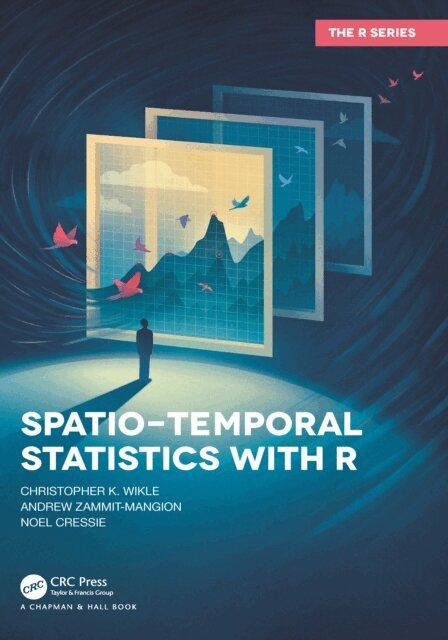
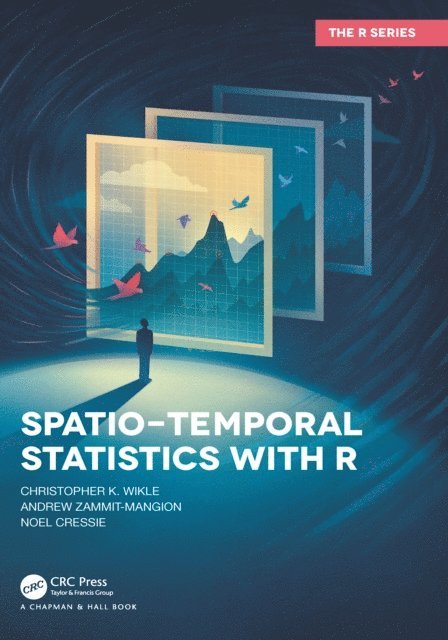
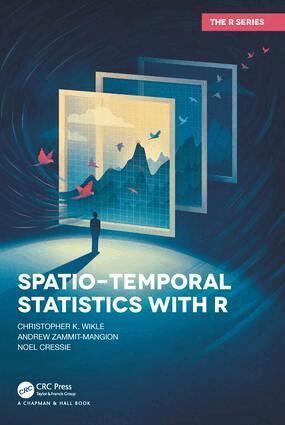
The world is becoming increasingly complex, with larger quantities of data available to be analyzed. It so happens that much of these "big data" that are available are spatio-temporal in nature, meaning that they can be indexed by their spatial locations and time stamps.
Spatio-Temporal Statistics with R provides an accessible introduction to statistical analysis of spatio-temporal data, with hands-on applications of the statistical methods using R Labs found at the end of each chapter. The book:
Gives a step-by-step approach to analyzing spatio-temporal data, starting with visualization, then statistical modelling, with an emphasis on hierarchical statistical models and basis function expansions, and finishing with model evaluation Provides a gradual entry to the methodological aspects of spatio-temporal statistics Provides broad coverage of using R as well as "R Tips" throughout. Features detailed examples and applications in end-of-chapter Labs Features "Technical Notes" throughout to provide additional technical detail where relevant Supplemented by a website featuring the associated R package, data, reviews, errata, a discussion forum, and moreThe book fills a void in the literature and available software, providing a bridge for students and researchers alike who wish to learn the basics of spatio-temporal statistics. It is written in an informal style and functions as a down-to-earth introduction to the subject. Any reader familiar with calculus-based probability and statistics, and who is comfortable with basic matrix-algebra representations of statistical models, would find this book easy to follow. The goal is to give as many people as possible the tools and confidence to analyze spatio-temporal data.
903 kr
Skickas inom 5-8 vardagar
1 007 kr
Läs direkt efter köp
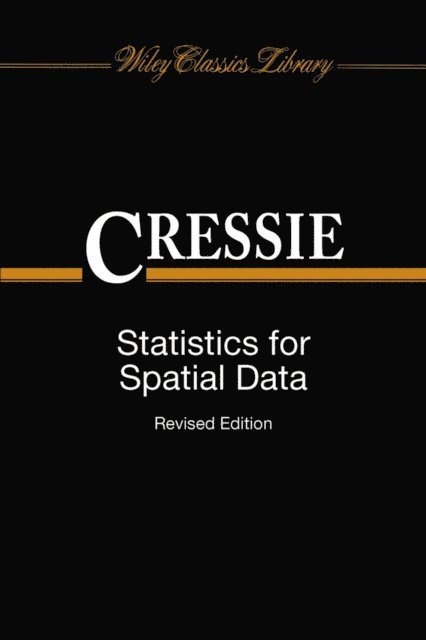
The Wiley Classics Library consists of selected books that have been made more accessible to consumers in an effort to increase global appeal and general circulation. With these new unabridged softcover volumes, Wiley hopes to extend the lives of these works by making them available to future generations of statisticians, mathematicians, and scientists.
Spatial statistics — analyzing spatial data through statistical models — has proven exceptionally versatile, encompassing problems ranging from the microscopic to the astronomic. However, for the scientist and engineer faced only with scattered and uneven treatments of the subject in the scientific literature, learning how to make practical use of spatial statistics in day-to-day analytical work is very difficult.
Designed exclusively for scientists eager to tap into the enormous potential of this analytical tool and upgrade their range of technical skills, Statistics for Spatial Data is a comprehensive, single-source guide to both the theory and applied aspects of spatial statistical methods. The hard-cover edition was hailed by Mathematical Reviews as an "excellent book which will become a basic reference." This paper-back edition of the 1993 edition, is designed to meet the many technological challenges facing the scientist and engineer. Concentrating on the three areas of geostatistical data, lattice data, and point patterns, the book sheds light on the link between data and model, revealing how design, inference, and diagnostics are an outgrowth of that link. It then explores new methods to reveal just how spatial statistical models can be used to solve important problems in a host of areas in science and engineering.
Discussion includes:
Exploratory spatial data analysis Spectral theory for stationary processes Spatial scale Simulation methods for spatial processes Spatial bootstrapping Statistical image analysis and remote sensing Computational aspects of model fitting Application of models to disease mappingDesigned to accommodate the practical needs of the professional, it features a unified and common notation for its subject as well as many detailed examples woven into the text, numerous illustrations (including graphs that illuminate the theory discussed) and over 1,000 references.
Fully balancing theory with applications, Statistics for Spatial Data, Revised Edition is an exceptionally clear guide on making optimal use of one of the ascendant analytical tools of the decade, one that has begun to capture the imagination of professionals in biology, earth science, civil, electrical, and agricultural engineering, geography, epidemiology, and ecology.
1 007 kr
Läs direkt efter köp
The Wiley Classics Library consists of selected books that have been made more accessible to consumers in an effort to increase global appeal and general circulation. With these new unabridged softcover volumes, Wiley hopes to extend the lives of these works by making them available to future generations of statisticians, mathematicians, and scientists.
Spatial statistics — analyzing spatial data through statistical models — has proven exceptionally versatile, encompassing problems ranging from the microscopic to the astronomic. However, for the scientist and engineer faced only with scattered and uneven treatments of the subject in the scientific literature, learning how to make practical use of spatial statistics in day-to-day analytical work is very difficult.
Designed exclusively for scientists eager to tap into the enormous potential of this analytical tool and upgrade their range of technical skills, Statistics for Spatial Data is a comprehensive, single-source guide to both the theory and applied aspects of spatial statistical methods. The hard-cover edition was hailed by Mathematical Reviews as an "excellent book which will become a basic reference." This paper-back edition of the 1993 edition, is designed to meet the many technological challenges facing the scientist and engineer. Concentrating on the three areas of geostatistical data, lattice data, and point patterns, the book sheds light on the link between data and model, revealing how design, inference, and diagnostics are an outgrowth of that link. It then explores new methods to reveal just how spatial statistical models can be used to solve important problems in a host of areas in science and engineering.
Discussion includes:
Exploratory spatial data analysis Spectral theory for stationary processes Spatial scale Simulation methods for spatial processes Spatial bootstrapping Statistical image analysis and remote sensing Computational aspects of model fitting Application of models to disease mappingDesigned to accommodate the practical needs of the professional, it features a unified and common notation for its subject as well as many detailed examples woven into the text, numerous illustrations (including graphs that illuminate the theory discussed) and over 1,000 references.
Fully balancing theory with applications, Statistics for Spatial Data, Revised Edition is an exceptionally clear guide on making optimal use of one of the ascendant analytical tools of the decade, one that has begun to capture the imagination of professionals in biology, earth science, civil, electrical, and agricultural engineering, geography, epidemiology, and ecology.
777 kr
Skickas inom 10-15 vardagar
831 kr
Tillfälligt slut