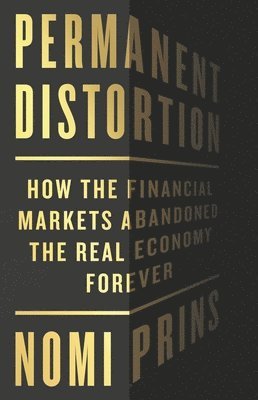
It is abundantly clear that our world is divided into two very different economies. The real one, for the average worker, is based on productivity and results. It behaves according to traditional rules of money and economics. The other doesn't. It is the product of years of loose money, poured by central banks into a system dominated by financial titans. It is powerful enough to send stock markets higher even in the face of a global pandemic and threats of nuclear war. This parting from reality has its roots in an emergency response to the financial crisis of 2008. "Quantitative Easing" injected a vast amount of cash into the economy-especially if you were a major Wall Street bank. What began as a short-term dependency became a habit, then a compulsion, and finally an addiction. Nomi Prins relentlessly exposes a world fractured by policies crafted by the largest financial institutions, led by the Federal Reserve, that have supercharged the financial system while selling out regular citizens and leading to social and political reckonings. She uncovers a newly polarized world of the mega rich versus the never rich, the winners and losers of an unprecedented distortion that can never return to "normal."
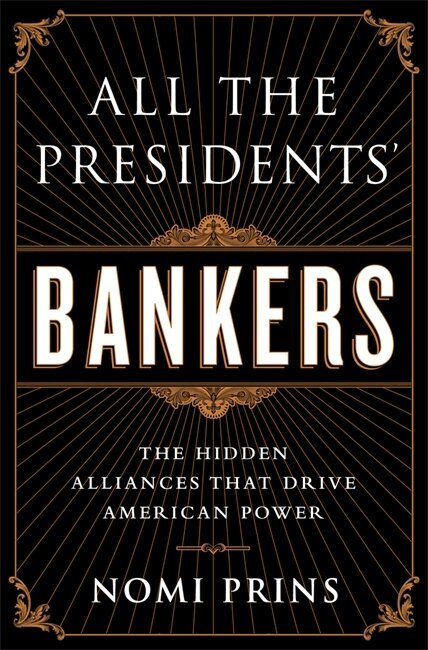
Who rules America? All the Presidents' Bankers is a ground-breaking narrative of how an elite group of men transformed the American economy and government, dictated foreign and domestic policy, and shaped world history.Culled from original presidential archival documents, All the Presidents' Bankers delivers an explosive account of the hundred-year interdependence between the White House and Wall Street that transcends a simple analysis of money driving politics,or greed driving bankers.Prins ushers us into the intimate world of exclusive clubs, vacation spots, and Ivy League universities that binds presidents and financiers. She unravels the multi-generational blood, intermarriage, and protege relationships that have confined national influence to a privileged cluster of people. These families and individuals recycle their power through elected office and private channels in Washington, DC. All the Presidents' Bankers sheds new light on pivotal historic events,such as why, after the Panic of 1907, America's dominant bankers convened to fashion the Federal Reserve System how J. P.Morgan's ambitions motivated President Wilson during World War I how Chase and National City Bank chairmen worked secretly with President Roosevelt to rescue capitalism during the Great Depression while J.P. Morgan Jr. invited Roosevelt's son yachting and how American financiers collaborated with President Truman to construct the World Bank and IMF after World War II.Prins divulges how, through the Cold War and Vietnam era, presidents and bankers pushed America's superpower status and expansion abroad, while promoting broadly democratic values and social welfare at home. But from the 1970s, Wall Street's rush to secure Middle East oil profits altered the nature of political-financial alliances. Bankers' profit motive trumped heritage and allegiance to public service, while presidents lost control over the economy,as was dramatically evident in the financial crisis of 2008.This unprecedented history of American power illuminates how the same financiers retained their authoritative position through history, swaying presidents regardless of party affiliation.All the Presidents' Bankers explores the alarming global repercussions of a system lacking barriers between public office and private power. Prins leaves us with an ominous choice: either we break the alliances of the power elite, or they will break us.
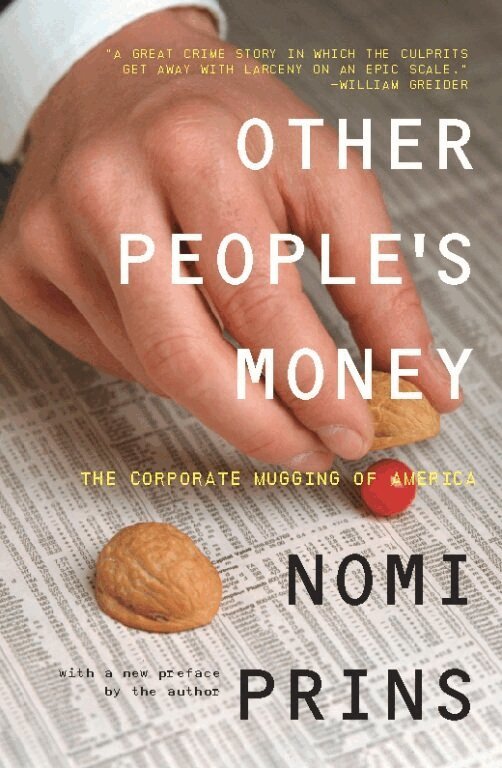
Critical, independent voices are seldom found within the citadels of international finance. That's what makes Nomi Prins unique. During fifteen years as an executive at skyscraping banks like Goldman Sachs, Bear Stearns, and Lehman Brothers, Prins never lost her ability to see the broader picture. She walked away from the game in 2002 out of disgust with the burgeoning corporate corruption, just as its magnitude was becoming clear to the public.In this acclaimed exposé, named one of the best books of 2004 by The Economist, Barron's, Library Journal, and The Progressive, Prins provides fascinating firsthand details of day-to-day life in the financial leviathans, with all its rich absurdities. She demonstrates how the much-publicized fraud of recent years resulted from deregulation that trashed the rules of responsible corporate behavior, and not simply the unbridled greed of a select few. While the stock market roared on the back of phony balance sheets, executives made out like bandits and Congress looked the other way. Worse yet, as the new foreword to this edition makes clear, everything remains in place for a repeat performance.