Norbert M. Seel – författare
858 kr
Skickas inom 10-15 vardagar
1 930 kr
Skickas inom 10-15 vardagar
2 523 kr
Skickas inom 5-8 vardagar
858 kr
Skickas inom 10-15 vardagar
1 013 kr
Läs direkt efter köp
Curriculum, Plans, and Processes in Instructional Design: International Perspectives presents perspectives on the relationship between curriculum research and instructional design, as well as new developments in the use of information and communication technology. In their introductory chapter, the editors provide an overview of the volume and introduce the discussions found in three sections: *The chapters in Part I (Theoretical Foundations and Innovations) describe and discuss new theoretical and innovative approaches to instructional design that integrate curriculum development with information and communication technologies. *Part II (Curriculum Development, Instructional Design, and Information Technology) focuses on curriculum development and its impact on models of instructional design. *Part III (Information and Communication Technology and Instructional Design) addresses the challenge of advancing information and communication technologies for instructional planning and curriculum development. Prominent researchers and practitioners from instructional design, as well as the learning sciences--from both the U.S. and around the world--have contributed to this volume. This volume is a valuable resource for graduate students, scholars, and researchers in the fields of instructional design and educational technology, as well as for those who wish to develop expertise in training in industrial, military, public and academic organizations.
1 013 kr
Läs direkt efter köp
Curriculum, Plans, and Processes in Instructional Design: International Perspectives presents perspectives on the relationship between curriculum research and instructional design, as well as new developments in the use of information and communication technology. In their introductory chapter, the editors provide an overview of the volume and introduce the discussions found in three sections: *The chapters in Part I (Theoretical Foundations and Innovations) describe and discuss new theoretical and innovative approaches to instructional design that integrate curriculum development with information and communication technologies. *Part II (Curriculum Development, Instructional Design, and Information Technology) focuses on curriculum development and its impact on models of instructional design. *Part III (Information and Communication Technology and Instructional Design) addresses the challenge of advancing information and communication technologies for instructional planning and curriculum development. Prominent researchers and practitioners from instructional design, as well as the learning sciences--from both the U.S. and around the world--have contributed to this volume. This volume is a valuable resource for graduate students, scholars, and researchers in the fields of instructional design and educational technology, as well as for those who wish to develop expertise in training in industrial, military, public and academic organizations.
2 186 kr
Läs direkt efter köp
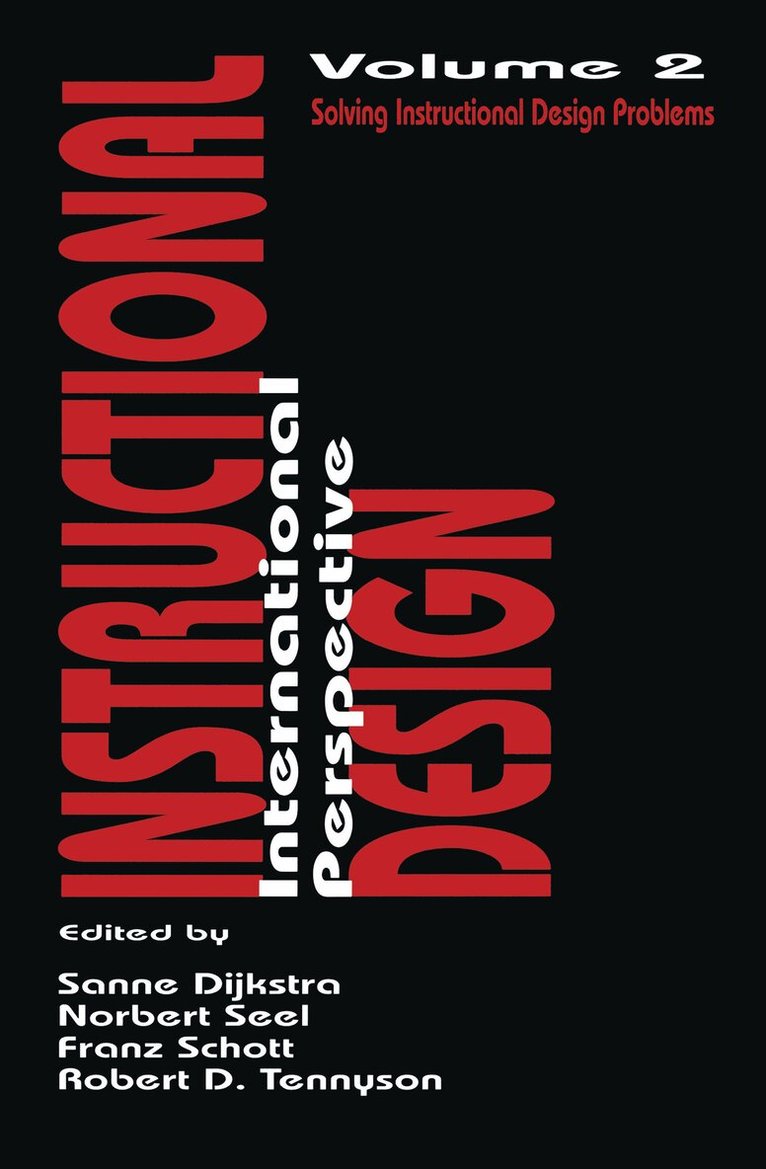
Instructional design theory and practice has evolved over the past 30 years from an initial narrow focus on programmed instruction to a multidimensional field of study integrating psychology, technology, evaluation, measurement, and management. The growth of instructional design (ID) has occurred because of direct needs, problems, and goals from society. Its application in planning instruction first developed in the United States with the Department of Defense during World War II with the purpose of meeting immediate concerns for effective training of larger numbers of military personnel. From the beginning, ID has rapidly expanded into applications in industrial and executive training, vocational training, classroom learning, and professional education. Although ID has its roots in the U.S., applications and theoretical growth is an international activity. However, literature at the international level is still limited to either individual author contributions or collections primarily represented by single countries. As a result, there is no standard reference source that contains the rich variety of theories and applications to form the international foundation for the field. The goal of this two-volume set is to establish international foundations for ID theory, research, and practice within the framework of the two following objectives: * to identify and define the theoretical, research, and model foundations for ID, and * to bridge the gap between ID foundations and application. Volume I includes chapters on philosophical and theoretical issues on learning theory and ID models. Volume II provides an overview of the state of the art of solving ID problems. The contributors offer contrasting points of view which provide a rare opportunity to see the diversity and complexity in the field. The editorial committee has selected a wide range of internationally known authors to make presentations in the topic areas of the field.
2 186 kr
Läs direkt efter köp
Instructional design theory and practice has evolved over the past 30 years from an initial narrow focus on programmed instruction to a multidimensional field of study integrating psychology, technology, evaluation, measurement, and management. The growth of instructional design (ID) has occurred because of direct needs, problems, and goals from society. Its application in planning instruction first developed in the United States with the Department of Defense during World War II with the purpose of meeting immediate concerns for effective training of larger numbers of military personnel. From the beginning, ID has rapidly expanded into applications in industrial and executive training, vocational training, classroom learning, and professional education. Although ID has its roots in the U.S., applications and theoretical growth is an international activity. However, literature at the international level is still limited to either individual author contributions or collections primarily represented by single countries. As a result, there is no standard reference source that contains the rich variety of theories and applications to form the international foundation for the field. The goal of this two-volume set is to establish international foundations for ID theory, research, and practice within the framework of the two following objectives: * to identify and define the theoretical, research, and model foundations for ID, and * to bridge the gap between ID foundations and application. Volume I includes chapters on philosophical and theoretical issues on learning theory and ID models. Volume II provides an overview of the state of the art of solving ID problems. The contributors offer contrasting points of view which provide a rare opportunity to see the diversity and complexity in the field. The editorial committee has selected a wide range of internationally known authors to make presentations in the topic areas of the field.
992 kr
Läs direkt efter köp
Instructional design theory and practice has evolved over the past 30 years from an initial narrow focus on programmed instruction to a multidimensional field of study integrating psychology, technology, evaluation, measurement, and management. The growth of instructional design (ID) has occurred because of direct needs, problems, and goals from society. Its application in planning instruction first developed in the United States with the Department of Defense during World War II with the purpose of meeting immediate concerns for effective training of larger numbers of military personnel. From the beginning, ID has rapidly expanded into applications in industrial and executive training, vocational training, classroom learning, and professional education. Although ID has its roots in the U.S., applications and theoretical growth is an international activity. However, literature at the international level is still limited to either individual author contributions or collections primarily represented by single countries. As a result, there is no standard reference source that contains the rich variety of theories and applications to form the international foundation for the field. The goal of this two-volume set is to establish international foundations for ID theory, research, and practice within the framework of the two following objectives: * to identify and define the theoretical, research, and model foundations for ID, and * to bridge the gap between ID foundations and application. Volume I includes chapters on philosophical and theoretical issues on learning theory and ID models. Volume II provides an overview of the state of the art of solving ID problems. The contributors offer contrasting points of view which provide a rare opportunity to see the diversity and complexity in the field. The editorial committee has selected a wide range of internationally known authors to make presentations in the topic areas of the field.
992 kr
Läs direkt efter köp
Instructional design theory and practice has evolved over the past 30 years from an initial narrow focus on programmed instruction to a multidimensional field of study integrating psychology, technology, evaluation, measurement, and management. The growth of instructional design (ID) has occurred because of direct needs, problems, and goals from society. Its application in planning instruction first developed in the United States with the Department of Defense during World War II with the purpose of meeting immediate concerns for effective training of larger numbers of military personnel. From the beginning, ID has rapidly expanded into applications in industrial and executive training, vocational training, classroom learning, and professional education. Although ID has its roots in the U.S., applications and theoretical growth is an international activity. However, literature at the international level is still limited to either individual author contributions or collections primarily represented by single countries. As a result, there is no standard reference source that contains the rich variety of theories and applications to form the international foundation for the field. The goal of this two-volume set is to establish international foundations for ID theory, research, and practice within the framework of the two following objectives: * to identify and define the theoretical, research, and model foundations for ID, and * to bridge the gap between ID foundations and application. Volume I includes chapters on philosophical and theoretical issues on learning theory and ID models. Volume II provides an overview of the state of the art of solving ID problems. The contributors offer contrasting points of view which provide a rare opportunity to see the diversity and complexity in the field. The editorial committee has selected a wide range of internationally known authors to make presentations in the topic areas of the field.
502 kr
Skickas inom 10-15 vardagar
37 038 kr
Skickas inom 10-15 vardagar
39 121 kr
Läs direkt efter köp
Over the past century, educational psychologists and researchers have posited many theories to explain how individuals learn, i.e. how they acquire, organize and deploy knowledge and skills. The 20th century can be considered the century of psychology on learning and related fields of interest (such as motivation, cognition, metacognition etc.) and it is fascinating to see the various mainstreams of learning, remembered and forgotten over the 20th century and note that basic assumptions of early theories survived several paradigm shifts of psychology and epistemology. Beyond folk psychology and its naïve theories of learning, psychological learning theories can be grouped into some basic categories, such as behaviorist learning theories, connectionist learning theories, cognitive learning theories, constructivist learning theories, and social learning theories.
Learning theories are not limited to psychology and related fields of interest but rather we can find the topic of learning in various disciplines, such as philosophy and epistemology, education, information science, biology, and – as a result of the emergence of computer technologies – especially also in the field of computer sciences and artificial intelligence. As a consequence, machine learning struck a chord in the 1980s and became an important field of the learning sciences in general. As the learning sciences became more specialized and complex, the various fields of interest were widely spread and separated from each other; as a consequence, even presently, there is no comprehensive overview of the sciences of learning or the central theoretical concepts and vocabulary on which researchers rely.
The Encyclopedia of the Sciences of Learning provides an up-to-date, broad and authoritative coverage of the specific terms mostly used in the sciences of learning and its related fields, including relevant areas of instruction,pedagogy, cognitive sciences, and especially machine learning and knowledge engineering. This modern compendium will be an indispensable source of information for scientists, educators, engineers, and technical staff active in all fields of learning. More specifically, the Encyclopedia provides fast access to the most relevant theoretical terms provides up-to-date, broad and authoritative coverage of the most important theories within the various fields of the learning sciences and adjacent sciences and communication technologies; supplies clear and precise explanations of the theoretical terms, cross-references to related entries and up-to-date references to important research and publications. The Encyclopedia also contains biographical entries of individuals who have substantially contributed to the sciences of learning; the entries are written by a distinguished panel of researchers in the various fields of the learning sciences.
1 577 kr
Skickas inom 10-15 vardagar
1 992 kr
Läs direkt efter köp
What is knowledge? How can it be successfully assessed? How can we best use the results? As questions such as these continue to be discussed and the learning sciences continue to deal with expanding amounts of data, the challenge of applying theory to diagnostic methods takes on more complexity.
Computer-Based Diagnostics and Systematic Analysis of Knowledge meets this challenge head-on as an international panel of experts reviews current and emerging assessment methodologies in the psychological and educational arenas. Emphasizing utility, effectiveness, and ease of interpretation, contributors critically discuss practical innovations and intriguing possibilities (including mental representations, automated knowledge visualization, modeling, and computer-based feedback) across fields ranging from mathematics education to medicine. These contents themselves model the steps of systematic inquiry, from theoretical construct to real-world application:
Historical and theoretical foundations for the investigation of knowledgeCurrent opportunities for understanding knowledge empiricallyStrategies for the aggregation and classification of knowledgeTools and methods for comparison and empirical testingData interfaces between knowledge assessment toolsGuidance in applying research results to particular fieldsResearchers and professionals in education psychology, instructional technology, computer science, and linguistics will find Computer-Based Diagnostics and Systematic Analysis of Knowledge a stimulating guide to a complex present and a rapidly evolving future.
1 577 kr
Skickas inom 10-15 vardagar
1 420 kr
Läs direkt efter köp
1 552 kr
Skickas inom 5-8 vardagar
561 kr
Skickas inom 5-8 vardagar
436 kr
Läs direkt efter köp