Norio Konno – författare
Visar alla böcker från författaren Norio Konno. Handla med fri frakt och snabb leverans.
3 produkter
3 produkter
Del 1954 - Lecture Notes in Mathematics
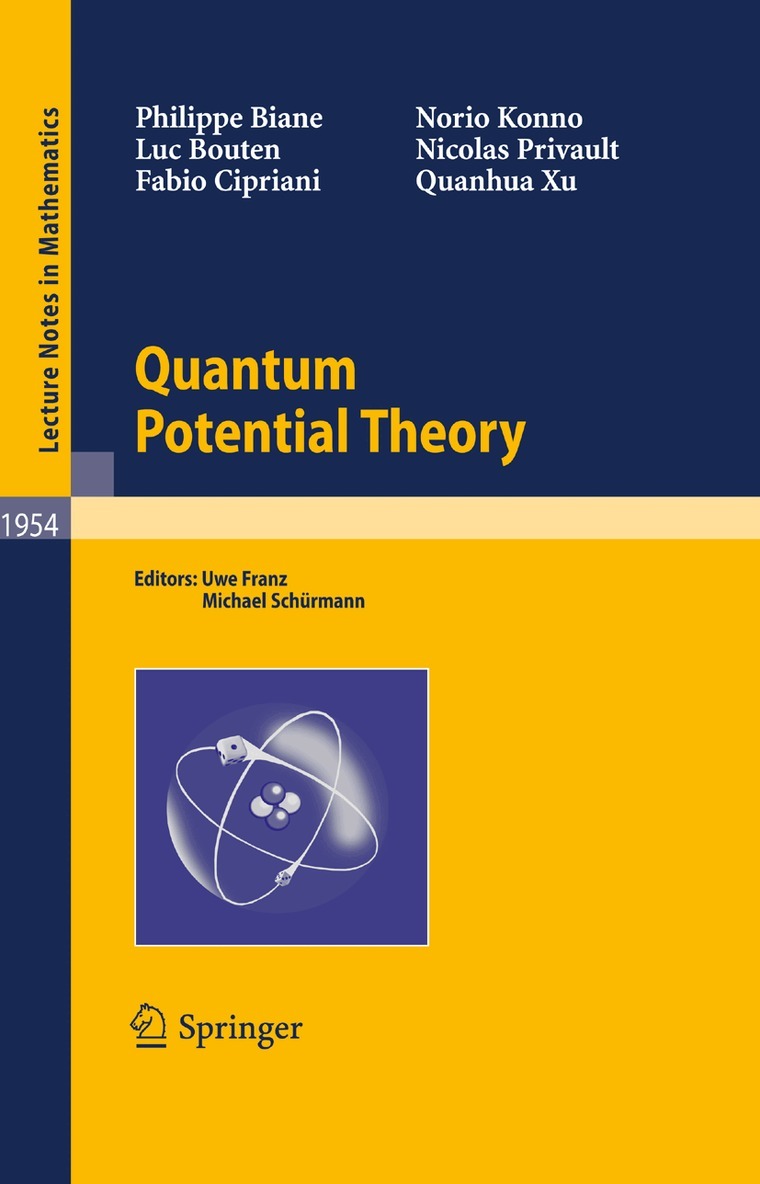
Quantum Potential Theory
Häftad, Engelska, 2008
544 kr
Skickas inom 10-15 vardagar
This volume contains the notes of lectures given at the School "Quantum Potential Theory: Structure and Applications to Physics". This school was held at the Alfried Krupp Wissenschaftskolleg in Greifswald from February 26 to March 9, 2007. We thank the lecturers for the hard work they - complished in preparing and giving these lectures and in writing these notes. Theirlecturesgiveanintroductiontocurrentresearchintheirdomains,which is essentially self-contained and should be accessible to Ph.D. students. We hope that this volume will help to bring together researchers from the areas of classical and quantum probability, functional analysis and operator al- bras, and theoretical and mathematical physics, and contribute in this way to developing further the subject of quantum potential theory. We are greatly indebted to the Alfried Krupp von Bohlen und Halbach- Stiftung for the ?nancial support, without which the school would not have been possible. We are also very thankful for the support by the University of Greifswald and the University of Franche-Comt' e.One of the organisers(UF) wassupportedby a MarieCurieOutgoingInternationalFellowshipofthe EU (Contract Q-MALL MOIF-CT-2006-022137).Special thanks go to Melanie Hinz who helped with the preparation and organisation of the school and who took care of all of the logistics. Finally, we would like to thank all the students for coming to Greifswald and helping to make the school a success.
E-bok
PDF, Engelska, 2008687 kr
Läs direkt efter köp
Inbunden, Engelska, 1995
1 357 kr
Tillfälligt slut
Recently, interacting particle systems have been studied widely from the standpoints of mathematics, physics, chemistry and biology. Many researchers are becoming interested in this field.This book focuses on the phase transitions of interacting particle systems, especially their critical values and order parameters. It poses the following question: How can we get good bounds on the critical values and the order parameters? This question is very basic, and many researchers have been trying to get better bounds rigorously. Hence the book provides bounds — both the author's and others'.